

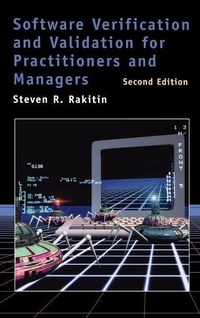
Software Verification and Validation for Practitioners and Managers
2nd Edition
Published in August 2001
Book
Hardback
420 pages
978-1-58053-296-9 (ISBN)
Description
A concise and practical introduction to the basic principles of effective software verification and validation (V&V). This edition has been revised and includes five new chapters and five new appendices focused on management techniques to make your company's software V&V efforts more cost-effective. Managers should learn how to help their organization create more accurate estimates and schedules. Practitioners should learn fundamental software V&V practices such as the formal inspection process, configuration management, effective testing techniques, and how to use measurements to drive further process improvements.
More details
Edition
2nd edition
Language
English
Place of publication
Norwood
United States
Target group
Professional and scholarly
Edition type
New edition
Product notice
Laminated cover
Illustrations
black & white illustrations
Dimensions
Height: 235 mm
Width: 162 mm
Thickness: 31 mm
Weight
853 gr
ISBN-13
978-1-58053-296-9 (9781580532969)
Copyright in bibliographic data and cover images is held by Nielsen Book Services Limited or by the publishers or by their respective licensors: all rights reserved.
Schweitzer Classification
Other editions
Additional editions
Steven R. Rakitin
Software Verification And Validation For Practitioners And Managers, Second Edition
E-Book
01/2000
1st Edition
Artech House
€70.49
Available for download
Person
Steven R. Rakitin is the president of Software Quality Consulting, Inc. in Upton, MA. He is also the author of the first edition of Software Verification and Validation: A Practitioner's Guide (Artech House, 1997). Mr. Rakitin received his B.S. in electrical engineering from Northeastern University and his M.S. in computer science from Rensselaer Polytechnic Institute.
Content
Software in perspective; software development lifecycle models; the software development process; economic justification; the inspection process; applying the inspection process; software quality metrics; configuration management; testing; software validation metrics; software reliability growth; motivation; balancing quality, features, and schedule; accurate estimating and scheduling; balancing people, process and product; managing commitments and risk.