

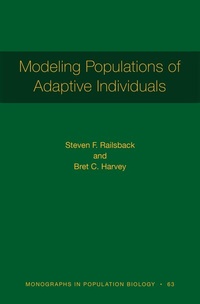
Modeling Populations of Adaptive Individuals
1st Edition
Published on 22. June 2020
216 pages
978-0-691-19537-7 (ISBN)
Description

Ecologists now recognize that the dynamics of populations, communities, and ecosystems are strongly affected by adaptive individual behaviors. Yet until now, we have lacked effective and flexible methods for modeling such dynamics. Traditional ecological models become impractical with the inclusion of behavior, and the optimization approaches of behavioral ecology cannot be used when future conditions are unpredictable due to feedbacks from the behavior of other individuals. This book provides a comprehensive introduction to state- and prediction-based theory, or SPT, a powerful new approach to modeling trade-off behaviors in contexts such as individual-based population models where feedbacks and variability make optimization impossible.
Modeling Populations of Adaptive Individuals features a wealth of examples that range from highly simplified behavior models to complex population models in which individuals make adaptive trade-off decisions about habitat and activity selection in highly heterogeneous environments. Steven Railsback and Bret Harvey explain how SPT builds on key concepts from the state-based dynamic modeling theory of behavioral ecology, and how it combines explicit predictions of future conditions with approximations of a fitness measure to represent how individuals make good-not optimal-decisions that they revise as conditions change. The resulting models are realistic, testable, adaptable, and invaluable for answering fundamental questions in ecology and forecasting ecological outcomes of real-world scenarios.
Modeling Populations of Adaptive Individuals features a wealth of examples that range from highly simplified behavior models to complex population models in which individuals make adaptive trade-off decisions about habitat and activity selection in highly heterogeneous environments. Steven Railsback and Bret Harvey explain how SPT builds on key concepts from the state-based dynamic modeling theory of behavioral ecology, and how it combines explicit predictions of future conditions with approximations of a fitness measure to represent how individuals make good-not optimal-decisions that they revise as conditions change. The resulting models are realistic, testable, adaptable, and invaluable for answering fundamental questions in ecology and forecasting ecological outcomes of real-world scenarios.
More details
Other editions
Additional editions
Steven F. Railsback | Bret C. Harvey
Modeling Populations of Adaptive Individuals
Book
05/2020
Princeton University Press
€49.50
Shipment within 10-20 days
Steven F. Railsback | Bret C. Harvey
Modeling Populations of Adaptive Individuals
Book
05/2020
Princeton University Press
€133.50
Shipment within 10-20 days
Persons
Steven F. Railsback is adjunct professor of mathematics at Humboldt State University and a consulting ecologist. His books include Individual-based Modeling and Ecology and Agent-Based and Individual-Based Modeling (both Princeton). Bret C. Harvey is an aquatic ecologist with the US Forest Service and adjunct professor of fisheries biology at Humboldt State.
Content
- Cover
- Title
- Copyright
- Dedication
- Contents
- Preface
- Acknowledgments
- 1. Adaptive Individuals and Population Ecology
- 1.1 Adaptive Trade-Off Behavior and Ecology
- 1.2 Modeling Systems of Adaptive Individuals
- 1.3 Adaptive Behavior in Individual-Based Models
- 1.4 Adaptive Behavior, Physiology, and Neurobiology
- 1.5 What We Need to Link Behavioral and Population Ecology: Across-Level Theory
- 1.6 State-and Prediction-Based Theory (SPT)
- 1.7 Monograph Objectives and Overview
- 2. Case Study: Modeling Trout Population Response to River Management
- 2.1 Introduction and Model Purpose
- 2.2 Adaptive Behavior in the Trout Model: Habitat Selection
- 2.3 A Second Adaptive Behavior: Activity Selection
- 2.4 Conclusions
- 3. Introduction to State- and Prediction-Based Theory
- 3.1 What Is SPT?
- 3.2 Five Steps for Implementing SPT
- 3.3 A Look Ahead
- 4. A First Example: Forager Patch Selection
- 4.1 Objectives
- 4.2 The Model
- 4.3 Results and Comparison of SPT to Dynamic State Variable Modeling
- 4.4 Version 2: Foraging with Competition
- 4.5 Version 3: Continuous Starvation Risk
- 4.6 Conclusions
- 5. A Second Example: Vertical Migration and Reproductive Effort in Daphnia
- 5.1 Objectives
- 5.2 The Model
- 5.3 SPT Version 1: Expected Future Reproduction with Current Growth and Survival
- 5.4 SPT Version 2: Predicted Offspring
- 5.5 SPT Version 3: Diurnal Prediction
- 5.6 Prediction Complexity and Fitness: Population Simulations
- 5.7 Conclusions
- 6. Example Three: Temporal Patterns in Limpet Foraging
- 6.1 Background and Objectives
- 6.2 The DSVM Model of Limpet Foraging
- 6.3 The Model
- 6.4 SPT Version 1: Maximizing Short-Term Expected Energy Reserves
- 6.5 SPT Version 2: Maximizing Mean Expected Energy Reserves until Day's End
- 6.6 Conclusions
- 7. Example Four: Facultative Anadromy in Salmonid Fishes
- 7.1 Introduction and Objectives
- 7.2 The DSVM Model
- 7.3 The IBM Using SPT
- 7.4 SPT Model Results and Applications
- 8. Guidance for Using State- and Prediction-Based Theory
- 8.1 Introduction and Objectives
- 8.2 Step 1: Defining the Decision That SPT Models
- 8.3 Step 2: Selecting Fitness Measures and Time Horizons
- 8.4 Step 3: Modeling Prediction of Environmental Conditions and Fitness Elements
- 8.4.1 General Guidance on Modeling Prediction
- 8.4.2 Predicting Growth and Size
- 8.4.3 Predicting Starvation Risk
- 8.4.4 Predicting Predation and Other Risks
- 8.4.5 Predicting Reproductive Success
- 8.5 Step 4: Selecting a Decision Algorithm
- 8.6 Step 5: Implementing and Testing the Theory
- 8.7 Conclusions
- 9. Testing and Refining State- and Prediction-Based Theory
- 9.1 Introduction and Objectives
- 9.2 The Pattern-Oriented Theory Development Cycle
- 9.3 Examples of Theory Development and Testing
- 9.3.1 Literature Examples
- 9.3.2 Trout Habitat Selection
- 9.3.3 Activity Selection in Trout
- 9.3.4 Foraging Habitat Selection in Songbirds
- 9.4 Conclusions
- 10. Building Model Credibility
- 10.1 Introduction and Objectives
- 10.2 Issues in "Validation" of Individual-Based Population Models
- 10.3 Strategies for Building Credibility
- 10.4 Lessons Learned in Field, Laboratory, and Simulation Experiments
- 10.5 Conclusions
- 11. Empirical Research on Populations of Adaptive Individuals
- 11.1 Introduction and Objectives
- 11.2 Benefits of Models for Field Studies
- 11.3 Modeling Phase 1: Formulate the Question
- 11.4 Modeling Phase 2: Assemble Hypotheses
- 11.5 Modeling Phase 3: Choose Model Structure
- 11.6 Modeling Phase 5: Analyze the Model
- 11.7 Conclusions
- 12. Conclusions and Outlook
- 12.1 Modeling Populations of Adaptive Individuals
- 12.2 Key Characteristics of the Approach
- 12.3 Conclusions from Example Models
- 12.4 Outlook
- References
- Index
