

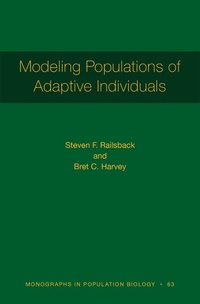
Modeling Populations of Adaptive Individuals
Published on 19. May 2020
Book
Hardback
216 pages
978-0-691-18049-6 (ISBN)
Description
Ecologists now recognize that the dynamics of populations, communities, and ecosystems are strongly affected by adaptive individual behaviors. Yet until now, we have lacked effective and flexible methods for modeling such dynamics. Traditional ecological models become impractical with the inclusion of behavior, and the optimization approaches of behavioral ecology cannot be used when future conditions are unpredictable due to feedbacks from the behavior of other individuals. This book provides a comprehensive introduction to state- and prediction-based theory, or SPT, a powerful new approach to modeling trade-off behaviors in contexts such as individual-based population models where feedbacks and variability make optimization impossible.
Modeling Populations of Adaptive Individuals features a wealth of examples that range from highly simplified behavior models to complex population models in which individuals make adaptive trade-off decisions about habitat and activity selection in highly heterogeneous environments. Steven Railsback and Bret Harvey explain how SPT builds on key concepts from the state-based dynamic modeling theory of behavioral ecology, and how it combines explicit predictions of future conditions with approximations of a fitness measure to represent how individuals make good-not optimal-decisions that they revise as conditions change. The resulting models are realistic, testable, adaptable, and invaluable for answering fundamental questions in ecology and forecasting ecological outcomes of real-world scenarios.
Modeling Populations of Adaptive Individuals features a wealth of examples that range from highly simplified behavior models to complex population models in which individuals make adaptive trade-off decisions about habitat and activity selection in highly heterogeneous environments. Steven Railsback and Bret Harvey explain how SPT builds on key concepts from the state-based dynamic modeling theory of behavioral ecology, and how it combines explicit predictions of future conditions with approximations of a fitness measure to represent how individuals make good-not optimal-decisions that they revise as conditions change. The resulting models are realistic, testable, adaptable, and invaluable for answering fundamental questions in ecology and forecasting ecological outcomes of real-world scenarios.
Reviews / Votes
"[A] welcome addition to the esteemed monographs in [the] Population Biology series from Princeton University Press."---Darcy Visscher, The Quarterly Review of BiologyMore details
Series
Language
English
Place of publication
New Jersey
United States
Target group
College/higher education
Professional and scholarly
Product notice
Trade binding
Illustrations
34 b/w illus.
Dimensions
Height: 241 mm
Width: 163 mm
Thickness: 20 mm
Weight
454 gr
ISBN-13
978-0-691-18049-6 (9780691180496)
Copyright in bibliographic data and cover images is held by Nielsen Book Services Limited or by the publishers or by their respective licensors: all rights reserved.
Schweitzer Classification
Other editions
Additional editions
Steven F. Railsback | Bret C. Harvey
Modeling Populations of Adaptive Individuals
E-Book
06/2020
1st Edition
Princeton University Press
€51.99
Available for download
Persons
Steven F. Railsback is adjunct professor of mathematics at Humboldt State University and a consulting ecologist. His books include Individual-based Modeling and Ecology and Agent-Based and Individual-Based Modeling (both Princeton). Bret C. Harvey is an aquatic ecologist with the US Forest Service and adjunct professor of fisheries biology at Humboldt State.