

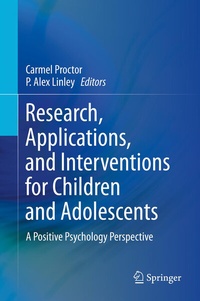
Research, Applications, and Interventions for Children and Adolescents
Description

More details
Other editions
Additional editions
Persons
Carmel Proctor has a PhD from the School of Psychology, University of Leicester, UK and has a MA in Measurement, Evaluation and Research Methodology from the University of British Columbia, Canada from where she originates. For her first degree she attended Simon Fraser University, BC, Canada and was awarded a Certificate in Liberal Arts and a BA in Psychology. Carmel is the founding director of the Positive Psychology Research Centre, in the UK. She is co-author of Strengths Gym (PPRC, 2009) a character strengths-based educational course for children and adolescents. Carmel has also written and co-written several research papers and book chapters and is a member of the editorial board for the Encyclopedia of Quality of Life Research. Alex Linley is Founding Director of the Centre of Applied Positive Psychology, in the UK. Academically, Alex holds the position of Visiting Professor in Psychology at the University of Leicester, and has delivered keynote presentations on strengths and positive psychology throughout Europe and in the Caribbean, the Middle East, the United States, and India. He has written, co-written, or edited more than 130 research papers and book chapters, and 8 books, including Positive Psychology in Practice (Wiley, 2004) and Average to A+: Realising Strengths in Yourself and Others (CAPP Press, 2008).
Alex Linley is Founding Director of the Centre of Applied Positive Psychology, in the UK. Academically, Alex holds the position of Visiting Professor in Psychology at the University of Leicester, and has delivered keynote presentations on strengths and positive psychology throughout Europe and in the Caribbean, the Middle East, the United States, and India. He has written, co-written, or edited more than 130 research papers and book chapters, and 8 books, including Positive Psychology in Practice (Wiley, 2004) and Average to A+: Realising Strengths in Yourself and Others (CAPP Press, 2008).
Content
Foreword; Anthony Seldon.- Chapter 1. Surveying the Landscape of Positive Psychology and Adolescents; P. Alex Linley and Carmel Proctor.- Part I. Strengths and Well-Being.- Chapter 2. The Importance of Good Character; Carmel Proctor.- Chapter 3. Assessment and Promotion of Life Satisfaction in Youth; E. Scott Huebner, Kimberly J. Hills and Xu Jiang.- Chapter 4. Promoting Hope Among Youth: Theory, Research, and Practice; Lisa M. Edwards and Jessica B. McClintock.- Part II. Interventions and Applications.- Chapter 5. Flourishing Among Children and Adolescents: Structure and Correlates of Positive Mental Health, and Interventions for its Enhancement; Andrew J. Howell, Corey L.M. Keyes and Holli-Anne Passmore.- Chapter 6. Assessment of Character Strengths in Children and Adolescents; Tayyab Rashid, Afroze Anjum, Denise Quinlan, Ryan M. Niemiec, Donna Mayerson and Fahim Kazemi.- Chapter 7. Gratitude Intervention in Adolescence and Youth Adulthood; Nathaniel Lambert and Amanda Veldorale-Brogan.- Part III. Family, Friends, and Community.- Chapter 8. Parent-Child Relationships and Well-Being; Shannon M. Suldo and Sarah A. Fefer.- Chapter 9. Peer Relations; B. Bradford Brown and Michael T. Braun.- Chapter 10. The Emotional Warmth Approach to Professional Child-Care: Positive Psychology and Highly Vulnerable Children in our Society; Colin Maggin and R.J. Seán Cameron.- Part IV. Positive Education.- Chapter 11. A Place for Happiness in the Classroom?; Ian Morris.- Chapter 12. Positive Education, or Just Education; Hans Henrik Knoop.- Chapter 13. Enhancing Well-Being in Adolescents: Positive Psychology and Coaching Psychology Interventions in Schools; Lisa Suzanne Green and Paula Robinson.- Part V. Positive Youth Development: Practice, Policy, and Law.- Chapter 14. Sociomoral Development for Behaviorally At-Risk Youth: Mac's Group Meeting; John C. Gibbs, Granville Bud Potter and Anne-Marie DiBiase.- Chapter 15. Positive Youth Development in Organized Programs: HowTeens Learn to Manage Emotion; Nathalie Rusk, Reed W. Larson, Marcela Raffealli, Kathrin Walker, LaTesha Washington, Vanessa Gutierrez, Hyeyoung Kang, Steve Tran, and Stephen Cole Perry.- Chapter 16. Legal Foundations of Adolescents' Rights and Positive Youth Development; Roger J.R. Leveseque.
