

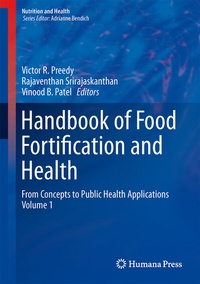
Handbook of Food Fortification and Health
Description

Handbook of Food Fortification and Health: From Concepts to Public Health Applications Volume 1 represents a multidisciplinary approach to food fortification. This book aims to disseminate important material pertaining to the fortification of foods from strategic initiatives to public health applications. Optimal nutritional intake is an essential component of health and wellbeing. Unfortunately situations arise on a local or national scale when nutrient supply or intake is deemed to be suboptimal. As a consequence, ill health occurs affecting individual organs or causing premature death. In terms of public health, malnutrition due to micronutrient deficiency can be quite profound imposing economic and social burdens on individuals and whole communities. This comprehensive text examines the broad spectrum of food fortification in all its manifestations. Coverage includes sections on definitions of fortifications, fortified foods, beverages and nutrients, fortifications with micronutrients, biofortification, impact on individuals, public health concepts and issues, and selective methods and food chemistry. Handbook of Food Fortification and Health: From Concepts to Public Health Applications Volume 1 is an indispensable text designed for nutritionists, dietitians, clinicians and health related professionals.
More details
Other editions
Additional editions
Persons
Content
Part 1. Introductory chapters and perspectives of fortification .- Chapter 1. The link between organizational bodies and fortification strategies and practice: the role of the Flour Fortification Initiative.- Chapter 2. Current mandatory fortificants in developed nations compared to developing nations.- Chapter 3. Fortified Humanitarian Food-Aid Commodities.- Chapter 4. Middle East perspectives of food fortification: Implementation dynamics and policy factors.- Chapter 5. Food fortification policy in Canada.- Part 2. Iron Fortification .- Chapter 6. Iron fortification of milk and dairy products.- Chapter 7. Ferric pyrophosphate as an alternative iron source for food fortification.- Chapter 8. Iron and zinc- fortified parboiled rice.- Chapter 9. Millet flours as a vehicle for fortification with iron and zinc.- Chapter 10. Iron Fortified Drinking Water.- Chapter 11. Heme Iron as source of iron in food fortification.- Part 3. Fortified foods and beverages .- Chapter 12. Fortification of corn flour-derived products.- Chapter 13. Fortified margarine and fat spreads.- Chapter 14. Commercial Conjugated Linoleic Acid (CLA) Fortified Dairy Products.- Chapter 15. Calcium-fortified soymilk.- Chapter 16. The stability of water soluble vitamins and issues in the fortification of foods.- Chapter 17. Fortification of milk with mineral elements.- Chapter 18. Iodine Nutrition: Salt Fortification with Iodine.- Chapter 19. Iodine fortification and hyperthyroidism.- Chapter 20. Lentils (Lens culinaris L.) as a Source of Dietary Selenium.- Chapter 21. Tocotrienol fortification in eggs.- Chapter 22. Vitamin A Fortification of Cooking Oils.- Part 4. Biofortification: biological modes of enhancing nutrient intake .- Chapter 23. Iron and Zinc enhancement in rice endosperm by targeted and synergistic action of genes.- Chapter 24. Novel fortification strategies for staple gluten-free products.- Chapter 25. Biofortified rice to fight folate deficiency.- Chapter 26. Transgenic multivitamin biofortified corn: Science, regulation and politics.- Chapter 27. Selenium Bio-fortified Wheat.- Chapter 28. Market potential of folate biofortified rice in China.- Chapter 29. Biofortified Crops with a Visible Trait: the example of Orange-fleshed Sweetpotato in Sub-Saharan Africa.
