

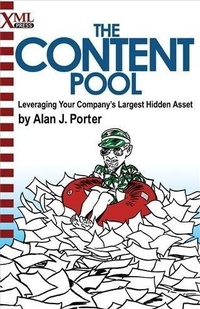
Content Pool
Leveraging Your Company's Largest Hidden Asset
Published on 11. April 2013
249 pages
978-1-4571-8262-4 (ISBN)
Description

All companies, no matter what industry they are in, or what product or service they create, do four basic things. Offer something for sale, sell it, collect money for it, and create content about what they do. Product development, Marketing, Sales, and Finance are all essential to the organization and are typically managed at the VP or CXO level, yet a company's content, which contains all of its intellectual property, is often overlooked. The Content Pool: Leveraging Your Company's Largest Hidden Asset makes the case for placing content creation, management, and distribution on a par with other core strategic business activities.
Inside the Book
- Identifying Your Content
- Organizing Your Content
- Managing Your Content
- Leveraging Your Content
- The Case for a Chief Content Officer
- Bibliography and Index
More details
Other editions
Additional editions

Book
02/2012
XML Press
€28.50
Shipment within 3-4 weeks
Content
- Cover
- The Content Pool
- Table of Contents
- Foreword
- Introduction
- Part I. Identifying Your Content
- Chapter 1. Why Is Content So Important?
- Stale information
- Content creation inefficiency
- Chapter 2. What Do You Produce Now and How Do You Use It?
- What content do you produce now?
- How do you use that content?
- What does it cost to produce and distribute?
- Summary
- Chapter 3. Identifying the Audience: Today and in the Future
- Who is my intended audience?
- Who is my actual audience?
- How do they find my content?
- How do they consume content?
- Chapter 4. What About the Language You Use?
- Liability and language
- Localization
- Customer service
- Legal action
- How does it happen?
- Mistranslations
- Cultural errors
- Ambiguity
- Low quality
- What's the solution?
- Vocabulary
- Restricted vocabulary
- Restricted grammar rules
- Types of controlled language
- The benefits of controlled language
- Chapter 5. The Global Language
- Representational graphics
- Iconic abstraction
- Symbolic usage
- Combining techniques
- Understand the user
- Part II. Organizing Your Content
- Chapter 6. Gain Through Collaboration
- Collaboration
- Content development silos
- Knowledge sharing
- Basic reuse
- Intelligent content
- Collaborative platforms
- Chapter 7. Consistency Saves You Money
- Clarity
- Consistency
- Honesty
- Findability
- Chapter 8. Where Are Your Pain Points?
- Potential pain points
- Content design
- Content development
- Content distribution
- How to identify pain points
- Part III. Managing Your Content
- Chapter 9. Styles and Standards
- Why we need standards
- Content standards
- A strategy for picking standards
- A process for picking a set of standards
- Company style guides
- Don't forget ripple effects
- Conclusions
- Chapter 10. Rewrite and Reuse
- Independent content
- Naming conventions
- Structured content development
- Topic-based structure
- Task-based structure
- Minimalism
- Reuse
- Content management
- Managing the change
- Chapter 11. Answers are the Answer
- How to find the "How"
- Chapter 12. User-Generated Content
- The myth of inaccuracy
- Defining user-generated content
- Managing the new content
- Managing content ownership
- Incorporating feedback
- Round-tripping
- Independent user content
- Chapter 13. The Technology Question
- Choosing different tools
- Planning for future technology
- Part IV. Leveraging Your Content
- Chapter 14. Content as a Revenue Source
- Two scenarios
- Company A - Documentation included
- Company B - Documentation separate
- Indirect revenue impacts.
- Chapter 15. Quality Content
- So what is good content?
- Answer questions
- Inform
- Add value
- Mamet's three rules
- Unhappy customers
- The customer experience
- Chapter 16. Finding Things
- Chapter 17. Develop a Content Strategy
- Defining content strategy
- The ripple effect
- Proven benefits of a content strategy
- Keeping afloat in the Content Pool
- Chapter 18. The Case For A Chief Content Officer
- Five ways to make executives love content development
- Why you need a CCO
- 1. Create something
- 2. Tell people about it
- 3. Get people to buy it
- 4. Collect money for it
- 5. Create content about it.
- Appendix A. Acknowledgments
- Bibliography
- Index
