

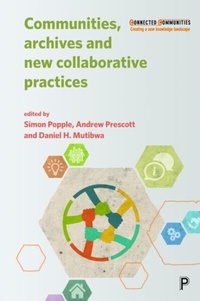
Communities, Archives and New Collaborative Practices
1st Edition
Published on 26. February 2020
296 pages
978-1-4473-4193-2 (ISBN)
Description

This innovative book examines the changing relationship between communities, citizens and the notion of the archive.
Archives have traditionally been understood as repositories of knowledge and experience, remote from the ordinary people who fund and populate them, however digital resources have led to a growing plurality of archives and the practices associated with collecting and curating. This book uses a broad range of case studies which place communities at the heart of this exciting development, to illustrate how their experiences are central to our understanding of this new terrain which challenges traditional histories and the control of knowledge and power.
Archives have traditionally been understood as repositories of knowledge and experience, remote from the ordinary people who fund and populate them, however digital resources have led to a growing plurality of archives and the practices associated with collecting and curating. This book uses a broad range of case studies which place communities at the heart of this exciting development, to illustrate how their experiences are central to our understanding of this new terrain which challenges traditional histories and the control of knowledge and power.
Reviews / Votes
"A testament to the vibrancy, depth, and diversity of collaborative research practices involving archives and archiving in the UK. It examines the challenges of collaboration, but even handedly celebrates the many benefits afforded by such modes of work." Richard Clay, Newcastle UniversityMore details
Series
Edition
First Edition
Language
English
Place of publication
Bristol
United Kingdom
Publishing group
Bristol University Press
Target group
Professional and scholarly
Illustrations
22 s/w Abbildungen, 1 s/w Tabelle
1 Tables, black and white; 22 Illustrations, black and white
ISBN-13
978-1-4473-4193-2 (9781447341932)
DOI
https://doi.org/10.51952/9781447341932
Copyright in bibliographic data and cover images is held by Nielsen Book Services Limited or by the publishers or by their respective licensors: all rights reserved.
Schweitzer Classification
Other editions
Additional editions
Simon Popple | Andrew Prescott | Daniel Mutibwa
Communities, Archives and New Collaborative Practices
Book
02/2020
1st Edition
Policy Press
€96.50
Shipment within 15-20 days
Simon Popple | Andrew Prescott | Daniel Mutibwa
Communities, Archives and New Collaborative Practices
Book
02/2020
1st Edition
Policy Press
€48.70
Shipment within 15-20 days
Simon Popple | Andrew Prescott | Daniel Mutibwa
Communities, Archives and New Collaborative Practices
E-Book
02/2020
1st Edition
Policy Press
€60.49
Available for download
Persons
Simon Popple is Director of Impact and a Senior Lecturer in Photography and Digital Culture at the School of Media and Communication, University of Leeds.
Andrew Prescott is Professor of Digital Humanities at the University of Glasgow.
Daniel H. Mutibwa is Assistant Professor in Creative Industries and Digital Culture at the University of Nottingham, UK Campus.
Andrew Prescott is Professor of Digital Humanities at the University of Glasgow.
Daniel H. Mutibwa is Assistant Professor in Creative Industries and Digital Culture at the University of Nottingham, UK Campus.
Content
Community archives and the creation of living knowledge ~ Simon Popple, Daniel H. Mutibwa and Andrew Prescott
Disorderly conduct: the community in the archive ~ Simon Popple
PART I: Storytelling, co-curation and community archives
BBC Pebble Mill: issues around collaborative community online archives - a case study of the Pebble Mill Project ~ Vanessa Jackson
New island stories: heritage, archives, the digital environment and community regeneration ~ Paul R.J. Duffy
Memories on film: public archive images and participatory film-making with people with dementia ~ Andrea Capstick and Katherine Ludwin
Doing-It-Together: citizen archivists and the online environment ~ Jez Collins
'I've never told anybody that before': the virtual archive and collaborative spaces of knowledge production ~ Tom Jackson
PART II: Citizens, archives and the institution
Rising beyond museological practice and use: a model for community and museum partnerships working towards modern curatorship in this day and age ~ Daniel H. Mutibwa
Enhancing museum visits through the creation of data visualisation to support the recording and sharing of experience ~ Ian Gwilt, Patrick McEntaggart, Melanie Levick-Parkin and Jonathan Wood
The digital citizen: working upstream of digital and broadcast archive developments ~ Kim Hammond, George Revill and Joe Smith
Institutional collaboration in the creation of digital linguistic resources: the case of the British Telecom correspondence corpus ~ Ralph Morton and Hilary Nesi
PART III: Disruptive and counter voices: the community turn
Mainstream institutional collecting of anti-institutional archives: opportunities and challenges ~ Anna Sexton
Silver hair, silver tongues, silver screen: recollection, reflection and representation through digital storytelling with older people ~ Tricia Jenkins and Pip Hardy
'Wibbly-wobbly timey-wimey' LGBT histories: community 195 archives as boundary objects ~ Niamh Moore
Locating the Black archive ~ Hannah Ishmael, Ego Ahaiwe Sowinski, Kelly Foster, Etienne Joseph and Nathan E. Richards
The public and the relational: the collaborative practices of the Inclusive Archive of Learning Disability History ~ Helen Graham, Victoria Green, Kassie Headon, Nigel Ingham, Sue Ledger, Andy Minnion, Row Richards and Liz Tilley
Archive utopias: linking collaborative histories to local democracy ~ Lianne Brigham, Richard Brigham, Helen Graham and Victoria Hoyle
Community archives and the health of the internet ~ Andrew Prescott
Disorderly conduct: the community in the archive ~ Simon Popple
PART I: Storytelling, co-curation and community archives
BBC Pebble Mill: issues around collaborative community online archives - a case study of the Pebble Mill Project ~ Vanessa Jackson
New island stories: heritage, archives, the digital environment and community regeneration ~ Paul R.J. Duffy
Memories on film: public archive images and participatory film-making with people with dementia ~ Andrea Capstick and Katherine Ludwin
Doing-It-Together: citizen archivists and the online environment ~ Jez Collins
'I've never told anybody that before': the virtual archive and collaborative spaces of knowledge production ~ Tom Jackson
PART II: Citizens, archives and the institution
Rising beyond museological practice and use: a model for community and museum partnerships working towards modern curatorship in this day and age ~ Daniel H. Mutibwa
Enhancing museum visits through the creation of data visualisation to support the recording and sharing of experience ~ Ian Gwilt, Patrick McEntaggart, Melanie Levick-Parkin and Jonathan Wood
The digital citizen: working upstream of digital and broadcast archive developments ~ Kim Hammond, George Revill and Joe Smith
Institutional collaboration in the creation of digital linguistic resources: the case of the British Telecom correspondence corpus ~ Ralph Morton and Hilary Nesi
PART III: Disruptive and counter voices: the community turn
Mainstream institutional collecting of anti-institutional archives: opportunities and challenges ~ Anna Sexton
Silver hair, silver tongues, silver screen: recollection, reflection and representation through digital storytelling with older people ~ Tricia Jenkins and Pip Hardy
'Wibbly-wobbly timey-wimey' LGBT histories: community 195 archives as boundary objects ~ Niamh Moore
Locating the Black archive ~ Hannah Ishmael, Ego Ahaiwe Sowinski, Kelly Foster, Etienne Joseph and Nathan E. Richards
The public and the relational: the collaborative practices of the Inclusive Archive of Learning Disability History ~ Helen Graham, Victoria Green, Kassie Headon, Nigel Ingham, Sue Ledger, Andy Minnion, Row Richards and Liz Tilley
Archive utopias: linking collaborative histories to local democracy ~ Lianne Brigham, Richard Brigham, Helen Graham and Victoria Hoyle
Community archives and the health of the internet ~ Andrew Prescott
