

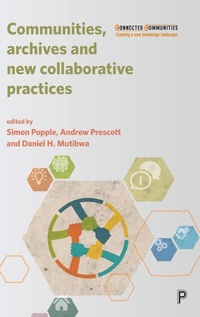
Communities, Archives and New Collaborative Practices
1st Edition
Published on 26. February 2020
Book
Hardback
256 pages
978-1-4473-4189-5 (ISBN)
Description
This book examines the changing relationship between communities, citizens and the notion of the archive. Digital resources have made archiving widely accessible, and there is now a growing plurality of practices associated with collecting and curating. Using a range of case studies, this book challenges perceived barriers to collaboration between communities and archives and promotes the value of co-creation.
Reviews / Votes
"A testament to the vibrancy, depth, and diversity of collaborative research practices involving archives and archiving in the UK. It examines the challenges of collaboration, but even handedly celebrates the many benefits afforded by such modes of work." Richard Clay, Newcastle UniversityMore details
Series
Edition
First Edition
Language
English
Place of publication
Bristol
United Kingdom
Target group
Professional and scholarly
Illustrations
22 s/w Abbildungen, 1 s/w Tabelle
Dimensions
Height: 240 mm
Width: 161 mm
Thickness: 21 mm
Weight
614 gr
ISBN-13
978-1-4473-4189-5 (9781447341895)
Copyright in bibliographic data and cover images is held by Nielsen Book Services Limited or by the publishers or by their respective licensors: all rights reserved.
Schweitzer Classification
Other editions
Additional editions
Simon Popple | Andrew Prescott | Daniel Mutibwa
Communities, Archives and New Collaborative Practices
Book
02/2020
1st Edition
Policy Press
€48.70
Shipment within 15-20 days
Simon Popple | Andrew Prescott | Daniel Mutibwa
Communities, Archives and New Collaborative Practices
E-Book
02/2020
1st Edition
Policy Press
€60.49
Available for download
Simon Popple | Andrew Prescott | Daniel Mutibwa
Communities, Archives and New Collaborative Practices
E-Book
02/2020
1st Edition
Policy Press
€231.99
Available for download
Persons
Simon Popple is the Deputy Head for the School of Media and Communication at the University of Leeds, and a Senior Lecturer in Photography and Digital Culture at the University of Leeds.
Andrew Prescott is a Professor of Digital Humanities at the University of Glasgow.
Daniel H. Mutibwa is a Assistant Professor in Creative Industries at the University of Nottingham.
Andrew Prescott is a Professor of Digital Humanities at the University of Glasgow.
Daniel H. Mutibwa is a Assistant Professor in Creative Industries at the University of Nottingham.
Content
Preface;
Introductory Chapter: Remaking the Archive;
Section 1: Storytelling, Co-curation and Community Archives;
Chapter 1: New Island Stories: Heritage, Archives and the Digital Environment as a basis for Community Regeneration;
Chapter 2: Speaking through Making: living archives, embodied value;
Chapter 3: BBC Pebble Mill: Issues around collaborative community online archives - A case study of the http://pebblemill.org project;
Chapter 4: Memories on film: Public archive images and participatory film?making with people with dementia;
Chapter 5: Doing-It-Together: Co-creating popular music history in the online environment;
Section 2: Citizen Archives and the Institution;
Chapter 6: Museums and Communities in the Virtual Age: From Museological Use to Digital Heritage Engagement?;
Chapter 7: Enhancing museum visits through the creation of data visualisation to support informed choices and the recording and sharing of experience;
Chapter 8: Letter to an Unknown Soldier;
Chapter 9: Earth in Vision and the Digital Citizen: Working Upstream of Digital and Broadcast Archive Developments;
Chapter 10: Institutional collaboration in the creation of digital linguistic resources: the case of the British Telecom Correspondence Corpus;
Chapter 11: Archiving art school atmosphere: digital collecting, cultural heritage practice and non-materiality;
Section 3: Disruptive and Counter Voices: The Community Turn;
Chapter 12: Anti-Institutional Mental Health Archives: Tensions, Challenges and Reward.;
Chapter 13: 'Weapons in the struggle' Independent radical archives.;
Chapter 14: Silver hair, silver tongues, silver screen: recollection, reflection and representation through digital storytelling with older people;
Chapter 15: Prejudice and Pride: Archiving 'wibbly-wobbly timey-wimey' LGBT histories;
Chapter 16: Locating the Black Archive;
Chapter 17: Archive, Museum, Library, In/tangible Heritage, Web: Ways of being inclusive and alive.;
Chapter 18: Archive Utopias: Linking collaborative histories to local decision-making;
Concluding Chapter: The Archive in a World of Datafication.
Introductory Chapter: Remaking the Archive;
Section 1: Storytelling, Co-curation and Community Archives;
Chapter 1: New Island Stories: Heritage, Archives and the Digital Environment as a basis for Community Regeneration;
Chapter 2: Speaking through Making: living archives, embodied value;
Chapter 3: BBC Pebble Mill: Issues around collaborative community online archives - A case study of the http://pebblemill.org project;
Chapter 4: Memories on film: Public archive images and participatory film?making with people with dementia;
Chapter 5: Doing-It-Together: Co-creating popular music history in the online environment;
Section 2: Citizen Archives and the Institution;
Chapter 6: Museums and Communities in the Virtual Age: From Museological Use to Digital Heritage Engagement?;
Chapter 7: Enhancing museum visits through the creation of data visualisation to support informed choices and the recording and sharing of experience;
Chapter 8: Letter to an Unknown Soldier;
Chapter 9: Earth in Vision and the Digital Citizen: Working Upstream of Digital and Broadcast Archive Developments;
Chapter 10: Institutional collaboration in the creation of digital linguistic resources: the case of the British Telecom Correspondence Corpus;
Chapter 11: Archiving art school atmosphere: digital collecting, cultural heritage practice and non-materiality;
Section 3: Disruptive and Counter Voices: The Community Turn;
Chapter 12: Anti-Institutional Mental Health Archives: Tensions, Challenges and Reward.;
Chapter 13: 'Weapons in the struggle' Independent radical archives.;
Chapter 14: Silver hair, silver tongues, silver screen: recollection, reflection and representation through digital storytelling with older people;
Chapter 15: Prejudice and Pride: Archiving 'wibbly-wobbly timey-wimey' LGBT histories;
Chapter 16: Locating the Black Archive;
Chapter 17: Archive, Museum, Library, In/tangible Heritage, Web: Ways of being inclusive and alive.;
Chapter 18: Archive Utopias: Linking collaborative histories to local decision-making;
Concluding Chapter: The Archive in a World of Datafication.