

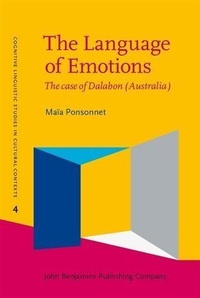
The Language of Emotions
The case of Dalabon (Australia)
1st Edition
Published on 3. December 2014
XXVII, 466 pages
978-90-272-6920-1 (ISBN)
Description

The Language of Emotions: The case of Dalabon (Australia) is the first extensive study of the linguistic encoding of emotions in an Australian language, and further, in an endangered, non-European language. Based on first-hand data collected using innovative methods, the monograph describes and analyzes how Dalabon speakers express emotions (using interjections, prosody, evaluative morphology) and the words they use to describe and discuss emotions. Like many languages, Dalabon makes broad use of body-part words in descriptions of emotions. The volume analyzes the figurative functions of these body-part words, as well as their non-figurative functions. Correlations between linguistic features and cultural patterns are systematically questioned.
Beyond Australianists and linguists working on emotions, the book will be of interest to anthropological linguists, cognitive linguists, or linguists working on discourse and communication for instance. It is accessible also to non-linguists with an interest in language, in particular anthropologists and psychologists.
Beyond Australianists and linguists working on emotions, the book will be of interest to anthropological linguists, cognitive linguists, or linguists working on discourse and communication for instance. It is accessible also to non-linguists with an interest in language, in particular anthropologists and psychologists.
More details
Other editions
Additional editions
Book
12/2014
John Benjamins Publishing Co
€111.30
Shipment within 10-15 days
Person
Content
- The Language of Emotions
- Editorial page
- Title page
- LCC data
- Dedication page
- Table of contents
- Acknowledgements
- Preface
- List of tables
- List of figures
- Abbreviations and conventions
- Recordings
- Orthographic conventions
- Chapter 1. Introduction
- 1. Defining emotions
- 1.1 Universalists and relativists
- 1.2 Working definition
- 1.2.1 Emotions are private states
- 1.2.2 Other criteria and properties
- 1.2.3 Summary
- 1.3 The concept of emotion in Dalabon
- 2. Linguistic approaches to emotions
- 2.1 Expression vs description
- 2.2 Focus on meaning vs focus on metaphor
- 2.2.1 Describing meanings in Dalabon
- 2.2.2 Reflecting on tropes
- 3. Structure of the work
- Chapter 2. Ethnographic context
- 1. Who are the Dalabon?
- 2. Pre-colonial life style, environment and connection to the land
- 2.1 Social organization
- 2.1.1 Kinship
- 2.1.2 Marriages
- 2.1.3 Subsections
- 2.2 Cosmogonies
- 2.3 Secrecy and gender division
- 3. Colonization and recent history
- 3.1 Dalabon life style
- 3.2 The Dalabon and their historical background
- 4. Emotions in the Dalabon context
- 4.1 The status of emotions
- 4.2 Managing painful emotions
- Chapter 3. Linguistic context
- 1. Linguistic context
- 1.1 The local language ecology
- 1.1.1 Dalabon
- 1.1.2 Kriol
- 1.2 Gathering data on emotions in Dalabon
- 1.2.1 Vantage point
- 1.2.2 Caveats and methodological solutions
- 1.2.3 Limitations of the data
- 1.2.4 Corpora and their indexation
- 1.2.5 Glosses
- 2. The Dalabon language
- 2.1 Profile and previous works
- 2.2 The verb template
- 2.3 Noun incorporation
- 2.3.1 Syntactic noun incorporation and lexicalized compounds
- 2.3.2 Lexicalization and metaphors
- 2.4 Body-part nouns and nominal subclasses
- 2.4.1 The animate-part nominal subclass
- 2.4.2 Morphosyntactic behavior of animate-part nouns
- Chapter 4. Expressive features
- 1. Methodology
- 1.1 Data
- 1.2 Categories
- 1.3 Comparison with Kriol
- 2. Other emotional devices
- 2.1 Apprehensive mood
- 2.2 Reported speech
- 2.3 Demonstratives
- 3. Diminutives
- 3.1 -Wurd with nouns referring to animates
- 3.1.1 Categories not defined by age
- 3.1.2 Categories defined by age
- 3.1.3 Distribution
- 3.1.4 Other animates
- 3.2 -Wurd on nouns referring to inanimates
- 3.2.1 Emotional connotations
- 3.2.2 Softening pragmatic functions
- 3.3 Verbs
- 3.3.1 Scalar senses
- 3.3.2 Emotional senses
- 3.3.3 Softening functions
- 3.4 -Wurd on other word classes
- 3.5 Yaw-
- 3.6 Conclusions
- 4. Emotive interjections
- 4.1 Definitions
- 4.2 Emotive interjections in Dalabon
- 4.3 Core emotive interjections
- 4.3.1 Weh-no
- 4.3.2 Bordo(h)
- 4.3.3 Woywoy
- 4.3.4 Comparison
- 4.3.5 Note on bobala
- 4.3.6 Conclusions
- 5. Emotional prosodic features
- 5.1 Variations in pitch
- 5.1.1 Emotional prosodic contour
- 5.1.2 Contexts
- 5.1.3 High pitch
- 5.1.4 Other contours
- 5.2 Phonation and intensity
- 5.2.1 Creakiness
- 5.2.2 Whispering
- 5.2.3 Lower intensity
- 5.3 The 'sad register'
- 5.4 Conclusions
- 6. Expressives: Final remarks
- Chapter 5. The lexicon: Structure
- 1. Extent and structure of the lexicon
- 1.1 Word classes and their numbers
- 1.2 Compounds and the role of body-parts
- 2. Syntax
- 2.1 Argument marking in Dalabon
- 2.2 One-place predicates
- 2.3 Two-place predicates
- 2.3.1 Animate stimulus
- 2.3.2 Causative verbs
- 2.3.3 Isolated patterns
- 2.4 Valence-changing operations
- 2.4.1 Benefactives
- 2.4.2 Lexicalized benefactive: marnu-djare 'like, love'
- 2.4.3 Reciprocals
- 2.4.4 Reflexives
- 2.5 Alternative constructions
- 2.5.1 Clausal adjuncts
- 2.5.2 Case marking
- 2.5.3 Possessive markers
- 3. Aspect
- 4. Conclusion
- Chapter 6. The lexicon: Semantics
- 1. Frequent lexemes
- 2. Emotions and their patterns of lexicalization
- 2.1 Interpersonal relationships
- 2.1.1 Other-oriented and self-oriented emotions
- 2.1.2 Conflict-related emotions
- 2.1.3 Compassion
- 2.1.4 Shame
- 2.1.5 Mourning-related emotions
- 2.2 The autonomous self
- 2.3 Jealousy, love and sexual desire
- 2.3.1 Love and jealousy
- 2.3.2 Love, sexuality and gender
- 2.4 Fear and surprise
- 3. Conclusion
- Chapter 7. Metaphors: Introduction
- 1. Introduction: The nature of emotional compounds
- 2. Metaphors: Definitions and debates
- 2.1 The cognitivists' and the anthropologists' views on metaphors
- 2.2 Historical depth
- 3. The notion of trope in this work
- 3.1 Dalabon lexical tropes: Imposed but active
- 3.2 Focus on synchrony and reinterpretation
- 3.3 Literal vs figurative meaning
- 4. The power of tropes
- 4.1 Tropes as conceptual suggestions
- 4.2 Tropes as motivations of lexical form and semantic change
- 4.3 Conceptual tropes resulting from linguistic forms
- 5. Methodological issues
- 5.1 Metaphors and metonymies
- 5.2 The typology of metaphors
- 5.3 Terminology
- 6. Conclusion
- Chapter 8. Metaphors: Around the body
- 1. KANGU 'belly'
- 1.1 Senses
- 1.2 Remarks on the semantics of KANGU compounds
- 1.3 Bridging somatic metonymies: physical state of the belly for emotional state
- 1.4 Other metonymies: Belly for seat of emotions
- 1.4.1 Belly for seat of physical responses to emotions
- 1.4.2 Belly for seat of emotions
- 1.4.3 Belly for experiencer of emotions
- 1.4.4 Relevance to speakers
- 1.5 State of the belly metaphors
- 1.5.1 Resistance metaphors: Blockage, softness, fluidity, movement
- 1.5.2 Destruction metaphors
- 1.5.3 Accessibility metaphor
- 1.5.4 Relevance to speakers
- 1.6 Other 'free' metaphors with kangu-no 'belly'
- 1.7 Discussion
- 2. Around the heart: NGURLK and NGERH
- 2.1 Meanings of the body-part components
- 2.2 NGURLK compounds
- 2.2.1 Heart for affection metonymy
- 2.2.2 Height and verticality metaphors
- 2.2.3 Heart for seat of emotions metonymy
- 2.3 NGERH compounds
- 2.3.1 Somatic metonymy: Affected heart rate for emotional states
- 2.3.2 Free metaphors with ngerh-no
- 2.4 Salience of conceptual metaphors
- 3. YOLH 'pep, feelings'
- 3.1 Sense and etymology
- 3.2 YOLH compounds
- 3.3 Compositional interpretations
- 3.4 Metaphors involving feelings
- 3.4.1 Existence metaphor and its extensions
- 3.4.2 Blockage and mobility metaphors
- 3.4.3 Change metaphor
- 3.4.4 Resistance metaphor and KANGU analogues
- 3.5 Discussion
- 4. Conclusions
- Chapter 9. Other emotion metaphors
- 1. YIRRU 'conflict, anger'
- 1.1 YIRRU and KANGU-YIRRU compounds
- 1.1.1 YIRRU compounds
- 1.1.2 KANGU-YIRRU compounds
- 1.2 Generic metaphors
- 1.2.1 Anger is like a part of the person
- 1.2.2 Anger is like an entity independent of the person
- 1.3 Specific metaphors
- 1.3.1 Appearing entity
- 1.3.2 Living entity
- 1.3.3 Anger, pain, diseases and poison
- 1.3.4 Anger is a fluid
- 1.4 Metaphors specific to KANGU-YIRRU compounds
- 1.5 Other anger metaphors
- 1.6 Discussion
- 1.6.1 Representations of anger in Dalabon
- 1.6.2 Cross-linguistic comparison
- 2. RE 'laughter, smile' and RU 'tears'
- 3. BRUK 'dry'
- 3.1 Dryness of attribute for emotional composure
- 3.2 Emotions are fluids
- 4. Free metaphor: The body as a container
- 5. Conclusions
- Chapter 10. Body-parts and emotional behaviors
- 1. Emotional behavior sets
- 1.1 Yirru 'conflict', 'anger'
- 1.2 Yer(mu) 'avoid interactions for fear of others'
- 1.3 Dje-bruH(mu) 'be sulky, be sad/put on a dark face'
- 1.3.1 Sense and etymology
- 1.3.2 Body-part alternations
- 1.4 BRUK 'dry/QUIET'
- 1.5 Behavioral verbs
- 1.5.1 Redji 'smile, laugh'
- 1.5.2 Run 'cry'
- 1.6 Conclusions on emotional behavior sets
- 2. Body-parts with emotional connotations
- 2.1 Effect for cause metonymies
- 2.2 Part for whole metonymies
- 2.3 Analogy within metaphorical sets
- 2.4 Compositional interpretation of KANGU compounds
- 3. Analogy, compositionality, body-parts and emotions
- 4. Emotional behavior sets and the perception of emotions
- 5. Conclusions
- Chapter 11. Conclusion
- 1. Expressive features
- 2. The lexicon
- 3. Metonymy and metaphor
- 4. Body-parts and emotional behaviors
- 5. Conceptual motivations and formal motivations
- 6. Dalabon representations of emotions
- References
- Appendix 1. Table of Dalabon: Emotion verbs and adjectives
- Appendix 2. Dalabon emotion lexicon
- Emotion Finder-List
- Appendix 3. Predicate components
- General index
- Index of languages and groups
