

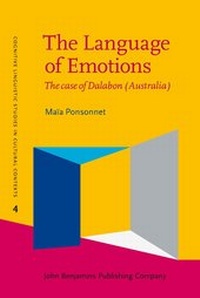
The Language of Emotions
The case of Dalabon (Australia)
Published on 3. December 2014
Book
Hardback
466 pages
978-90-272-0407-3 (ISBN)
Description
The Language of Emotions: The case of Dalabon (Australia) is the first extensive study of the linguistic encoding of emotions in an Australian language, and further, in an endangered, non-European language. Based on first-hand data collected using innovative methods, the monograph describes and analyzes how Dalabon speakers express emotions (using interjections, prosody, evaluative morphology) and the words they use to describe and discuss emotions. Like many languages, Dalabon makes broad use of body-part words in descriptions of emotions. The volume analyzes the figurative functions of these body-part words, as well as their non-figurative functions. Correlations between linguistic features and cultural patterns are systematically questioned.
Beyond Australianists and linguists working on emotions, the book will be of interest to anthropological linguists, cognitive linguists, or linguists working on discourse and communication for instance. It is accessible also to non-linguists with an interest in language, in particular anthropologists and psychologists.
Beyond Australianists and linguists working on emotions, the book will be of interest to anthropological linguists, cognitive linguists, or linguists working on discourse and communication for instance. It is accessible also to non-linguists with an interest in language, in particular anthropologists and psychologists.
Reviews / Votes
In The Language of Emotions: The Case of Dalabon (Australia), Ponsonnet presents an impressively broad and competent study of the language and culture of the Dalabon people of southwestern Arnhem Land, the Northern Territory, Australia, ultimately focusing on their ways of talking about and expressing emotions. A reader with even a smidgeon of interest in the cultural and linguistic changes undergone by Australian Aboriginal peoples will find the book a great read, as did this reviewer. Ponsonnet provides insights on traditional culture, early contacts and recent relations with European colonists, the status of contemporary Dalabon language and culture, the dominance of Kriol, and the persistence of traditional kinship practices and interests. Her discussions of linguistic theory pertaining to emotion are thought-provoking on two issues: the difficulty of applying a scientific definition of emotion to Dalabon language practices (they are emotionally reticent) and the question of whether emotion language is best treated as expressive of internal states or as pragmatic action. The linguistic analysis is appropriate and meticulous, covering syntax, semantics, figurative language, and expressive qualities such as prosody and emotional behavior. For the comparativists, there are interlinear translations, tables, and a lexicon. -- Gary Palmer, University of Nevada, Las VegasMore details
Series
Language
English
Place of publication
Amsterdam
Netherlands
Target group
Professional and scholarly
Illustrations
+ index
Weight
1005 gr
ISBN-13
978-90-272-0407-3 (9789027204073)
Copyright in bibliographic data and cover images is held by Nielsen Book Services Limited or by the publishers or by their respective licensors: all rights reserved.
Schweitzer Classification
Other editions
Additional editions
E-Book
12/2014
1st Edition
John Benjamins Publishing Company
€130.99
Available for download
Person
Content
1. Acknowledgements; 2. Preface; 3. List of tables; 4. List of figures; 5. Abbreviations and conventions; 6. Recordings; 7. Orthographic conventions; 8. Chapter 1: Introduction; 9. Chapter 2: Ethnographic context; 10. Chapter 3: Linguistic context; 11. Chapter 4: Expressive features; 12. Chapter 5: The lexicon: structure; 13. Chapter 6: The lexicon: semantics; 14. Chapter 7: Metaphors: introduction; 15. Chapter 8: Metaphors: around the body; 16. Chapter 9: Other emotion metaphors; 17. Chapter 10: Body-parts and emotional behaviors; 18. Chapter 11: Conclusion; 19. References; 20. Appendix 1; 21. Appendix 2; 22. Appendix 3; 23. General index; 24. Index of languages and groups