

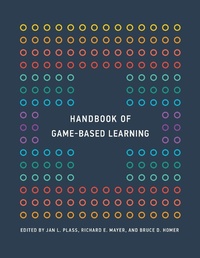
Handbook of Game-Based Learning
Description

This book offers a comprehensive introduction to the latest research on learning and instruction with computer games. Unlike other books on the topic, which emphasize game development or best practices, Handbook of Game-Based Learning is based on empirical findings and grounded in psychological and learning sciences theory. The contributors, all leading researchers in the field, offer a range of perspectives, including cognitive, motivational, affective, and sociocultural. They explore research on whether (and how) computer games can help students learn educational content and academic skills; which game features (including feedback, incentives, adaptivity, narrative theme, and game mechanics) can improve the instructional effectiveness of these games; and applications, including games for learning in STEM disciplines, for training cognitive skills, for workforce learning, and for assessment. The Handbook offers an indispensable reference both for readers with practical interests in designing or selecting effective game-based learning environments and for scholars who conduct or evaluate research in the field. It can also be used in courses related to play, cognition, motivation, affect, instruction, and technology.
Contributors Roger Azevedo, Ryan S. Baker, Daphne Bavelier, Amanda E. Bradbury, Ruth C. Clark, Michele D. Dickey, Hamadi Henderson, Bruce D. Homer, Fengfeng Ke, Younsu Kim, Charles E. Kinzer, Eric Klopfer, James C. Lester, Kristina Loderer, Richard E. Mayer, Bradford W. Mott, Nicholas V. Mudrick, Brian Nelson, Frank Nguyen, V. Elizabeth Owen, Shashank Pawar, Reinhard Pekrun, Jan L. Plass, Charles Raffale, Jonathon Reinhardt, C. Scott Rigby, Jonathan P. Rowe, Richard M. Ryan, Ruth N. Schwartz, Quinnipiac Valerie J. Shute, Randall D. Spain, Constance Steinkuehler, Frankie Tam, Michelle Taub, Meredith Thompson, Steven L. Thorne, A. M. Tsaasan
More details
Other editions
Additional editions
Persons
Richard E. Mayer is Distinguished Professor of Psychological and Brain Sciences at the University of California, Santa Barbara.
Bruce D. Homer is Associate Professor of Educational Psychology and Human Development at the Graduate Center of City University New York.
