

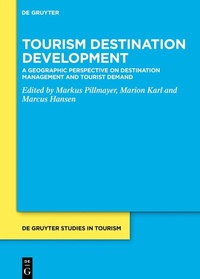
Tourism Destination Development
Description

Although destination management is regarded as the supreme discipline in tourism management, little attention is paid to destination development, especially from a geographical perspective. This book analyses destination development and proposes key strategies for a positive destination development in the future in regard to sustainability, accessibility and economic prosperity. International scholars from a range of disciplines explore current issues in destination development and propose solutions that can help policy-makers prepare for future challenges. This book includes case studies from all around the globe to illustrate the diversity of destination development. This book thus offers students, colleagues from the scientific community as well as practitioners and political decision-makers numerous suggestions, considerations and decision-making aids with regard to destination development.
More details
Other editions
Additional editions
Persons
Markus Pillmayer is Professor of Destination Management and Destination Development at the Department of Tourism at the Munich University of Applied Sciences. With a Ph.D. in cultural geography, his research focuses on geographical development which he has explored in several contexts including citizen participation, health, sustainability, and resilience. Among other things, he is head of the Living Lab Tourism, Sustainability and Quality of Life. He can draw on many years of experience in the international tourism industry and tourism policy, which also benefits him in the context of his scientific activities. In addition, he is a fellow of various scientific associations such as IGU (International Geographic Union), GHRA (Global Hospitality Research Alliance) or the DGT (German Society for Tourism Research), the latter he serves on the board.
Marion Karl is a Senior Lecturer in Tourism Management and Marketing at the School of Hospitality and Tourism Management, University of Surrey. Her research focuses on travel decision-making and its influencing factors, such as constraints, risk perception or emotions. While her previous research has mainly focused on understanding people's travel decision-making processes, she has now translates this knowledge into ways that change tourists' behaviour in a positive way (e.g. sustainable behaviour). Marion regularly publishes in key tourism journals and serves on the editorial boards of several tourism journals. She also works on projects on behaviour change with international hospitality and tourism companies.
Marcus Hansen is a senior lecturer in tourism & events at Liverpool John Moores University. Marcus teaches and conducts research in relation to tourism and events management. His research interests are particularly around the topics of accessible tourism & events, including travelling with a vision impairment and making destinations dementia friendly. Marcus has published widely, including in key tourism journals such as Tourism Management and Annals of Tourism Research. Through his research, Marcus continues to work with various organisations in an effort to make tourism more accessible to people with disabilities.
Content
- Intro
- Foreword
- Preface
- Contents
- The Need to Engage with Destination Development
- Part I: Developing Competitive Destinations
- Tourism Destinations: Risk, Management and Communication
- Destination Competitiveness and AI-based Methods
- Change Management Approaches to Encounter Rural Overtourism
- Visitor Management in Tourism Destinations: Current Challenges in Measuring and Managing Visitors' Spatio-Temporal Behaviour
- Supporting Economically and Socially Sustainable Destination Development through Branding: Opportunities and Challenges
- Part II: Developing Sustainable Destinations
- From Global Frameworks to Local Meanings: Assessing Resilience for Sustainable Destinations through the Lens of Transdisciplinary Research
- Destination Resilience in the Context of COVID-19 and Its Hysteretic Impact on the Tourism System of South Tyrol
- Local Participation for a Higher Commitment to Destination Development
- Residents' Attitudes and Sustainable Destination Development: Introducing the Tourism Acceptance Score
- Dogs, Frogs and Degrowth: Sustainable Development and Arctification as a Destination Development Dilemma in Northern Sweden
- Part III: Developing Accessible Destinations
- Principles and Practices of Effective Inclusive Stakeholder Community Engagement
- The Role of Universal Design in the Future of Tourism Planning and Development
- Developing Social Sustainable Tourism for and with People with Hidden Disabilities: Reflections from Fyn, Denmark
- Tourism Promotional Materials: Examining the Intersections of Accessibility and Inclusion
- Inclusive Destination Management Strategies
- Part IV: Developing Future-Proof Destinations
- Business as Usual or Completely Different? COVID-19 and Its Influence on the Participation in Tourism of the German Population
- Beyond Overtourism, Undertourism, the End of Tourism: New Perspectives for Urban Tourism
- Flight and Migration in the Context of Destinations: Conceptional Approaches and Empirical Insights Based on the Repurposing of Tourist Accommodation as Accommodation for Refugees - Case Study Bavaria
- The Challenge of Climate Change and Net-Zero Emissions for Destinations
- Techno-Utopia or Techno-Dystopia: Current and Future Extended Reality and Artificial Intelligence Developments in Destinations
- The Contribution of Academia to Destination Development
- List of Figures
- List of Tables
- List of Contributors
- Index
