

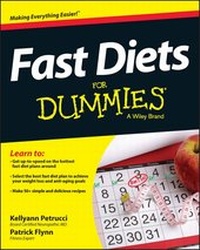
Fast Diets For Dummies
Description

More details
Other editions
Additional editions
Persons
Content
Chapter 1
Fasting — Nature's Ultimate Fat-Burning Secret Weapon
In This Chapter
Discovering what fasting is
Understanding what fasting can do for you
Recognizing who should and shouldn't fast
Determining whether or not fasting is right for you
Almost any diet works, for a period of time. Because at root, all diets operate on the same premises — calorie restriction. Though many try to deny this plain and simple fact, it's quite undeniable. If you take in fewer calories than you get rid of, you will lose weight. It's inevitable.
You don't need to eat healthy to lose weight, believe it or not. You need only to eat less. But we don't recommend that you cut your intake of sandwich cookies in half, from ten to five, because being healthy is more than just losing weight. In other words you can be thin and unhealthy.
A good diet is an economical one. It contains no unnecessary foods and no unnecessary meals, which means you're judicious about your food quality and also your food quantity. As a result, you should omit needless foods, which means anything you ingest that that will either make you more or less healthy. If a food doesn't directly benefit you, then you should omit it. Many good books discuss the importance of food quality. (In this book, we briefly discuss food quality, but our mission is to focus on quantity.)
This chapter (and this book) focuses on the quantity — how to not eat — in other words, how to fast for health, fat loss, and longevity. Not eating, in fact, is darn near one of the healthiest things you can do for yourself that you've probably never thought to do. And you've probably never thought to do it, because all conventional wisdom has led you to believe that skipping meals or not eating for a while is bad for you.
In this chapter we introduce you to fasting to help you understand what fasting is, why it's such a beneficial health practice, and why it's so darn effective for weight loss. We then help you decide whether or not fasting is right for you.
Getting a Better Idea of What Fasting Really Is
The concept of fasting is quite simple. Fasting means you don't eat for a while. Although it may sound a bit contrarian, it is, without a doubt, a very safe and very sound health practice. In fact, it's good for your mind, body, and soul.
You may have heard that not eating is a bad idea, because it will slow your metabolism and cause you to gain weight. Well, you've heard wrong. Fasting is not only good for you, but also perhaps the healthiest thing you can ever do for yourself.
Fasting works because it's a hardship. It's short-term deprivation, to be exact. And, to that end, any diet that touts itself as superior because it isn't deprivation-based is not superior at all, but far inferior, to be sure. Any diet that says you can “eat whatever you want so long as you . . . ” or “eat as much as you want so long as you . . . ” is immediately a pile of fatuous nonsense and is to be straightaway ignored.
These sections examine the positive benefits of fasting, explain how fasting works, and discuss how you can fast. The other chapters in Part I provide more detail about these discussions to help if you want to change your lifestyle for the better and incorporate fasting into your diet.
Identifying the positive effects of fasting
Fasting can help you feel and look better. In addition, here are a few of the positive effects fasting can have on your body. Fasting
- Burns fat: When fasting, the body naturally taps into stored body fat for energy, a process that is severely inhibited when eating frequently throughout the day. Studies have shown that fasting dramatically increases lipolysis, which is the fancy term for fat burning.
- Boosts energy: Fasting is slightly stimulatory, because it increases your natural adrenal response. In plain English, it means that while you're fasting, you can expect your productivity to increase and concentration to improve.
- Fights disease: Fasting naturally boosts immunity and allows your body to naturally detoxify itself. While fasting, your body purges unhealthy, damaged, and polluted cells — as well as spurs the growth of new healthy cells.
- Delays aging: Eating has an aging effect on the body, which happens primarily through insulin, which is your body's primary nutrient transport and blood-sugar regulating hormone. When you eat, your pancreas secretes insulin. And the problem with eating too much or too frequently is that insulin speeds up biological aging process. Fasting delays aging by suppressing insulin levels.
- Enhances exercise: Fasting and exercise potentiate each other, meaning they increase each other's positive effects. Exercising in a fasted state can help you to burn more fat, increase vitality, and build muscle more efficiently.
The benefits of fasting are huge, whereas there really isn't a reason why you shouldn't fast on a regular basis. In fact, fasting is also the world's most ancient healing mechanism. All animals, except human beings, fast instinctively when sick or wounded. Chapter 2 discusses these benefits in more detail.
Examining how it works
The human body can be either in a fasted state or a fed state; it can't be in between. Therefore, if the fed state is yang, then the fasting state is yin. Fasting provides balance — by adding in more yin to counterweigh all that yang. Fasting basically works in three ways:
- It optimizes your hormonal makeup. When in a fasted state, hormones that are particularly beneficial are permitted free reign, including glucagon, which is the yin to insulin's yang. Glucagon, like insulin, is secreted by the pancreas in order to regulate blood sugar. But rather than shutting nutrients into cells, glucagon pulls nutrients out of cells, including fatty acids, which has earned glucagon the reputation of being something of a fat-burning hormone. However, glucagon can only prevail in a fasted state.
- It surges natural growth hormone. Insulin, the hormone secreted during the fed state, heavily suppresses natural growth hormone. Meaning, the more frequently you eat, the less natural growth hormone your body produces. Natural growth hormone is the closest thing humans have to a fountain of youth. It burns fat, builds muscle, and works to keep the body biologically young and resilient.
- It permits the body to cleanse itself. When in a fasted state, the body disperses its natural house cleaners, which consist primarily of microphages (think of these as cells that attack and destroy harmful invaders) and white blood cells that pull toxins out of cells, engulf them, and dispose of them. When constantly fed, this natural detoxification process is hampered. Frequently feeding functions as a one-way escape valve, permitting toxins into the body, but not letting them back out. Not until you enter a fasted state can you flip that valve and allow toxins to pour out of the body.
Chapter 2 delves deeper into the science of fasting.
Understanding the best way to go about it
You may be surprised to hear that you can go about fasting in several different ways. Some of them include longer fasting periods (up to 24 hours at a time), whereas others include short fasting periods (12 to 16 hours). Some methods include strict fasts (nothing but water) and others include controlled fasts (limited caloric intake).
In this book, we discuss four common fasting options. These options are as follows:
- Intermittent fasting: Intermittent fasting is when you fast for 24 to 36 hours (typically once or twice a week). This method is a simple way to introduce fasting into your life because you only need to take a break from eating for a day. This works exceptionally well to reduce overall calorie intake without having to worry about making many other changes on your nonfasting days. Check out Chapter 4 for more details.
- 5:2 Diet: The 5:2 Diet, also known as the Fast Diet, is the gentlest introduction to fasting, because it simply requires that for two days out of the week you only eat two meals (500-calorie meals if you're a woman and 600-calorie meals if you're a man). This method is perhaps the best way for most people to get acclimated with fasting, before perusing some of the more intensive efforts. Chapter 5 gives you the lowdown on this method.
- Micro-fasting: Micro-fasting is a daily fasting regimen. Think of it as the no breakfast diet. This idea flies in the face of conventional wisdom, but for good reasons (all of which we explain in Chapter 6). Micro-fasting has you fasting for 16 hours each day, compressing the time you eat into an eight-hour window. Micro-fasting is both easy to implement and enormously beneficial. Head to Chapter 6 for how to incorporate micro-fasting into your diet.
- The Warrior Diet: The Warrior Diet, made popular by the book of the same title, is similar to micro-fasting in the sense that it condenses the time you're allowed to eat into a small window (about four hours), but different in a few other regards. The fasting period is less strict, and more of a...
