

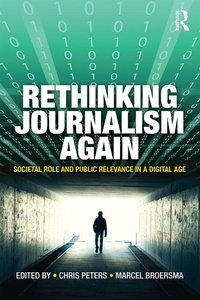
Rethinking Journalism Again
Societal role and public relevance in a digital age
Published on 13. September 2016
246 pages
978-1-317-50641-6 (ISBN)
Description

It's easy to make a rhetorical case for the value of journalism. Because, it is a necessary precondition for democracy; it speaks to the people and for the people; it informs citizens and enables them to make rational decisions; it functions as their watchdog on government and other powers that be.
But does rehashing such familiar rationales bring journalism studies forward? Does it contribute to ongoing discussions surrounding journalism's viability going forth? For all their seeming self-evidence, this book considers what bearing these old platitudes have in the new digital era. It asks whether such hopeful talk really reflects the concrete roles journalism now performs for people in their everyday lives. In essence, it poses questions that strike at the core of the idea of journalism itself. Is there a singular journalism that has one well-defined role in society? Is its public mandate as strong as we think?
The internationally-renowned scholars comprising the collection address these recurring concerns that have long-defined the profession and which journalism faces even more acutely today. By discussing what journalism was, is, and (possibly) will be, this book highlights key contemporary areas of debate and tackles on-going anxieties about its future.
But does rehashing such familiar rationales bring journalism studies forward? Does it contribute to ongoing discussions surrounding journalism's viability going forth? For all their seeming self-evidence, this book considers what bearing these old platitudes have in the new digital era. It asks whether such hopeful talk really reflects the concrete roles journalism now performs for people in their everyday lives. In essence, it poses questions that strike at the core of the idea of journalism itself. Is there a singular journalism that has one well-defined role in society? Is its public mandate as strong as we think?
The internationally-renowned scholars comprising the collection address these recurring concerns that have long-defined the profession and which journalism faces even more acutely today. By discussing what journalism was, is, and (possibly) will be, this book highlights key contemporary areas of debate and tackles on-going anxieties about its future.
Reviews / Votes
"Rethinking Journalism Again invites a leading group of scholars to reflect on the past and reimagine the future of journalism. Given this freedom, this group of prolific and influential contributors suggests truly innovative directions and new language for mapping the place of journalism in contemporary societies. This outstanding volume takes inspiration from the past to rethink, and reinvent the future of journalism with rigor, guts, and, above all, a sense of adventure."Zizi Papacharissi, University of Illinois at Chicago, USA
"Rethinking again? Yes, again. And well worth it. Journalism is in such a crisis that practitioners and analysts alike are confused about whether it is in crisis or not. Is it the loss of newsroom jobs for journalists? Or the loss of a public for news? Has journalism failed - or has it stumbled toward goals (building democracy or arriving at a purity of fact-gathering) beyond its reach? Have new media added to journalism's power or undermined its functions or introduced new aspirations (like 'reciprocity') never before contemplated? Readers will find in this learned and lively collection new questions to ponder and the makings of a new agenda for the study of journalism today."
Michael S. Schudson, Professor of Journalism, Columbia University, USA
More details
Language
English
Place of publication
London
United Kingdom
Publishing group
Taylor & Francis Ltd
Target group
College/higher education
Professional and scholarly
Illustrations
1 s/w Tabelle
1 Tables, black and white
File size
7,41 MB
ISBN-13
978-1-317-50641-6 (9781317506416)
Copyright in bibliographic data and cover images is held by Nielsen Book Services Limited or by the publishers or by their respective licensors: all rights reserved.
Schweitzer Classification
Other editions
Additional editions
Chris Peters | Marcel Broersma
Rethinking Journalism Again
Societal role and public relevance in a digital age
Book
09/2016
1st Edition
Routledge
€67.80
Shipment within 10-20 days
Chris Peters | Marcel Broersma
Rethinking Journalism Again
Societal role and public relevance in a digital age
Book
09/2016
1st Edition
Routledge
€206.40
Shipment within 10-20 days
Persons
Chris Peters is Associate Professor of Media and Communication at Aalborg University's Copenhagen campus. His research explores how people get and experience news and information in everyday life, and the sociocultural impact of transformations in the digital era. His publications include Rethinking Journalism and Retelling Journalism.
Marcel Broersma is Professor of Journalism Studies and Media, and the director of the Centre for Media and Journalism Studies at the University of Groningen. He has published widely on historical and current transformations in journalism. His publications include Form and Style in Journalism, Rethinking Journalism and Retelling Journalism.
Marcel Broersma is Professor of Journalism Studies and Media, and the director of the Centre for Media and Journalism Studies at the University of Groningen. He has published widely on historical and current transformations in journalism. His publications include Form and Style in Journalism, Rethinking Journalism and Retelling Journalism.
Content
Introduction: Towards a Functional Perspective on Journalism's Role and Relevance
Marcel Broersma and Chris Peters
Part I: Journalism and Its Societal Role
Chapter 1 Reconstructing Journalism's Public Rationale
Nick Couldry
Chapter 2 Reappraising Journalism's Normative Foundations
John Steel
Chapter 3 Establishing the Boundaries of Journalism's Public Mandate
Matt Carlson
Chapter 4 The Disruption in Journalistic Expertise
Zvi Reich and Yigal Godler
Chapter 5 New Media, Search Engines and Social Networking Sites as Varieties of Online Gatekeepers
Rasmus Kleis Nielsen
Chapter 6 Is There a 'Postmodern Turn' in Journalism?
Karin Wahl-Jorgensen
Part II: Journalism and Its Public Relevance
Chapter 7 What Journalism Becomes
Mark Deuze and Tamara Witschge
Chapter 8 The Journalist as Entrepreneur
Jane B. Singer
Chapter 9 A Journalism of Care
Kaori Hayashi
Chapter 10 From Participation to Reciprocity in the Journalist-Audience Relationship
Seth C. Lewis, Avery E. Holton and Mark Coddington
Chapter 11 The Gap Between The Media and the Public
Pablo J. Boczkowski and Eugenia Mitchelstein
Chapter 12 The Rhetorical Illusions of News
Chris Peters and Marcel Broersma
Afterword Crisis? What Crisis?
Silvio Waisbord
Afterword Revisioning Journalism and 'The Pictures in Our Heads'
Stuart Allan
Marcel Broersma and Chris Peters
Part I: Journalism and Its Societal Role
Chapter 1 Reconstructing Journalism's Public Rationale
Nick Couldry
Chapter 2 Reappraising Journalism's Normative Foundations
John Steel
Chapter 3 Establishing the Boundaries of Journalism's Public Mandate
Matt Carlson
Chapter 4 The Disruption in Journalistic Expertise
Zvi Reich and Yigal Godler
Chapter 5 New Media, Search Engines and Social Networking Sites as Varieties of Online Gatekeepers
Rasmus Kleis Nielsen
Chapter 6 Is There a 'Postmodern Turn' in Journalism?
Karin Wahl-Jorgensen
Part II: Journalism and Its Public Relevance
Chapter 7 What Journalism Becomes
Mark Deuze and Tamara Witschge
Chapter 8 The Journalist as Entrepreneur
Jane B. Singer
Chapter 9 A Journalism of Care
Kaori Hayashi
Chapter 10 From Participation to Reciprocity in the Journalist-Audience Relationship
Seth C. Lewis, Avery E. Holton and Mark Coddington
Chapter 11 The Gap Between The Media and the Public
Pablo J. Boczkowski and Eugenia Mitchelstein
Chapter 12 The Rhetorical Illusions of News
Chris Peters and Marcel Broersma
Afterword Crisis? What Crisis?
Silvio Waisbord
Afterword Revisioning Journalism and 'The Pictures in Our Heads'
Stuart Allan
