

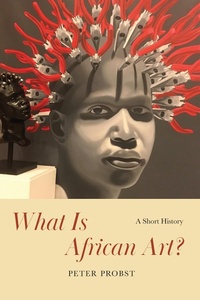
What Is African Art?
A Short History
Published on 6. December 2022
256 pages
978-0-226-79329-0 (ISBN)
Description

A history of the evolving field of African art.
This book examines the invention and development of African art as an art historical category. It starts with a simple question: What do we mean when we talk about African art? By confronting the historically shifting answers to this question, Peter Probst identifies "African art" as a conceptual vessel that manifests wider societal transformations.
What Is African Art? covers three key stages in the field's history. Starting with the late nineteenth through the mid-twentieth centuries, the book first discusses the colonial formation of the field by focusing on the role of museums, collectors, and photography in disseminating visual cultures as relations of power. It then explores the remaking of the field at the dawn of African independence with the shift toward contemporary art and the rise of Black Atlantic studies in the 1970s and 1980s. Finally, it examines the post- and decolonial reconfiguration of the field driven by questions of representation, repair, and restitution.
This book examines the invention and development of African art as an art historical category. It starts with a simple question: What do we mean when we talk about African art? By confronting the historically shifting answers to this question, Peter Probst identifies "African art" as a conceptual vessel that manifests wider societal transformations.
What Is African Art? covers three key stages in the field's history. Starting with the late nineteenth through the mid-twentieth centuries, the book first discusses the colonial formation of the field by focusing on the role of museums, collectors, and photography in disseminating visual cultures as relations of power. It then explores the remaking of the field at the dawn of African independence with the shift toward contemporary art and the rise of Black Atlantic studies in the 1970s and 1980s. Finally, it examines the post- and decolonial reconfiguration of the field driven by questions of representation, repair, and restitution.
More details
Other editions
Additional editions
Book
12/2022
University of Chicago Press
€104.16
Shipment within 10-20 days
Book
12/2022
University of Chicago Press
€36.00
Shipment within 10-20 days
