

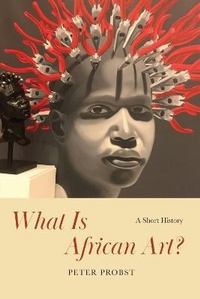
What Is African Art?
A Short History
Published on 21. December 2022
Book
Hardback
248 pages
978-0-226-79301-6 (ISBN)
Description
A history of the evolving field of African art.
This book examines the invention and development of African art as an art historical category. It starts with a simple question: What do we mean when we talk about African art? By confronting the historically shifting answers to this question, Peter Probst identifies "African art" as a conceptual vessel that manifests wider societal transformations.
What Is African Art? covers three key stages in the field's history. Starting with the late nineteenth through the mid-twentieth centuries, the book first discusses the colonial formation of the field by focusing on the role of museums, collectors, and photography in disseminating visual cultures as relations of power. It then explores the remaking of the field at the dawn of African independence with the shift toward contemporary art and the rise of Black Atlantic studies in the 1970s and 1980s. Finally, it examines the post- and decolonial reconfiguration of the field driven by questions of representation, repair, and restitution.
This book examines the invention and development of African art as an art historical category. It starts with a simple question: What do we mean when we talk about African art? By confronting the historically shifting answers to this question, Peter Probst identifies "African art" as a conceptual vessel that manifests wider societal transformations.
What Is African Art? covers three key stages in the field's history. Starting with the late nineteenth through the mid-twentieth centuries, the book first discusses the colonial formation of the field by focusing on the role of museums, collectors, and photography in disseminating visual cultures as relations of power. It then explores the remaking of the field at the dawn of African independence with the shift toward contemporary art and the rise of Black Atlantic studies in the 1970s and 1980s. Finally, it examines the post- and decolonial reconfiguration of the field driven by questions of representation, repair, and restitution.
Reviews / Votes
"[What Is African Art?] a deeply researched, important contribution to the study of art history, with relevance to disciplines beyond the study of African art." * Library Journal * "This is the first book-length attempt at a historiography of African art study. Tracing the development of the field from the colonial era through to the present, Probst argues that the ways in which 'African art' has been discussed tell us at least as much about the speakers as the subject." * Apollo * "This detailed study spans more than a century of African art, charting how museums, curators and scholars began documenting aspects of the genre in the late 19th century through to 'the quest for a decolonial future.' Chapters cover topics such as 'challenging representation: postcolonial critique and curation' and 'tradition and tribality in the Cold War era.'" * The Art Newspaper * "This is the first book-length attempt at a historiography of African art study. Tracing the development of the field from the colonial era through to the present, Probst argues that the ways in which 'African art' has been discussed tell us at least as much about the speakers as the subject." * Apollo * [What Is African Art?] is a creditable overview highlighting tensions between Western interpretations of what African art is and interpretations of African artists, scholars, and curators, who assert their own vision of narrative African art and how it should be exhibited. . . This is a much-needed introduction to the contemporary African art world. Recommended." * Choice * "Wedged between anthropology and art history, the study of African art requires a balanced assessment of the defining moments in the making of this field. What Is African Art?-the first historiography of its kind-takes on this challenge superbly, offering a major critical achievement. This book is indispensable to a sound understanding of the field and is a joy to read." -- Ferdinand de Jong, author of Decolonizing Heritage: Time to Repair in Senegal "What Is African Art? is a sophisticated, insightful critique of the trajectories that collectors, curators, and scholars of African art have followed since the end of the nineteenth century. As the first monographic historiography of Africanist art studies, it is sure to seed lively debate that interrogates the past and informs the future. An essential read for any and all students of African art." -- Raymond Silverman, professor emeritus of the history of art, African studies, and museum Studies, University of MichiganMore details
Language
English
Place of publication
Chicago
United States
Publishing group
The University of Chicago Press
Target group
Professional and scholarly
Illustrations
91 halftones
Dimensions
Height: 229 mm
Width: 152 mm
Thickness: 30 mm
Weight
708 gr
ISBN-13
978-0-226-79301-6 (9780226793016)
Copyright in bibliographic data and cover images is held by Nielsen Book Services Limited or by the publishers or by their respective licensors: all rights reserved.
Schweitzer Classification
Other editions
Additional editions
E-Book
12/2022
University of Chicago Press
€42.99
Available for download
Person
Peter Probst is professor of art history and anthropology at Tufts University. He is the author or editor of several books, including National Museums of Africa, Osogbo and the Art of Heritage, Kalumbas Fest, and African Modernities.
Content
Introduction
Part I
1. Forming a Field: Colonial Collecting, Racial Omissions, and National Rivalries
2. Celebrating Form: From Primitive to Primitivism
3. Creating Visibility and Value: Photography and Its Effects
Part II
4. Discovering the African Artist: Tradition and Tribality in the Cold War Era
5. Acknowledging the Contemporary: New Forms, New Actors
6. Extending the Horizon: Africa in the Americas
Part III
7. Intervening the Canon: The Postmodern, the Popular, and the Authentic
8. Challenging Representation: Postcolonial Critique and Curation
9. Undoing the Empire: Duress, Defiance, and Decolonial Futures
Epilogue
Acknowledgments
Notes
Index
Part I
1. Forming a Field: Colonial Collecting, Racial Omissions, and National Rivalries
2. Celebrating Form: From Primitive to Primitivism
3. Creating Visibility and Value: Photography and Its Effects
Part II
4. Discovering the African Artist: Tradition and Tribality in the Cold War Era
5. Acknowledging the Contemporary: New Forms, New Actors
6. Extending the Horizon: Africa in the Americas
Part III
7. Intervening the Canon: The Postmodern, the Popular, and the Authentic
8. Challenging Representation: Postcolonial Critique and Curation
9. Undoing the Empire: Duress, Defiance, and Decolonial Futures
Epilogue
Acknowledgments
Notes
Index