

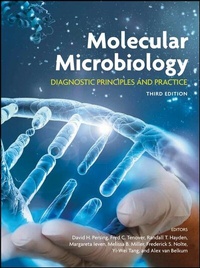
Molecular Microbiology
Description

Presenting the latest molecular diagnostic techniques in one comprehensive volume
The molecular diagnostics landscape has changed dramatically since the last edition of Molecular Microbiology: Diagnostic Principles and Practice in 2011. With the spread of molecular testing and the development of new technologies and their opportunities, laboratory professionals and physicians more than ever need a resource to help them navigate this rapidly evolving field.
Editors David Persing and Fred Tenover have brought together a team of experienced researchers and diagnosticians to update this third edition comprehensively, to present the latest developments in molecular diagnostics in the support of clinical care and of basic and clinical research, including next-generation sequencing and whole-genome analysis. These updates are provided in an easy-to-read format and supported by a broad range of practical advice, such as determining the appropriate type and quantity of a specimen, releasing and concentrating the targets, and eliminating inhibitors.
Molecular Microbiology: Diagnostic Principles and Practice
- Presents the latest basic scientific theory underlying molecular diagnostics
- Offers tested and proven applications of molecular diagnostics for the diagnosis of infectious diseases, including point-of-care testing
- Illustrates and summarizes key concepts and techniques with detailed figures and tables
- Discusses emerging technologies, including the use of molecular typing methods for real-time tracking of infectious outbreaks and antibiotic resistance
- Advises on the latest quality control and quality assurance measures
- Explores the increasing opportunities and capabilities of information technology
Molecular Microbiology: Diagnostic Principles and Practice is a textbook for molecular diagnostics courses that can also be used by anyone involved with diagnostic test selection and interpretation. It is also a useful reference for laboratories and as a continuing education resource for physicians.
If you are looking for online access to the latest clinical microbiology content, please visit www.wiley.com/learn/clinmicronow.
More details
Other editions
Additional editions
Content
Contributors
Preface
Section I: Novel and Emerging Technologies
1 Nucleic Acid Amplification Methods Overview
2 Application of Identification of Bacteria by DNA Target Sequencing in a Clinical Microbiology Laboratory
3 Microbial Whole-Genome Sequencing: Applications in Clinical Microbiology and Public Health
4 Digital PCR and Its Potential Application to Microbiology
5 Massively Parallel DNA Sequencing and Microbiology
6 Next-Generation Sequencing
7 Pathogen Discovery
8 Matrix-Assisted Laser Desorption Ionization-Time of Flight Mass Spectrometry for Microbial Identification in Clinical Microbiology
9 Multiplex Technologies
Section II: Metagenomics: Implications for Diagnostics
10 The Skin Microbiome: Insights into Potential Impact on Diagnostic Practice
11 The Gastrointestinal Microbiome
12 The Vaginal Microbiome
13 Microbial Communities of the Male Urethra
14 The Human Virome in Health and Disease
Section III: Health Care-Associated Infections
15 Molecular Detection of Staphylococcus aureus Colonization and Infection
16 Molecular Diagnostics for Clostridium difficile
17 Overview of Molecular Diagnostics in Multiple-Drug-Resistant Organism Prevention: Focus on Multiple-Drug-Resistant Gram-Negative Bacterial Organisms
18 Detection of Vancomycin-Resistant Enterococci
Section IV: Molecular Diagnostics and Public Health
19 The Impact of Molecular Diagnostics on Surveillance of Foodborne Infections
20 Role of Molecular Methods in Improving Public Health Surveillance of Infections Caused by Antimicrobial-Resistant Bacteria in Health Care and Community Settings
21 Molecular Diagnostics: Huge Impact on the Improvement of Public Health in China
22 Surveillance and Epidemiology of Norovirus Infections
23 Molecular Diagnostic Assays for the Detection and Control of Zoonotic Diseases
Section V: Syndromic Diagnostics
24 Molecular Approaches to the Diagnosis of Meningitis and Encephalitis
25 Using Nucleic Acid Amplification Techniques in a Syndrome-Oriented Approach: Detection of Respiratory Agents
26 Molecular and Mass Spectrometry Detection and Identification of Causative Agents of Bloodstream Infections
27 Molecular Diagnosis of Gastrointestinal Infections
28 Diagnostic Approaches to Genitourinary Tract Infections
29 Syndromic Diagnostic Approaches to Bone and Joint Infections
Section VI: Virology
30 Molecular Detection and Characterization of Human Immunodeficiency Virus Type 1
31 Molecular Detection and Characterization of Hepatitis C Virus
32 Molecular Detection and Characterization of Hepatitis B Virus
33 Molecular Detection of Human Papillomaviruses
34 Molecular Diagnostics for Viral Infections in Transplant Recipients
Section VII: Fungi and Protozoa
35 Molecular Detection and Identification of Fungal Pathogens
36 Molecular Approaches for Diagnosis of Chagas' Disease and Genotyping of Trypanosoma cruzi
37 Molecular Approaches for Diagnosis of Malaria and the Characterization of Genetic Markers for Drug Resistance
38 Molecular Detection of Gastrointestinal Parasites
Section VIII: Point-of-Care/Near-Care Diagnostics
39 Molecular Diagnostics and the Changing Face of Point-of-Care
40 Point-of-Care Technologies for the Diagnosis of Active Tuberculosis
41 Molecular Diagnostics for Use in HIV/AIDS Care and Treatment in Resource-Limited Settings
42 Rapid Point-of-Care Diagnosis of Malaria and Dengue Infection
Section IX: The Host and Host Response
43 Implications of Pharmacogenetics for Antimicrobial Prescribing
44 Exploiting MicroRNA (miRNA) Profiles for Diagnostics
45 Host Response in Human Immunodeficiency Virus Infection
46 Biomarkers of Gastrointestinal Host Responses to Microbial Infections
Section X: Information Technology
47 Point-of-Care Medical Device Connectivity: Developing World Landscape
48 WHONET: Software for Surveillance of Infecting Microbes and Their Resistance to Antimicrobial Agents
49 Cloud-Based Surveillance, Connectivity, and Distribution of the GeneXpert Analyzers for Diagnosis of Tuberculosis (TB) and Multiple-Drug-Resistant TB in South Africa
Section XI: Quality Assurance
50 Molecular Method Verification
51 Molecular Microbiology Test Quality Assurance and Monitoring
52 Proficiency Testing and External Quality Assessment for Molecular Microbiology
53 Practices of Sequencing Quality Assurance
54 Verification and Validation of Matrix-Assisted Laser Desorption Ionization Time of Flight Mass Spectrometry-Based Protocols
Section XII: The Business of Diagnostics
55 Improved Diagnostics in Microbiology: Developing a Business Case for Hospital Administration
56 Molecular Diagnostics and the Changing Legal Landscape
Index
CONTENTS
NOVEL AND EMERGING TECHNOLOGIES
1 Nucleic Acid Amplification Methods Overview
FREDERICK S. NOLTE AND CARL T. WITTWER
KARISSA D. CULBREATH, KEITH E. SIMMON, AND CATHY A. PETTI
3 Microbial Whole-Genome Sequencing: Applications in Clinical Microbiology and Public Health
M. E. TÖRÖK AND S. J. PEACOCK
4 Digital PCR and Its Potential Application to Microbiology
JIM F. HUGGETT, JEREMY A. GARSON, AND ALEXANDRA S. WHALE
5 Massively Parallel DNA Sequencing and Microbiology
ULF GYLLENSTEN, RUSSELL HIGUCHI, AND DAVID PERSING
CHARLES CHIU AND STEVE MILLER
EFREM S. LIM AND DAVID WANG
ALEX VAN BELKUM, VICTORIA GIRARD, MAUD ARSAC, AND ROBIN PATEL
KEVIN ALBY AND MELISSA B. MILLER
METAGENOMICS: IMPLICATIONS FOR DIAGNOSTICS
10 The Skin Microbiome: Insights into Potential Impact on Diagnostic Practice
ELIZABETH A. GRICE
11 The Gastrointestinal Microbiome
ABRIA MAGEE, JAMES VERSALOVIC, AND RUTH ANN LUNA
DAVID N. FREDRICKS
13 Microbial Communities of the Male Urethra
BARBARA VAN DER POL AND DAVID E. NELSON
14 The Human Virome in Health and Disease
KRISTINE M. WYLIE AND GREGORY A. STORCH
HEALTH CARE-ASSOCIATED INFECTIONS
15 Molecular Detection of Staphylococcus aureus Colonization and Infection
KATHY A. MANGOLD AND LANCE R. PETERSON
16 Molecular Diagnostics for Clostridium difficile
FRÉDÉRIC BARBUT AND CURTIS J. DONSKEY
KAEDE V. SULLIVAN AND DANIEL J. DIEKEMA
18 Detection of Vancomycin-Resistant Enterococci
ALLISON J. MCGEER AND BARBARA M. WILLEY
MOLECULAR DIAGNOSTICS AND PUBLIC HEALTH
19 The Impact of Molecular Diagnostics on Surveillance of Foodborne Infections
JOHN BESSER, HEATHER CARLETON, RICHARD GOERING, AND PETER GERNER-SMIDT
FRED C. TENOVER
21 Molecular Diagnostics: Huge Impact on the Improvement of Public Health in China
HUI WANG, BIN CAO, YAWEI ZHANG, AND SHUGUANG LI
22 Surveillance and Epidemiology of Norovirus Infections
JOHN P. HARRIS
23 Molecular Diagnostic Assays for the Detection and Control of Zoonotic Diseases
J. SCOTT WEESE
24 Molecular Approaches to the Diagnosis of Meningitis and Encephalitis
KAREN C. BLOCH AND YI-WEI TANG
KATHERINE LOENS AND MARGARETA IEVEN
ONYA OPOTA, KATIA JATON, GUY PROD'HOM, AND GILBERT GREUB
27 Molecular Diagnosis of Gastrointestinal Infections
BENJAMIN A. PINSKY AND NIAZ BANAEI
28 Diagnostic Approaches to Genitourinary Tract Infections
CLAIRE C. BRISTOW AND JEFFREY D. KLAUSNER
29 Syndromic Diagnostic Approaches to Bone and Joint Infections
ALEXANDER J. MCADAM
30 Molecular Detection and Characterization of Human Immunodeficiency Virus Type 1
ANGELA M. CALIENDO AND COLLEEN S. KRAFT
31 Molecular Detection and Characterization of Hepatitis C Virus
MICHAEL S. FORMAN AND ALEXANDRA VALSAMAKIS
32 Molecular Detection and Characterization of Hepatitis B Virus
JEFFREY J. GERMER AND JOSEPH D. C. YAO
33 Molecular Detection of Human Papillomaviruses
DENISE I. QUIGLEY AND ELIZABETH R. UNGER
34 Molecular Diagnostics for Viral Infections in Transplant Recipients
MATTHEW J. BINNICKER AND RAYMUND R. RAZONABLE
35 Molecular Detection and Identification of Fungal Pathogens
KATRIEN LAGROU, JOHAN MAERTENS, AND MARIE PIERRE HAYETTE
36 Molecular Approaches for Diagnosis of Chagas' Disease and Genotyping of Trypanosoma cruzi
PATRICIO DIOSQUE, NICOLAS TOMASINI, AND MICHEL TIBAYRENC
LISA C. RANFORD-CARTWRIGHT AND LAURA CIUFFREDA
38 Molecular Detection of Gastrointestinal Parasites
JACO J. VERWEIJ, ALEX VAN BELKUM, AND C. RUNE STENSVOLD
POINT-OF-CARE/NEAR-CARE DIAGNOSTICS
39 Molecular Diagnostics and the Changing Face of Point-of-Care
DAVID L. DOLINGER AND ANNE M. WHALEN
40 Point-of-Care Technologies for the Diagnosis of Active Tuberculosis
GRANT THERON
41 Molecular Diagnostics for Use in HIV/AIDS Care and Treatment in Resource-Limited Settings
MAURINE M. MURTAGH
42 Rapid Point-of-Care Diagnosis of Malaria and Dengue Infection
LIESELOTTE CNOPS, MARJAN VAN ESBROECK, AND JAN JACOBS
43 Implications of Pharmacogenetics for Antimicrobial Prescribing
AR KAR AUNG, ELIZABETH J. PHILLIPS, TODD HULGAN, AND DAVID W. HAAS
44 Exploiting MicroRNA (miRNA) Profiles for Diagnostics
ABHIJEET BAKRE AND RALPH A. TRIPP
45 Host Response in Human Immunodeficiency Virus Infection
PAUL J. MCLAREN AND AMALIO TELENTI
46 Biomarkers of Gastrointestinal Host Responses to Microbial Infections
RANA E. EL FEGHALY, HANSRAJ BANGAR, AND DAVID B. HASLAM
47 Point-of-Care Medical Device Connectivity: Developing World Landscape
JEFF BAKER
