

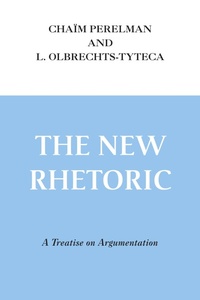
New Rhetoric, the
A Treatise on Argumentation
Published on 30. September 1991
576 pages
978-0-268-17509-2 (ISBN)
Description

The New Rhetoric is founded on the idea that since "argumentation aims at securing the adherence of those to whom it is addressed, it is, in its entirety, relative to the audience to be influenced," says Chaim Perelman and L. Olbrechts-Tyteca, and they rely, in particular, for their theory of argumentation on the twin concepts of universal and particular audiences: while every argument is directed to a specific individual or group, the orator decides what information and what approaches will achieve the greatest adherence according to an ideal audience. This ideal, Perelman explains, can be embodied, for example, "in God, in all reasonable and competent men, in the man deliberating or in an elite." Like particular audiences, then, the universal audience is never fixed or absolute but depends on the orator, the content and goals of the argument, and the particular audience to whom the argument is addressed. These considerations determine what information constitutes "facts" and "reasonableness" and thus help to determine the universal audience that, in turn, shapes the orator's approach.
The adherence of an audience is also determined by the orator's use of values, a further key concept of the New Rhetoric. Perelman's treatment of value and his view of epideictic rhetoric sets his approach apart from that of the ancients and of Aristotle in particular. Aristotle's division of rhetoric into three genres-forensic, deliberative, and epideictic-is largely motivated by the judgments required for each: forensic or legal arguments require verdicts on past action, deliberative or political rhetoric seeks judgment on future action, and epideictic or ceremonial rhetoric concerns values associated with praise or blame and seeks no specific decisions. For Aristotle, the epideictic genre was of limited importance in the civic realm since it did not concern facts or policies. Perelman, in contrast, believes not only that epideictic rhetoric warrants more attention, but that the values normally limited to that genre are in fact central to all argumentation. "Epideictic oratory," Perelman argues, "has significant and important argumentation for strengthening the disposition toward action by increasing adherence to the values it lauds." These values are central to the persuasiveness of arguments in all rhetorical genres since the orator always attempts to "establish a sense of communion centered around particular values recognized by the audience."
The adherence of an audience is also determined by the orator's use of values, a further key concept of the New Rhetoric. Perelman's treatment of value and his view of epideictic rhetoric sets his approach apart from that of the ancients and of Aristotle in particular. Aristotle's division of rhetoric into three genres-forensic, deliberative, and epideictic-is largely motivated by the judgments required for each: forensic or legal arguments require verdicts on past action, deliberative or political rhetoric seeks judgment on future action, and epideictic or ceremonial rhetoric concerns values associated with praise or blame and seeks no specific decisions. For Aristotle, the epideictic genre was of limited importance in the civic realm since it did not concern facts or policies. Perelman, in contrast, believes not only that epideictic rhetoric warrants more attention, but that the values normally limited to that genre are in fact central to all argumentation. "Epideictic oratory," Perelman argues, "has significant and important argumentation for strengthening the disposition toward action by increasing adherence to the values it lauds." These values are central to the persuasiveness of arguments in all rhetorical genres since the orator always attempts to "establish a sense of communion centered around particular values recognized by the audience."
Reviews / Votes
"Readers will find this volume a fascinating and firm first step toward the solution of some important philosophical problems."-Philosophy and Rhetoric"An important book, which should initiate re-estimation of the importance of a liberal art central to antiquity and the Renaissance, latterly eclipsed by the . . . logic of science and mathematics. . . . Dealing primarily with the written word, the authors analyze the constant and the variables in all argumentation, whether addressed to a universal audience or to one's self. Perelman claims that this work marks a break with a concept of reason which has dominated Western thought for three centuries. In 550 pages, he makes a good case for the claim." -The Key Reporter
"One of the best features of the book is that the authors have not merely described kinds of argument used in persuasive discourse, but have constantly shown how such arguments can be countered-and not merely by one's saying 'but that doesn't follow logically'. Even if we abandon the slogan 'deductive or defective' we are not required to abandon all criticism of nondeductive arguments. The non-logical has its own logic." -Mind
"An important work representing the recent increase of interest in rhetorical studies among Continental scholars. . . . The interest of philosophers of the rank of Perelman and Olbrechts-Tyteca in rhetoric marks a significant break from the influence of Ramus and Descartes upon Western philosophy's concept of reason and reasoning. An important work, highly recommended." -Choice
"It is difficult to see how any rhetorician, rhetorical critic, logician interested in verbal logic, or student of either philosophical or popular argument can claim full competence without familiarity with this work. It challenges the orthodoxies of all and suggests fresh modes of inquiry to all." -The Quarterly Journal of Speech
". . . a readable English translation of this highly influential work in which Perelman and Olbrechts-Tyteca point out historical and systematic inadequacies in much of contemporary logic and methodology." -The Review of Metaphysics
More details
Language
English
Place of publication
Notre Dame IN
United States
Target group
Professional and scholarly
Product notice
Reflowable
File size
1,28 MB
ISBN-13
978-0-268-17509-2 (9780268175092)
Copyright in bibliographic data and cover images is held by Nielsen Book Services Limited or by the publishers or by their respective licensors: all rights reserved.
Schweitzer Classification
Other editions
Additional editions
Book
09/1991
University of Notre Dame Press
€45.60
Shipment within 10-20 days
Book
10/1973
University of Notre Dame Press
€145.10
Shipment within 10-20 days
Persons
Chaim Perelman (1912-1984), a Polish-born philosopher of law, studied, taught, and lived most of his life in Brussels. He became the youngest full professor in the history of the Universite Libre de Bruxelles, where he remained for the rest of his career. He was among the most important argumentation theorists of the twentieth century. The New Rhetoric: A Treatise on Argumentation, written with Lucie Olbrechts-Tyteca in 1958, and translated into English by John Wilkinson and Purcell Weaver in 1969, is his chief work. He is also the author of The Realm of Rhetoric (University of Notre Dame Press, 1982).
L.Olbrechts-Tyteca (1899-1987) was a Belgian academic and longtime co-worker of Chaim Perelman. She volunteered in 1948 to support Perelman's work and developed several aspects of the New Rhetoric independently in later years.
L.Olbrechts-Tyteca (1899-1987) was a Belgian academic and longtime co-worker of Chaim Perelman. She volunteered in 1948 to support Perelman's work and developed several aspects of the New Rhetoric independently in later years.
Content
- Cover
- Title
- The New Rhetoric: A Treatise on Argumentation
- Copyright
- FOREWORD
- CONTENTS
- INTRODUCTION
- PART ONE: The Framework of Argumentation
- 1. Demonstration and Argumentation
- 2. The Contact of Minds
- 3. The Speaker and His Audience
- 4. The Audience as a Construction of the Speaker
- 5. Adaptation of the Speaker to the Audience
- 6. Persuading and Convincing
- 7. The Universal Audience
- 8. Argumentation Before a Single Hearer
- 9. Self-Deliberating
- 10. The Effects of Argumentation
- 11. The Epidictic Genre
- 12 . Education and Propaganda
- 13. Argumentation and Violence
- 14. Argumentation and Commitment
- PART TWO: The Starting Point of Argument
- CHAPTER 1: Agreement
- 15. The Premises of Argumentation
- 16. Facts and Truths
- 17. Presumptions
- 18. Values
- 19. Abstract Values and Concrete Values
- 20. Hierarchies
- 21. Loci
- 22. Loci of Quantity
- 23. Loci of Quality
- 24. Other Loci
- 25. Use and Systematization of Loci
- Classical Outlook and Romantic Outlook
- 26. Agreements of Certain Special Audiences
- 27. Agreements Particular to Each Discussion
- 28. Argumentation ad Hominem and Begging the Question
- CHAPTER 2: The Choice of Data and Their Adaptation for Argumentative Purposes
- 29. Selection of Data and Presence
- 30. The Interpretation of Data
- 31. The Interpretation of the Discourse and Its Problems
- 32. Choice of Qualifiers
- 33. On the Use of Notions
- 34. Clarification and Obscuration of Notions
- 35. Argumentative Usage and Plasticity of Notions
- CHAPTER 3: Presentation of Data and Form of the Discourse
- 36. Content and Form of the Discourse
- 37. Technical Problems in the Presentation of Data
- 38. Verbal Forms and Argumentation
- 39. Modalities in the Expression of Thought
- 40. Form of the Discourse and Communion with the Audience
- 41. Rhetorical Figures and Argumentation
- 42. Figures of Choice, Presence, and Communion
- 43. Status and Presentation of the Elements of the Argumentation
- PART THREE: Techniques of Argumentation
- 44. General Remarks
- CHAPTER 1: Quasi-Logical Arguments
- 45. The Characteristics of Quasi-Logical Argumentation
- 46. Contradiction and Incompatibility
- 47. Procedures for Avoiding Incompatibility
- 48. Techniques for Presenting Theses as Compatible or Incompatible
- 49. The Ridiculous and Its Role in Argumentation
- 50. Identity and Definition in Argumentation
- 51. Analyticity, Analysis, and Tautology
- 52. The Rule of Justice
- 53. Arguments of Reciprocity
- 54. Arguments by Transitivity
- 55. Inclusion of the Part in the Whole
- 56. Division of the Whole into Its Parts
- 57. Arguments by Comparison
- 58. Argumentation by Sacrifice
- 59. Probabilities
- CHAPTER 2: Arguments Based on the Structure of Reality
- 60. General Considerations
- 61. The Causal Link and Argumentation
- 62. The Pragmatic Argument
- 63. The Causal Link as the Relation of a Fact to Its Consequence or of a Means to Its End
- 64. Ends and Means
- 65. The Argument of Waste
- 66. The Argument of Direction
- 67. Unlimited Development
- 68. The Person and His Acts
- 69. Interaction of Act and Person
- 70. Argument from Authority
- 71. Techniques of Severance and Restraint Opposed to the Act-Person Interaction
- 72. The Speech as an Act of the Speaker
- 73. The Group and Its Members
- 74. Other Relations of Coexistence: Act and Essence
- 75. The Symbolic Relation
- 76. The Double Hierarchy Argument as Applied to Sequential Relations and Relations of Coexistence
- 77. Arguments Concerning Differences of Degree and of Order
- CHAPTER 3: The Relations Establishing the Structure of Reality
- 78. Argumentation by Example
- 79. Illustration
- 80. Model and Anti-Model
- 81. The Perfect Being as Model
- 82. What Is Analogy ?
- 83. Relations Between the Terms of an Analogy
- 84. Effects of Analogy
- 85. How Analogy Is Used
- 86. The Status of Analogy
- 87. Metaphor
- 88. Dormant Metaphors or Expressions with a Metaphorical Meaning
- CHAPTER 4: The Dissociation of Concepts
- 89. Breaking of Connect ing Links and Dissociation
- 90. The "Appearance-Reality" Pair
- 91. Philosophical Pairs and Their Justification
- 92. The Role of Philosophical Pairs and Their Transformations
- 93. The Expression of Dissociations
- 94. Statements Prompting Dissociation
- 95. Dissociative Definitions
- 96. Rhetoric as a Process
- CHAPTER 5: The Interaction of Arguments
- 97. Interaction and Strength of Arguments
- 98. Assessment of the Strength of Arguments as a Factor in Argumentation
- 99. Interaction by Convergence
- 100. Amplitude of the Argumentation
- 101. The Dangers of Amplitude
- 102. Offsetting the Dangers of Amplitude
- 103. Order and Persuasion
- 104. The Order of the Speech and Conditioning of the Audience
- 105. Order and Method
- CONCLUSION
- BIBLIOGRAPHY
- INDICES
- INDEX OF NAMES
- SUBJECT INDEX
