

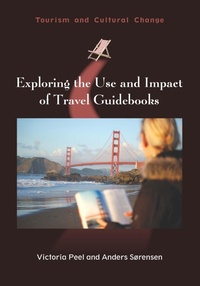
Exploring the Use and Impact of Travel Guidebooks
Published on 4. February 2016
256 pages
978-1-84541-565-5 (ISBN)
Description

This volume provides the first comprehensive examination of travel guidebooks and their conceptualisation, use and impact. Guidebooks have been key tourism paraphernalia for almost two centuries and although researched in some areas, academic knowledge on guidebooks in tourism has not been expansively communicated. The uncritical, unreflective and largely pejorative approach to guidebooks in the public sphere, and to some degree also present in academia, is reassessed in this book. This challenges the current limited tourism research approaches to the topic, including the routinely held assumption that the internet has all but destroyed the printed guidebook. This book will be a useful resource for postgraduate students and researchers in tourism and tourism communications and consumption.
Reviews / Votes
This book represents an ambitious exploration of one of the most pervasive and long standing requisites of tourism: the guidebook. It provides a comprehensive and critical review of contemporary research approaches addressing the entanglement of guidebooks with tourist experiences since the early days of mass tourism to digitalized travel. By combining conceptual insights with contextualized empirical enquiries, Peel and Sorensen offer a cutting-edge resource for advanced studies on tourism. * Szilvia Gyimothy, Aalborg University, Denmark * This is first class scholarship for two reasons. First, it is undoubtedly the best historic, semiotic, and literary ethnography of tourist guidebooks we have. Second, its analysis treats the question of tourists' understanding of the world with the conceptual and theoretical complexity it deserves. * Tom Selwyn, SOAS, University of London, UK * A refreshingly lucid, multifaceted exploration of the guidebook that advances the sociological analysis offered by MacCannell's reading of contemporary society. Peel and Sorensen eminently uncover how the guidebook influences tourists and tourism performances, the co-creation of tourism places and businesses as reflection of shifts in the overall tourism system. * Janne J. Liburd, University of Southern Denmark, Denmark * Peel and Sorensen have written a tightly constructed, well-written book that flows well and enhances the reader's understanding and enjoyment of the focus of the book. The chapters revolving around understanding tourists and their use of guidebooks were particularly beneficial to me. In conclusion, buy this book for the questions it answers and raises. You will be pleased with it as it does a very good job of lucidly delivering subject matter that is more complex than the average academic would expect. As with all well-written books, I left with a much greater understanding of the subject matter than which I began. I believe you will do and will do so in an enjoyable manner. -- Edward Udd, Radford University, USA * Annals of Leisure Research, 2016 *More details
Series
Language
English
Place of publication
Bristol
United Kingdom
Publishing group
Channel View Publications Ltd
Target group
Professional and scholarly
Product notice
Reflowable
ISBN-13
978-1-84541-565-5 (9781845415655)
Copyright in bibliographic data and cover images is held by Nielsen Book Services Limited or by the publishers or by their respective licensors: all rights reserved.
Schweitzer Classification
Other editions
Additional editions
Victoria Peel | Anders Sorensen
Exploring the Use and Impact of Travel Guidebooks
Book
02/2016
Channel View Publications
€55.60
Shipment within 10-20 days
Persons
Victoria Peel is a senior lecturer in cultural tourism management in the Graduate Tourism program hosted by the National Centre for Australian Studies, Monash University, Australia. Her research focuses on cultural tourism and the backpacker and student tourism markets.
Anders Sorensen is owner and manager of Tourismlab.dk, which provides tourism and hospitality research and consultancy and produces knowledge of tourism and tourists. His research interests include backpacker tourism, travel guidebooks and tourism in peripheral areas.
Anders Sorensen is owner and manager of Tourismlab.dk, which provides tourism and hospitality research and consultancy and produces knowledge of tourism and tourists. His research interests include backpacker tourism, travel guidebooks and tourism in peripheral areas.
Content
Chapter 1. Introduction: Travel Guidebooks and Tourism Discourse
Chapter 2. Conceptualising Travel Guidebooks
Chapter 3. Guidebook Histories
Chapter 4. Travel Guidebooks as Text
Chapter 5. According to the Guidebook: Exploring Lonely Planet's Australia
Chapter 6. 'Why I Love/Hate My Guidebook': Perspectives from the Blogosphere
Chapter 7. Slaves to the Guidebook? Exploring Guidebook Usage
Chapter 8. Towards a Typology of Guidebook Users
Chapter 9. Permission to Coast? Travel Guidebooks and Tourism Businesses
Chapter 10. 'Countdown to Doomsday'? Guidebook Agency in Destination Development
Chapter 11. Transformations in the Age of E-tourism: The End of the Guidebook as We Know It?
Chapter 12. The Stigma of Guidebooks: Causes and Questions
References
Chapter 2. Conceptualising Travel Guidebooks
Chapter 3. Guidebook Histories
Chapter 4. Travel Guidebooks as Text
Chapter 5. According to the Guidebook: Exploring Lonely Planet's Australia
Chapter 6. 'Why I Love/Hate My Guidebook': Perspectives from the Blogosphere
Chapter 7. Slaves to the Guidebook? Exploring Guidebook Usage
Chapter 8. Towards a Typology of Guidebook Users
Chapter 9. Permission to Coast? Travel Guidebooks and Tourism Businesses
Chapter 10. 'Countdown to Doomsday'? Guidebook Agency in Destination Development
Chapter 11. Transformations in the Age of E-tourism: The End of the Guidebook as We Know It?
Chapter 12. The Stigma of Guidebooks: Causes and Questions
References
