

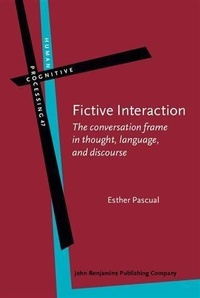
Fictive Interaction
The conversation frame in thought, language, and discourse
1st Edition
Published on 2. October 2014
XIV, 243 pages
978-90-272-6979-9 (ISBN)
Description

Language is intimately related to interaction. The question arises: Is the structure of interaction somehow mirrored in language structure and use? This book suggests a positive answer to this question by examining the ubiquitous phenomenon of fictive interaction, in which non-genuine conversational turns appear in discourse, even within clauses, phrases, and lexical items (e.g. "Not happy? Money back! guarantee"). The book is based on a collection of hundreds of examples of fictive interaction at all grammatical levels from a wide variety of spoken, written, and signed languages, and from many different discourse genres. Special attention is devoted to the strategic use of fictive interaction in legal argumentation, with a focus on high-profile criminal trials. Both trial lawyers and lay jurors often present material evidence or murder victims as speaking, and express emotions and intentions in conversational terms. The book thus establishes the role of the conversational turn-rather than the sentence-as the basic unit of language, and the role of conversation as a frame that structures cognition, discourse, and grammar.
More details
Other editions
Additional editions
Book
10/2014
John Benjamins Publishing Co
€100.70
Shipment within 10-15 days
Person
Content
- Fictive Interaction
- Editorial page
- Title page
- LCC data
- Dedication page
- Table of contents
- Tables and figures
- Acknowledgements
- Chapter 1. Introduction
- 1.1 Theoretical background
- 1.2 Fictive interaction
- 1.2.1 A communicative type of fictivity
- 1.2.2 Fictive interaction in different languages and discourse genres
- 1.3 Methodology
- 1.4 Book structure
- Part I. Forms and functions of fictive interaction
- Chapter 2. Fictive interaction
- 2.1 Inter-sentential fictive interaction
- 2.1.1 Topic
- 2.1.2 Focus
- 2.1.3 Relative clauses
- 2.1.4 Conditionals
- 2.2 Sentential fictive interaction
- 2.2.1 Fictive assertions
- 2.2.2 Fictive questions
- 2.2.3 Fictive commands
- 2.2.4 Fictive apologies, greetings, and politeness exchanges
- 2.3 Intra-sentential fictive interaction
- 2.3.1 The clausal level
- 2.3.2 The phrasal level
- 2.3.3 The lexical level
- 2.3.4 Theoretical discussion
- 2.4 Summary and conclusions
- Chapter 3. Direct speech compounds
- 3.1 Fictive interaction in compound modifiers
- 3.1.1 Database
- 3.1.2 Formal characteristics of the modifier
- 3.1.3 Pragmatic characteristics of the modifier
- 3.2 Setting up a fictive conversation
- 3.2.1 Metonymy
- 3.2.2 A fictive conversation as reference point
- 3.3 Creating a new category
- 3.4 Semantico-pragmatic types
- 3.4.1 Individual as communication participant
- 3.4.2 Type of communicative act
- 3.4.3 Means of communication
- 3.4.3.1 The medium is a text carrier
- 3.4.3.2 The medium is an entity
- 3.4.3.3 The medium is a physical act
- 3.4.3.4 The medium is a manner
- 3.4.4 Instrumentality
- 3.4.5 Mental or emotional state
- 3.4.5.1 Attitude or principle
- 3.4.5.2 Feeling
- 3.4.6 Time and space
- 3.4.7 Summary and discussion
- 3.5 Final remarks
- Chapter 4. From talk-in-interaction to grammar
- 4.1 Data
- 4.2 Direct speech for non-quotation: From multifunctionality to polysemy
- 4.2.1 Mental states
- 4.2.1.1 Oral languages
- 4.2.1.2 Chirographic languages
- 4.2.2 Emotional and attitudinal states
- 4.2.2.1 Oral languages
- 4.2.2.2 Chirographic languages
- 4.2.3 Desires, intentions and attempts
- 4.2.3.1 Oral languages
- 4.2.3.2 Chirographic languages
- 4.2.4 Causation
- 4.2.4.1 Oral languages
- 4.2.4.2 Chirographic languages
- 4.2.5 Reason or purpose
- 4.2.5.1 Oral languages
- 4.2.5.2 Chirographic languages
- 4.2.6 Actions and states of affairs
- 4.2.6.1 Oral languages
- 4.2.6.2 Chirographic languages
- 4.2.7 Tense
- 4.2.7.1 Oral languages
- 4.2.7.2 Chirographic languages
- 4.3 Discussion and conclusions
- PART II. Fictive interaction in criminal courts
- Chapter 5. It's like, why fictive interaction?
- 5.1 A fictive interaction construction
- 5.2 Data
- 5.3 Analysis
- 5.3.1 Speech and inferences from speech
- 5.3.2 Thoughts and decisions
- 5.3.3 Emotions and attitudes
- 5.3.4 Intentions and actions
- 5.4 Discussion and conclusions
- Chapter 6. The trial as fictive trialogue
- 6.1 Courtroom interaction
- 6.2 Many communicative events as one
- 6.2.1 Debate with Kant
- 6.2.2 Legal monologues and dialogues as fictive trialogues
- 6.3 The inferable as speaking
- 6.3.1 The speaking cross
- 6.3.2 The speaking evidence
- 6.4 The final decision as a moralistic address
- 6.4.1 "Voting as Speaking"
- 6.4.2 The jury's verdict as an audible message
- 6.5 Fictive interaction as a fundamental cognitive process
- 6.6 Conclusion
- Chapter 7. Triadic questions in court
- 7.1 Questions in court
- 7.2 Data
- 7.3 Legal trialogues and triadic questions
- 7.4 Analysis
- 7.4.1 Triadic expository questions
- 7.4.2 Constructed rhetorical question, asked and answered
- 7.4.3 A triadic how-to definition
- 7.4.4 Fictive embedded question, obvious answer
- 7.5 Summary and conclusions
- Chapter 8. Concluding remarks
- 8.1 Implications
- 8.2 Avenues for future research
- References
- Appendix 1: Sources for examples in Parts I and II
- Chapter 1
- Chapter 2
- Chapter 3
- Text
- Footnotes
- Chapter 4
- Chapter 5
- Chapter 6
- Appendix 2: Codes for ethnographic data in Part II
- Appendix 3: Abbreviations for interlinear glosses
- Author index
- Language index
- Subject index
