

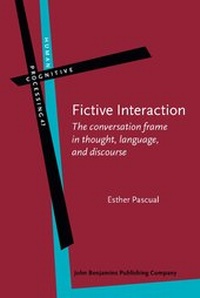
Fictive Interaction
The conversation frame in thought, language, and discourse
Published on 2. October 2014
Book
Hardback
243 pages
978-90-272-4663-9 (ISBN)
Description
Language is intimately related to interaction. The question arises: Is the structure of interaction somehow mirrored in language structure and use? This book suggests a positive answer to this question by examining the ubiquitous phenomenon of fictive interaction, in which non-genuine conversational turns appear in discourse, even within clauses, phrases, and lexical items (e.g. "Not happy? Money back! guarantee"). The book is based on a collection of hundreds of examples of fictive interaction at all grammatical levels from a wide variety of spoken, written, and signed languages, and from many different discourse genres. Special attention is devoted to the strategic use of fictive interaction in legal argumentation, with a focus on high-profile criminal trials. Both trial lawyers and lay jurors often present material evidence or murder victims as speaking, and express emotions and intentions in conversational terms. The book thus establishes the role of the conversational turn-rather than the sentence-as the basic unit of language, and the role of conversation as a frame that structures cognition, discourse, and grammar.
More details
Series
Language
English
Place of publication
Amsterdam
Netherlands
Target group
Professional and scholarly
Illustrations
+ index
Weight
615 gr
ISBN-13
978-90-272-4663-9 (9789027246639)
Copyright in bibliographic data and cover images is held by Nielsen Book Services Limited or by the publishers or by their respective licensors: all rights reserved.
Schweitzer Classification
Other editions
Additional editions
E-Book
10/2014
1st Edition
John Benjamins Publishing Company
€118.99
Available for download
Person
Content
1. Tables and figures; 2. Acknowledgements; 3. Chapter 1. Introduction: Language, interaction, and cognition; 4. Chapter 2. Fictive interaction: The conversation frame in discourse and grammar; 5. Chapter 3. Direct speech compounds: On the dialogue-morphology interface; 6. Chapter 4. From talk-in-interaction to grammar: A cross-linguistic study of fictive interaction; 7. Chapter 5. It's like, why fictive interaction?: Multifunctional direct speech in a jury deliberation; 8. Chapter 6. The trial as fictive trialogue: Fictive interaction imagery in legal argumentation; 9. Chapter 7. Triadic questions in court: Searching for answers about legal "truth"; 10. Chapter 8. Concluding remarks; 11. References; 12. Appendix 1: Sources for examples in Parts I and II; 13. Appendix 2: Codes for ethnographic data in Part II; 14. Appendix 3: Abbreviations for interlinear glosses; 15. Author index; 16. Language index; 17. Subject index