

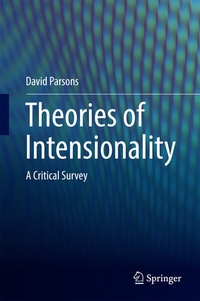
Theories of Intensionality
Description

This book offers a comprehensive primer for the study of intensionality. It explores and assesses those key theories of intensionality which have been developed in the twentieth and early twenty-first centuries. Each of the examined theories is tested as to whether it can account for the problems associated with (A) the intersubstitution salva veritate of co-extensional expressions, and (B) existential generalisation. All of these theories are subsequently compared so as to determine which of them comes closest to successfully solving these problems.
The book examines four kinds of intensionalist approaches: the Fregean approach (including Church's formalisation of Frege's theory); the possible-worlds approaches of Carnap, Montague and Cresswell; the theory of properties relations and propositions devised by Bealer; and the Meinongian approaches put forward by Zalta and Priest.
The book also proposes an alternative to intensionalism: sententialism. Sententialists argue that the problems of intensionality could be solved by appealing to linguistic items (usually sentences) rather than intensional entities. Drawing on the works of Quine, Davidson, Scheffler and R. M. Martin, it explores the viability and value of sententialism as an alternative to intensionalism.
Reviews / Votes
"Assessing each of the theories specifically through the lens of how well it grounds and clarifies the logical issues is already a major and valuable accomplishment. From that perspective, the book fulfills its goals impressively." (Michael Sheard, Mathematical Reviews, July, 2019)More details
Other editions
Additional editions
Person
David Parsons completed a Bachelor of Arts in Philosophy at the Australian Catholic University. His Honours thesis was recognised with First Class honours and the University medal. In 2014, he received a Doctor of Philosophy from the University of Queensland for his thesis on Intensional Logics and Their Rivals.
Content
1 Introduction.- 2 Frege's Theory of Sinn and Bedeutung.- 3 Church's Logic of Sense and Denotation.- 4 Carnap's Method of Extension and Intension.- 5 Montague's Possible-Worlds Approach.- 6 Cresswell's Theory of Structured Meanings.- 7 Bealer's Theory of Properties, Relations and Propositions.- 8 Zalta's Meinongian Approach.- 9 Priest's Noneist Approach.- 10 Quine's Sententialism.- 11 Davidson's Paratactic Approach.- 12 Scheffler's Inscriptionalism.- 13 An Inscriptional Meta-Language.
