

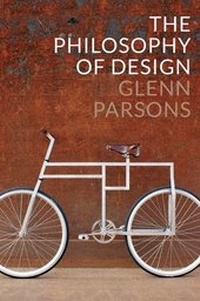
The Philosophy of Design
Description

Reviews / Votes
"This very readable and illuminating book is a must-have for designers and the students of design." Oxford JournalMore details
Other editions
Additional editions
Person
Content
1
What is Design?
When it comes to questions about design, perhaps the most fundamental one of all is simply: "What is it?" One way to respond to this question would be to pick out examples of design. With a visit to a design website, or a flip through a design magazine, we could easily point to some objects that are widely recognized as products of contemporary design: the Apple iPod, the Eames chair, Mies van der Rohe's Farnsworth House or Alessi's famous Juicy Salif citrus juicer. But identifying some examples of design does not really answer our question in a fully satisfying way. When we ask "What is design?," we want to understand what makes the production of these things, and others like them, instances of design. We would like to discover, in other words, the nature of the concept rather than mere examples of it. In this chapter, I take up this challenge, and examine some attempts to define the activity of design.1
Some concepts are hard to understand because the things that they refer to are unfamiliar: concepts such as God, infinity and the Big Bang do not correspond in any obvious way to the things we encounter in daily experience. Thus we struggle to discern their meaning. When it comes to the concept of design, however, this is not a difficulty we face. As we will see, with design, we run up against the opposite problem: the concept of design seems to refer to too much of what we experience, rather than too little (Heskett 2005, 3-5).
1.1 Defining "Design"
Before we examine some potential definitions of "design," we should first discuss the kind of definition we are seeking. When philosophers attempt to understand a concept, they typically look for a particular sort of definition, which we can call simply a "philosophical definition."2 This consists of a set of conditions that are individually necessary, and jointly sufficient, for being an instance of the concept. A condition that is necessary for being an instance of a concept specifies possession of a feature that any instance of the concept must have. For instance, "being unmarried" is a necessary condition for the concept "bachelor" since to be a bachelor something must be, as a matter of necessity, unmarried. A condition or set of conditions is sufficient for being an instance of a concept when anything that satisfies it must be, as a matter of necessity, an instance of the concept. Thus, the conditions "unmarried," "adult human" and "male" are together jointly sufficient for the concept "bachelor," since anything that satisfies these conditions has, of necessity, to be a bachelor. A definition of a concept that specifies a set of conditions that are individually necessary, and jointly sufficient, for being an instance of that concept has the special property of picking out all and only the instances of that concept. In doing so, it provides us with the "essence" of the concept, allowing us to understand it in a particularly satisfying way. Take, for example, the definition of "bachelor" as an unmarried adult male human being. This tells us precisely what bachelorhood consists in, and allows us to understand why any given thing is a bachelor or not one.
In seeking a definition of "design," perhaps the most instinctive thing to do is simply look in the dictionary. But dictionary definitions rarely measure up as definitions in the philosophical sense we have outlined. Take, as an example, the concept of art. We recognize instances of this concept easily enough: performances by symphony orchestras, the paintings of Picasso, the novels of James Joyce, and so on. And we can distinguish these instances of art from things that are not art, such as mailboxes, desks and grocery lists. The Oxford English Dictionary defines "the Arts" as "the various branches of creative activity concerned with the production of imaginative designs, sounds, or ideas." This definition is helpful in pointing us in the right direction, but it doesn't capture the essence of the concept. This is because, while the production of imaginative designs, sounds or ideas may be necessary for engaging in the arts, it clearly isn't sufficient: a politician with an imaginative idea for reforming the city budget, or an engineer who creates a new cooling system for a factory, is not engaging in the arts.
The dictionary tries to reinforce its definition by attaching to it a list of examples: "painting, music, and writing." This list is meant to suggest the distinction that we need here, since it does not include activities such as legislating, accounting and engineering. However, the list, and the definition more generally, offers us no basis for this distinction. Surely there is some reason why the imaginative productions of symphonic music are art, and those of accounting are not, but the dictionary definition fails to tell us what this could be. Thus, since it fails to specify a set of conditions that are individually necessary and jointly sufficient for being a work of art - that is, an essence - the dictionary definition does not allow us to fully understand the nature of art in the way a philosophical investigation of it would demand. For these reasons, philosophers interested in understanding the nature of art must move beyond dictionary definitions and work out philosophical definitions of the concept (for an overview of efforts in this area, see Stecker 2003). If, then, we seek to understand the nature of design, this is the project we must also undertake.
The search for philosophical definitions, or "conceptual analysis," as philosophers sometimes call it, is by no means uncontroversial.3 Some philosophers have been skeptical that such definitions can be found, and this skepticism has been influential in thinking about design (see, e.g., Walker 1989). The philosopher Jane Forsey, for example, rejects the possibility of a philosophical definition, or essence, for design, on the grounds that design is a phenomenon that evolves historically. In her view, this leads to two undesirable consequences. First, any philosophical definition is bound to fail once the phenomenon changes, as it inevitably will. Second, once the definition faces these inevitable counterinstances, the philosopher can only ignore them, "unconcerned with the objects that may then fall by the wayside of his theoretical ambition" (2013, 13).
However, both of Forsey's points are over-stated. The fact that a phenomenon changes does not entail that it changes its essential properties: cars are faster than they were 80 years ago, but this would hardly be a reason to rethink our definition of "automobile." Second, a philosopher who offers a philosophical definition for some phenomenon need not cling to it no matter what happens in the world around him: he may simply determine that the old concept is no longer in use, and offer a philosophical definition of the new one in play. In short, there is nothing in the historical nature of design to rule out philosophical definition.4
With this in mind, let us examine some definitions of design that have been offered by theorists writing on the subject. One important group of definitions is based on the idea that everything we do is design. The design theorist Victor Papanek, for example, wrote, "All men are designers. All that we do, almost all the time, is design" (Papanek 1971, 23; see also Nelson and Stolterman 2012). Design is, in his view, "the primary underlying matrix of life," and includes not only the production of machines, buildings and so on, but even mundane actions such as cleaning your desk drawer and baking a pie. In a similar vein, Henry Petroski says, "Designed things are the means by which we achieve desired ends" (Petroski 2006, 48). This definition includes even natural things that are appropriated by humans, with little or no modification, for use in pursuing some aim. A shell used to scoop water for drinking, for example, counts as a designed object by Petroski's lights. As he puts it, "mere selection for a purpose made [it] designed." On these definitions, designing is understood as nothing more than using things to achieve our aims.5
As philosophical definitions, however, these accounts are clearly problematic. Of course, there are some similarities between an everyday process like baking a pie and the process that produced the iPod, the Juicy Salif and the Eames chair. On the other hand, there are also differences, and we do distinguish between the two: it would be strange to call someone who baked a pie a "designer," for example. As a matter of fact, in our everyday thinking we distinguish design from all sorts of other activities in which we use things to achieve our aims: art, science, sports, war, as well as mundane activities such as cleaning and using sticks to draw in the sand. Given that we do make this distinction, we would like to understand the basis for it. But definitions such as "Design is using things to achieve our ends" can offer us no such understanding, since they simply ignore the distinction altogether (Love 2002). Put in more philosophical terms, the problem is that using things to achieve our aims is not sufficient for design.6
This raises an interesting question: Why are theorists drawn to...
