

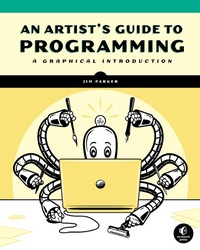
An Artist's Guide to Programming
A Graphical Introduction
Published on 7. June 2022
248 pages
978-1-7185-0165-2 (ISBN)
Description

Learn to program with visual examples. Programs increase in complexity as you progress - from drawing a circle to 3D graphics, animations, and simulations.
A Graphical Introduction to Programming teaches computer programming with the aid of 100 example programs, each of which integrates graphical or sound output. The Processing-language-based examples range from drawing a circle and animating bouncing balls to 3D graphics, audio visualization, and interactive games.
Readers learn core programming concepts like conditions, loops, arrays, strings and functions, as well as how to use Processing to draw lines, shapes, and 3D objects. They'll learn key computer graphics concepts like manipulating images, animating text, mapping textures onto objects, and working with video. Advanced examples include sound effects and audio visualization, network communication, 3D geometry and animation, simulations of snow and smoke, predator-prey populations, and interactive games.
A Graphical Introduction to Programming teaches computer programming with the aid of 100 example programs, each of which integrates graphical or sound output. The Processing-language-based examples range from drawing a circle and animating bouncing balls to 3D graphics, audio visualization, and interactive games.
Readers learn core programming concepts like conditions, loops, arrays, strings and functions, as well as how to use Processing to draw lines, shapes, and 3D objects. They'll learn key computer graphics concepts like manipulating images, animating text, mapping textures onto objects, and working with video. Advanced examples include sound effects and audio visualization, network communication, 3D geometry and animation, simulations of snow and smoke, predator-prey populations, and interactive games.
More details
Other editions
Additional editions
Book
06/2022
No Starch Press
€33.00
Shipment within 3-4 weeks
Person
Jim Parker is a professor, author, and artist. He has published a dozen books and over 170 technical papers, and also writes short stories. He has degrees in mathematics and computer science, and holds a PhD from the State University of Ghent, Belgium. Parker has exhibited generative art and even sent art into space.
