

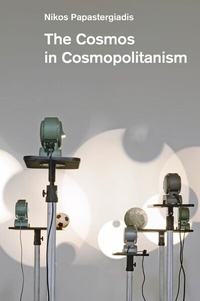
The Cosmos in Cosmopolitanism
Description

Rather than discarding the idea of cosmopolitanism, Nikos Papastergiadis seeks to reinvigorate it by examining the ways in which visual artists have explored themes associated with the cosmos. Kant regarded cosmopolitanism as the goal for humanity, but he turned his attention away from the connection to the cosmos and directed it toward the practical rules for peaceful co-existence. However, these two concerns are not in conflict. Today a new vision of the cosmos is being developed by artists, among others - one that brings together the cosmos and the polis. Scholars from the South are decolonizing the mindset which divided the world and split us from our common connections, while others are using art to highlight the existential threats we now face as a species.
By developing a distinctive form of aesthetic cosmopolitanism, this book shows that the idea of the cosmos is more important than ever today, and vital for our attempts to rethink our place as one species among others in a universe that extends far beyond our world.
More details
Other editions
Additional editions
Content
1 Introduction: A Constellation for Cosmopolitanism in Seven Points
Part 1 Cosmos in Antiquity
2 Cosmopolitanism in Antiquity
3 Stoic lives and the places of Cosmopolitanism
4 Cosmopolis and Physics of Cosmic Fire
Part 2 Closing Apertures: Fading Cosmos and Rising Anthropos
5 From St Paul to the Enlightenment
6 Kant: Cosmopolitanism or the Graveyard
Part 3 From the Moral Imperative to the Creative Constitutive
7 After Kant: Political Philosophy for Cosmopolitanism - Habermas and Derrida
8 After Kant: Political Philosophy against Cosmopolitanism - Sloterdijk and Mouffe
9 Cosmos Perduring in Art
10 Cosmos from the Global South: From Subaltern to Decolonial Perspectives
11 Cosmos for the World
12 Epilogue: Cosmic Fire and Liquid Polis
1
Introduction: A Constellation for Cosmopolitanism in Seven Points
Is cosmopolitanism a real and implicit part of everyday life? Alternately, is it, at best, an ideal against which we measure our human shortcomings, and at worst a delusional fantasy? What are the ways in which cosmopolitanism has been represented throughout the history of philosophy? How has the idea been tied to other artistic and political practices? In what ways is it linked to the social changes brought on by new patterns of mobility, global networks for commercial interdependence and ascendent technologies of digital communication? Is there only one form of cosmopolitanism, or does each culture imagine a different version? How does cosmological thinking shape our understanding of cosmopolitanism? Is the impulse of eros and creation linked to hospitality and cosmopolitanism?
These are the core questions that will drive this book. It is my contention, that cosmopolitanism is not just an empty abstraction but a living phenomenon. Sociologists such as Ulrich Beck (2006) argued that evidence of demographic and cultural changes was already indicating that cosmopolitanism was a social reality. Beck went so far as to describe the process of contemporary changes through the new verb - cosmopolitanization. In the past few decades there has been a plethora of new modifiers of cosmopolitanism - discrepant cosmopolitanism (Clifford 1992), subaltern cosmopolitanism (Mignolo 2000), vernacular cosmopolitanism (Werbner 2006), visceral cosmopolitanism (Nava 2007), indigenous cosmopolitanism (Mendieta 2009), diasporic cosmopolitanism (Glick-Schiller 2012). This is not only testament to the effort to wrestle the contemporary valency away from the traditional, elitist, patrician, and imperialistic versions of cosmopolitanism, but also part of an empirical project to demonstrate that cosmopolitanism is a productive prism for understanding ethics (Appiah 2006), citizenship (Held 1995) and belonging (Hall 2002) in the contemporary world. Consequently, the editors of a new collection of scholarly essays have claimed that there is an urgent need to develop a new transdisciplinary approach that can address cosmopolitanism "based on reciprocal comparison and the negotiation of performable values founded upon the potential improvement of human well-being and the sustainability of human life in accordance with its natural milieu" (Coste, Kkona, & Pireddu 2022: 6). This stretches cosmopolitanism across a vast terrain. The editors of an earlier collection had noted the conceptual incompleteness of cosmopolitanism. However, they proclaimed that any frustration over the indeterminacy of the term was to be taken forthwith as a spur to galvanize future possibilities, and therefore the fullness of its meaning was to be left open; the term could remain in a productive state that was always "yet to come" (Breckenridge, Pollock, Bhabha & Chakrabarty 2002: 4).
Although I lean in favor of these affirmative arguments my aim is not to prove the dependence of cosmopolitanism on ascendant communication technologies, the intensification of migration patterns, or even the widening of institutional frameworks. I believe that it is also reliant on something more fundamental - the sensory experience of companionship with the cosmos. This idea does not fit neatly into the existing moral, political, and sociological perspectives that are used for framing cosmopolitanism (Luek 2014). In this book I have added a fourth category: aesthetic cosmopolitanism. My wider aim is to address the cosmopolitan impulse for care, curiosity, and connection that extends from human fellowship and reaches all the way to the cosmos.
In antiquity the cosmos was the crown in an all-pervasive view of life and creation. Humanity and the cosmos were not aliens to each other, but part of an integrated whole. By being attuned to the cosmos humans could fulfill their nature - physis. The laws - nomos - of the polis were deemed just when they were in harmony with the cosmos. Christian theologians splintered this cosmic unity. Instead of a vibrant companionship with the cosmos there was a subdued position. Instead of the harmonics of continuum that was expressed by ancient philosophers the Christians inserted a duality between the celestial and the terrestrial, the body and soul, the visible materiality and invisible ideality. The cosmos was no longer a fragment that was in us, but a deferred state, one which we may gain access to if we submit to a life of privations. As pilgrims on the earth Christians were obliged to conform to the tangible laws of the polis - world - but also withdraw into an intangible journey that would lead to salvation in the next world - cosmos. Real life was in the future cosmos. The world of the now was mere illusion. The modern philosophers of the Enlightenment moved away from this dogma. A different vision of human agency was delivered, and a new faith was placed in the regulative function of legal, social, and political institutions. As cosmopolitan ideals were incorporated into specialist debates on human rights and global culture, it seemed that it was coming closer to the ground of here and now. Just before the turn of the millennium Ulrich Beck was convinced that not only was society increasingly undergoing a process of cosmopolitanization, but that a new global liberal-cosmopolitan democracy was becoming a realistic ideal (Beck 2006).
David Held also advocated for the expansion of liberal democratic values and procedures into a cosmopolitan framework. He argued that a new form of cosmopolitan democracy was possible if it involved both the formal recognition of every human being as a world citizen and the creation of a world parliament (Held 1995). In short, cosmopolitanism is good for democracy. Jürgen Habermas and Jacques Derrida shared this view. Habermas was committed to reforming transnational institutions, and while Derrida also remained optimistic, he adopted a more ambivalent position as he stressed that cosmopolitanism was caught in a double bind. There are also political philosophers who take a more dismissive view. They blame cosmopolitanism as being complicit with the alienating sense of placelessness and providing a justification for corporate expansion. From both positions, the outlook is rather bleak. At best, the modern trajectory in the philosophy on cosmopolitanism has sought to define the ground for universal rights and institutional safety nets and legitimate a wider frame for cross-cultural exchange. However, in the process of grounding philosophical ideals into the normative practice of governance, philosophy has diverted its gaze from the wider spheres of cosmological thinking. All too often we are left with either a melancholic hope for the renewal of ideals or a depressing account of the regressive tendencies. If we stress the idealism of cosmopolitanism, then its grip on reality is lost, and if it is interwoven with institutional life, then the beautiful dream is ruined.
In my view, artists have often insisted that the process of artistic creation is an expression of the connection with the cosmos. By hanging on to a belief in the companionship between creation and cosmos they also offer a different view on the double bind between cosmopolitan norms and ideals. Following from this assertion, we can identify a clearer distinction between the aesthetic and normative viewpoints on cosmopolitanism. Aesthetic approaches privilege the link between cosmos and creation in cosmopolitanism, while normative approaches focus on the moral rules for cosmopolitan governance. I sum up this distinction by defining aesthetic cosmopolitanism through the creative constitutive and argue that normative cosmopolitanism was directed toward the moral imperative.
This book takes inspiration from the bold aesthetic claims about the possibilities that another cosmos exists in art. It accepts that art can extend our thought and imagination beyond the spaces in which politics and philosophy tend to dwell. The challenge that follows from these claims is to then see how we can bridge these worlds. The radical idea of the Stoics rested on the presumption that democracy could be extended beyond the polis to the cosmos. In Kant and Habermas, we see how this cosmic idea was translated "down" toward the norms for the Earth. Let me therefore begin by laying out my definition of its meaning and scope, as well as introducing the difference between normative and aesthetic frameworks, and indicate parallels to the decolonial critique and scientific ideas in new physics.
Defining the Cosmos
When Socrates said that he was not just a citizen of Athens but also a citizen of the cosmos, he was also stating that his ultimate home was in his fellowship with the wise. At that time, it was accepted that the wise, or the sages, resided not on this terrestrial planet, but in a sphere that was known as the cosmos.
The earliest recorded expressions of universal belonging and human fellowship were found in texts from ancient Egypt, China, Greece, and India. These surviving references are confined to tiny fragments. Yet they seem to have been part of a wider exploration. As philosophers and poets wondered about the origins of creation they looked to the skies and speculated on a link between the sublime cosmos that was out there and the creative imagination in here. Priests and emperors then hijacked this imaginary continuum between the cosmos and humanity. By elevating themselves as mediators for the rest of their people they also pronounced themselves as gatekeepers to the cosmos. Being the exclusive...
