

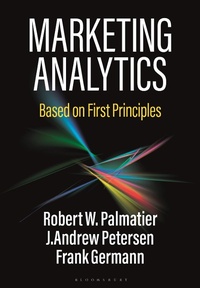
Marketing Analytics
Based on First Principles
1st Edition
Published on 24. March 2022
432 pages
978-1-350-31840-3 (ISBN)
Description

All customers differ. All customers change. All competitors react. All resources are limited.
Robert W. Palmatier's dynamic First Principles of Marketing framework provides the structure for this research-based, action-orientated guide to organizing analytics tools, marketing models and methodologies.
When should you use a specific technique in data analytics? How does each new analytics technique improve performance? Which techniques are worth time and investment to implement?
As organizations prioritize digital growth to better connect with customers, it is vital that you are able to respond confidently to these questions, enabling you to utilize marketing analytics to better understand your business and increase revenue.
Marketing Analytics will help you to:
· Learn how to contextualize models and statistical analysis within the foundational principles of marketing through the use of a problem-centric framework.
· Understand technical analyses by engaging with a pertinent range of vivid examples, and a running case study to contextualize practical, jargon-free descriptions.
· Embark on an applied learning pathway with a comprehensive companion website including datasets and walk-through videos on challenging tasks: bloomsbury.pub/marketing-analytics.
· Take a software-agnostic approach to learning, enhanced by the provision of examples in free, open-source R and Tableau software.
Authored by world-leading experts in marketing strategy, Marketing Analytics is the ideal textbook for advanced undergraduate, postgraduate and MBA students of marketing, and practitioners seeking to direct effective strategy from an analysis-based evidential approach.
Robert W. Palmatier's dynamic First Principles of Marketing framework provides the structure for this research-based, action-orientated guide to organizing analytics tools, marketing models and methodologies.
When should you use a specific technique in data analytics? How does each new analytics technique improve performance? Which techniques are worth time and investment to implement?
As organizations prioritize digital growth to better connect with customers, it is vital that you are able to respond confidently to these questions, enabling you to utilize marketing analytics to better understand your business and increase revenue.
Marketing Analytics will help you to:
· Learn how to contextualize models and statistical analysis within the foundational principles of marketing through the use of a problem-centric framework.
· Understand technical analyses by engaging with a pertinent range of vivid examples, and a running case study to contextualize practical, jargon-free descriptions.
· Embark on an applied learning pathway with a comprehensive companion website including datasets and walk-through videos on challenging tasks: bloomsbury.pub/marketing-analytics.
· Take a software-agnostic approach to learning, enhanced by the provision of examples in free, open-source R and Tableau software.
Authored by world-leading experts in marketing strategy, Marketing Analytics is the ideal textbook for advanced undergraduate, postgraduate and MBA students of marketing, and practitioners seeking to direct effective strategy from an analysis-based evidential approach.
More details
Edition
1. Auflage
Language
English
Place of publication
London
United Kingdom
Publishing group
Bloomsbury Publishing PLC
ISBN-13
978-1-350-31840-3 (9781350318403)
Copyright in bibliographic data and cover images is held by Nielsen Book Services Limited or by the publishers or by their respective licensors: all rights reserved.
Schweitzer Classification
Other editions
Additional editions
Robert W. Palmatier | J. Andrew Petersen | Frank Germann
Marketing Analytics
Based on First Principles
Book
03/2022
Bloomsbury Academic
€105.20
Shipment within 15-20 days
Persons
Robert W. Palmatier is Professor of Marketing, and John C. Narver Chair of Business Administration at the University of Washington, USA.
Frank Germann is Associate Professor of Marketing at the University of Notre Dame, USA.
J. Andrew Petersen is an Associate Professor of Marketing at the Pennsylvania State University, USA.
Frank Germann is Associate Professor of Marketing at the University of Notre Dame, USA.
J. Andrew Petersen is an Associate Professor of Marketing at the Pennsylvania State University, USA.
Content
Chapter 1 - Introduction to Marketing Analytics Based on First Principles
PART ONE - ALL CUSTOMERS DIFFER
Chapter 2 - Understanding Marketing Principles #1: All Customers Differ
Chapter 3 - Cluster Analysis for Segmentation
Chapter 4 - Discriminant Analysis for Targeting and Classification
Chapter 5 - Perceptual and Preference Mapping for Competitive Positioning
PART TWO - ALL CUSTOMERS CHANGE
Chapter 6 - Understanding Marketing Principle #2: All Customers Change
Chapter 7 - RFM Analysis
Chapter 8 - Logistic Regression
Chapter 9 - Customer Lifetime Value
PART THREE - ALL COMPETITORS REACT
Chapter 10 - Understanding Marketing Principle #3: All Competitors React
Chapter 11 - Survey Design and Testing to Derive Customer Insights
Chapter 12 - Conjoint Analysis for Product and Pricing Decisions
Chapter 13 - Forecasting Sales for New Products
PART FOUR - ALL RESOURCES ARE LIMITED
Chapter 14 - Understanding Marketing Principle #4: All Resources are Limited
Chapter 15 - Using Marketing Mix Models to Optimize the Marketing Mix
Chapter 16 - Using Marketing Experiments to Optimize the Marketing Mix
Chapter 17 - Using Topic Models to Glean Customer Insights
PART ONE - ALL CUSTOMERS DIFFER
Chapter 2 - Understanding Marketing Principles #1: All Customers Differ
Chapter 3 - Cluster Analysis for Segmentation
Chapter 4 - Discriminant Analysis for Targeting and Classification
Chapter 5 - Perceptual and Preference Mapping for Competitive Positioning
PART TWO - ALL CUSTOMERS CHANGE
Chapter 6 - Understanding Marketing Principle #2: All Customers Change
Chapter 7 - RFM Analysis
Chapter 8 - Logistic Regression
Chapter 9 - Customer Lifetime Value
PART THREE - ALL COMPETITORS REACT
Chapter 10 - Understanding Marketing Principle #3: All Competitors React
Chapter 11 - Survey Design and Testing to Derive Customer Insights
Chapter 12 - Conjoint Analysis for Product and Pricing Decisions
Chapter 13 - Forecasting Sales for New Products
PART FOUR - ALL RESOURCES ARE LIMITED
Chapter 14 - Understanding Marketing Principle #4: All Resources are Limited
Chapter 15 - Using Marketing Mix Models to Optimize the Marketing Mix
Chapter 16 - Using Marketing Experiments to Optimize the Marketing Mix
Chapter 17 - Using Topic Models to Glean Customer Insights
