

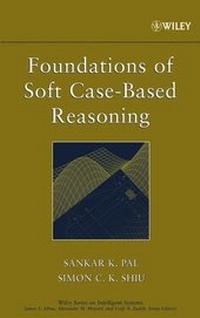
Foundations of Soft Case-Based Reasoning
Description

Reviews / Votes
"'Authored by prominent information scientists...it breaks newground in case-based reasoning and it is likely to be viewed inretrospect as a milestone it its field.' I fully agree with thisassessment." (International Journal of General Systems, June2005) "...well-written and self-contained...can be used bystudents who want to learn newtechniques...practitioners...[and] researchers..."(Journal of Intelligent & Fuzzy Systems, Vol. 16, No. 2,2005)More details
Other editions
Additional editions

Persons
Content
PREFACE.
ABOUT THE AUTHORS.
1 INTRODUCTION.
1.1 Background.
1.2 Components and Features of Case-Based Reasoning.
1.2.1 CBR System versus Rule-Based System.
1.2.2 CBR versus Human Reasoning.
1.2.3 CBR Life Cycle.
1.3 Guidelines for the Use of Case-Based Reasoning.
1.4 Advantages of Using Case-Based Reasoning.
1.5 Case Representation and Indexing.
1.5.1 Case Representation.
1.5.2 Case Indexing.
1.6 Case Retrieval.
1.7 Case Adaptation.
1.8 Case Learning and Case-Base Maintenance.
1.8.1 Learning in CBR Systems.
1.8.2 Case-Base Maintenance.
1.9 Example of Building a Case-Based Reasoning System.
1.9.1 Case Representation.
1.9.2 Case Indexing.
1.9.3 Case Retrieval.
1.9.4 Case Adaptation.
1.9.5 Case-Base Maintenance.
1.10 Case-Based Reasoning: Methodology or Technology?
1.11 Soft Case-Based Reasoning.
1.11.1 Fuzzy Logic.
1.11.2 Neural Networks.
1.11.3 Genetic Algorithms.
1.11.4 Some CBR Tasks for Soft Computing Applications.
1.12 Summary.
References.
2 CASE REPRESENTATION AND INDEXING.
2.1 Introduction.
2.2 Traditional Methods of Case Representation.
2.2.1 Relational Representation.
2.2.2 Object-Oriented Representation.
2.2.3 Predicate Representation.
2.2.4 Comparison of Case Representations.
2.3 Soft Computing Techniques for Case Representation.
2.3.1 Case Knowledge Representation Based on Fuzzy Sets.
2.3.2 Rough Sets and Determining Reducts.
2.3.3 Prototypical Case Generation Using Reducts with Fuzzy Representation.
2.4 Case Indexing.
2.4.1 Traditional Indexing Method.
2.4.2 Case Indexing Using a Bayesian Model.
2.4.3 Case Indexing Using a Prototype-Based Neural Network.
2.4.4 Case Indexing Using a Three-Layered Back Propagation Neural Network.
2.5 Summary.
References.
3 CASE SELECTION AND RETRIEVAL.
3.1 Introduction.
3.2 Similarity Concept.
3.2.1 Weighted Euclidean Distance.
3.2.2 Hamming and Levenshtein Distances.
3.2.3 Cosine Coefficient for Text-Based Cases.
3.2.4 Other Similarity Measures.
3.2.5 k-Nearest Neighbor Principle.
3.3 Concept of Fuzzy Sets in Measuring Similarity.
3.3.1 Relevance of Fuzzy Similarity in Case Matching.
3.3.2 Computing Fuzzy Similarity Between Cases.
3.4 Fuzzy Classification and Clustering of Cases.
3.4.1 Weighted Intracluster and Intercluster Similarity.
3.4.2 Fuzzy ID3 Algorithm for Classification.
3.4.3 Fuzzy c-Means Algorithm for Clustering.
3.5 Case Feature Weighting.
3.5.1 Using Gradient-Descent Technique and Neural Networks.
3.5.2 Using Genetic Algorithms.
3.6 Case Selection and Retrieval Using Neural Networks.
3.6.1 Methodology.
3.6.2 Glass Identification.
3.7 Case Selection Using a Neuro-Fuzzy Model.
3.7.1 Selection of Cases and Class Representation.
3.7.2 Formulation of the Network.
3.8 Case Selection Using Rough-Self Organizing Map.
3.8.1 Pattern Indiscernibility and Fuzzy Discretization of Feature Space.
3.8.2 Methodology for Generation of Reducts.
3.8.3 Rough SOM.
3.8.4 Experimental Results.
3.9 Summary.
References.
4 CASE ADAPTATION.
4.1 Introduction.
4.2 Traditional Case Adaptation Strategies.
4.2.1 Reinstantiation.
4.2.2 Substitution.
4.2.3 Transformation.
4.2.4 Example of Adaptation Knowledge in Pseudocode.
4.3 Some Case Adaptation Methods.
4.3.1 Learning Adaptation Cases.
4.3.2 Integrating Rule- and Case-Based Adaptation Approaches.
4.3.3 Using an Adaptation Matrix.
4.3.4 Using Configuration Techniques.
4.4 Case Adaptation Through Machine Learning.
4.4.1 Fuzzy Decision Tree.
4.4.2 Back-Propagation Neural Network.
4.4.3 Bayesian Model.
4.4.4 Support Vector Machine.
4.4.5 Genetic Algorithms.
4.5 Summary.
References.
5 CASE-BASE MAINTENANCE.
5.1 Introduction.
5.2 Background.
5.3 Types of Case-Base Maintenance.
5.3.1 Qualitative Maintenance.
5.3.2 Quantitative Maintenance.
5.4 Case-Base Maintenance Using a Rough-Fuzzy Approach.
5.4.1 Maintaining the Client Case Base.
5.4.2 Experimental Results.
5.4.3 Complexity Issues.
5.5 Case-Base Maintenance Using a Fuzzy Integral Approach.
5.5.1 Fuzzy Measures and Fuzzy Integrals.
5.5.2 Case-Base Competence.
5.5.3 Fuzzy Integral-Based Competence Model.
5.5.4 Experiment Results.
5.6 Summary.
References.
6 APPLICATIONS.
6.1 Introduction.
6.2 Web Mining.
6.2.1 Case Representation Using Fuzzy Sets.
6.2.2 Mining Fuzzy Association Rules.
6.3 Medical Diagnosis.
6.3.1 System Architecture.
6.3.2 Case Retrieval Using a Fuzzy Neural Network.
6.3.3 Case Evaluation and Adaptation Using Induction.
6.4 Weather Prediction.
6.4.1 Structure of the Hybrid CBR System.
6.4.2 Case Adaptation Using ANN.
6.5 Legal Inference.
6.5.1 Fuzzy Logic in Case Representation.
6.5.2 Fuzzy Similarity in Case Retrieval and Inference.
6.6 Property Valuation.
6.6.1 PROFIT System.
6.6.2 Fuzzy Preference in Case Retrieval.
6.7 Corporate Bond Rating.
6.7.1 Structure of a Hybrid CBR System Using Gas.
6.7.2 GA in Case Indexing and Retrieval.
6.8 Color Matching.
6.8.1 Structure of the Color-Matching Process.
6.8.2 Fuzzy Case Retrieval.
6.9 Shoe Design.
6.9.1 Feature Representation.
6.9.2 Neural Networks in Retrieval.
6.10 Other Applications.
6.11 Summary.
References.
APPENDIXES.
A FUZZY LOGIC.
A.1 Fuzzy Subsets.
A.2 Membership Functions.
A.3 Operations on Fuzzy Subsets.
A.4 Measure of Fuzziness.
A.5 Fuzzy Rules.
A.5.1 Definition.
A.5.2 Fuzzy Rules for Classification.
References.
B ARTIFICIAL NEURAL NETWORKS.
B.1 Architecture of Artificial Neural Networks.
B.2 Training of Artificial Neural Networks.
B.3 ANN Models.
B.3.1 Single-Layered Perceptron.
B.3.2 Multilayered Perceptron Using a Back-Propagation Algorithm.
B.3.3 Radial Basis Function Network.
B.3.4 Kohonen Neural Network.
References.
C GENETIC ALGORITHMS.
C.1 Basic Principles.
C.2 Standard Genetic Algorithm.
C.3 Examples.
C.3.1 Function Maximization.
C.3.2 Traveling Salesman Problem.
References.
D ROUGH SETS.
D.1 Information Systems.
D.2 Indiscernibility Relation.
D.3 Set Approximations.
D.4 Rough Membership.
D.5 Dependency of Attributes.
References.
INDEX.
