

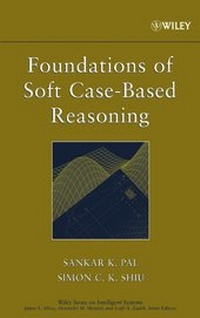
Foundations of Soft Case-Based Reasoning
1st Edition
Published on 18. March 2004
Book
Hardback
274 pages
978-0-471-08635-2 (ISBN)
Description
* Provides a self-contained description of this important aspect of information processing and decision support technology.
* Presents basic definitions, principles, applications, and a detailed bibliography.
* Covers a range of real-world examples including control, data mining, and pattern recognition.
Reviews / Votes
"'Authored by prominent information scientists...it breaks new ground in case-based reasoning and it is likely to be viewed in retrospect as a milestone it its field.' I fully agree with this assessment." (International Journal of General Systems, June 2005) "...well-written and self-contained...can be used by students who want to learn new techniques...practitioners...[and] researchers..." (Journal of Intelligent & Fuzzy Systems, Vol. 16, No. 2, 2005)More details
Series
Edition
1., Auflage
Language
English
Place of publication
New York
United States
Publishing group
John Wiley and Sons Ltd
Target group
Professional and scholarly
Illustrations
bibliography
Dimensions
Height: 23.9 cm
Width: 16.2 cm
Thickness: 20 mm
Weight
539 gr
ISBN-13
978-0-471-08635-2 (9780471086352)
Schweitzer Classification
Other editions
Additional editions
Sankar K. Pal | Simon C. K. Shiu
Foundations of Soft Case-Based Reasoning
E-Book
06/2004
Wiley
€101.99
Available for download
Persons
SANKAR K. PAL, PhD, is a Distinguished Scientist and founding head of the Machine Intelligence Unit at the Indian Statistical Institute, Calcutta. Professor Pal holds several PhDs and is a Fellow of the IEEE and IAPR.
SIMON C. K. SHIU, PhD, is Assistant Professor in the Department of Computing at Hong Kong Polytechnic University.
Content
FOREWORD.
PREFACE.
ABOUT THE AUTHORS.
1 INTRODUCTION.
1.1 Background.
1.2 Components and Features of Case-Based Reasoning.
1.3 Guidelines for the Use of Case-Based Reasoning.
1.4 Advantages of Using Case-Based Reasoning.
1.5 Case Representation and Indexing.
1.6 Case Retrieval.
1.7 Case Adaptation.
1.8 Case Learning and Case-Base Maintenance.
1.9 Example of Building a Case-Based Reasoning System.
1.10 Case-Based Reasoning: Methodology or Technology?
1.11 Soft Case-Based Reasoning.
1.12 Summary.
References.
2 CASE REPRESENTATION AND INDEXING.
2.1 Introduction.
2.2 Traditional Methods of Case Representation.
2.3 Soft Computing Techniques for Case Representation.
2.4 Case Indexing.
2.5 Summary.
References.
3 CASE SELECTION AND RETRIEVAL.
3.1 Introduction.
3.2 Similarity Concept.
3.3 Concept of Fuzzy Sets in Measuring Similarity.
3.4 Fuzzy Classification and Clustering of Cases.
3.5 Case Feature Weighting.
3.6 Case Selection and Retrieval Using Neural Networks.
3.7 Case Selection Using a Neuro-Fuzzy Model.
3.8 Case Selection Using Rough-Self Organizing Map.
3.9 Summary.
References.
4 CASE ADAPTATION.
4.1 Introduction.
4.2 Traditional Case Adaptation Strategies.
4.3 Some Case Adaptation Methods.
4.4 Case Adaptation Through Machine Learning.
4.5 Summary.
References.
5 CASE-BASE MAINTENANCE.
5.1 Introduction.
5.2 Background.
5.3 Types of Case-Base Maintenance.
5.4 Case-Base Maintenance Using a Rough-Fuzzy Approach.
5.5 Case-Base Maintenance Using a Fuzzy Integral Approach.
5.6 Summary.
References.
6 APPLICATIONS.
6.1 Introduction.
6.2 Web Mining.
6.3 Medical Diagnosis.
6.4 Weather Prediction.
6.5 Legal Inference.
6.6 Property Valuation.
6.7 Corporate Bond Rating.
6.8 Color Matching.
6.9 Shoe Design.
6.10 Other Applications.
6.11 Summary.
References.
APPENDIXES.
A FUZZY LOGIC.
A.1 Fuzzy Subsets.
A.2 Membership Functions.
A.3 Operations on Fuzzy Subsets.
A.4 Measure of Fuzziness.
A.5 Fuzzy Rules.
References.
B ARTIFICIAL NEURAL NETWORKS.
B.1 Architecture of Artificial Neural Networks.
B.2 Training of Artificial Neural Networks.
B.3 ANN Models.
References.
C GENETIC ALGORITHMS.
C.1 Basic Principles.
C.2 Standard Genetic Algorithm.
C.3 Examples.
References.
D ROUGH SETS.
D.1 Information Systems.
D.2 Indiscernibility Relation.
D.3 Set Approximations.
D.4 Rough Membership.
D.5 Dependency of Attributes.
References.
INDEX.