

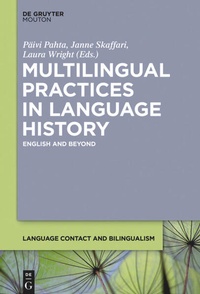
Multilingual Practices in Language History
Description

Texts of the past were often not monolingual but were produced by and for people with bi- or multilingual repertoires; the communicative practices witnessed in them therefore reflect ongoing and earlier language contact situations. However, textbooks and earlier research tend to display a monolingual bias. This collected volume on multilingual practices in historical materials, including code-switching, highlights the importance of a multilingual approach. The authors explore multilingualism in hitherto neglected genres, periods and areas, introduce new methods of locating and analysing multiple languages in various sources, and review terminology, theories and tools. The studies also revisit some of the issues already introduced in previous research, such as Latin interacting with European vernaculars and the complex relationship between code-switching and lexical borrowing. Collectively, the contributors show that multilingual practices share many of the same features regardless of time and place, and that one way or the other, all historical texts are multilingual. This book takes the next step in historical multilingualism studies by establishing the relevance of the multilingual approach to understanding language history.
More details
Other editions
Additional editions
Persons
Päivi Pahta , University of Tampere, Finland; Janne Skaffari , University of Turku, Finland; Laura Wright , University of Cambridge, UK
