

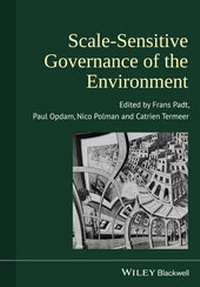
Scale-Sensitive Governance of the Environment
Description

Reviews / Votes
"Overall, I think that this book makes a genuinely useful contribution to the fields of scaling and governance and would highly recommend it as reading for those who are grappling with similar issues." (Restoration Ecology, 1 March 2015)More details
Other editions
Additional editions

Persons
Content
List of Contributors x
Foreword xiii
Preface xv
List of Abbreviations xx
1 Concepts of scale 1
Frans Padt and Bas Arts
1.1 Introduction 1
1.2 Definitions of scale 2
1.3 Scale-sensitive governance of . . . what? 4
1.4 Scale as a reality . . . or not? 8
1.5 The politics of scale 11
1.6 Acknowledgements 13
2 Incorporating multiple ecological scales into the governance of landscape services 17
Paul Opdam
2.1 Introduction 17
2.2 The social-ecological system at the local scale 19
2.3 Ecological scales and local social-ecological systems 22
2.4 Incorporating the ecological scale hierarchy into social-ecological system decision-making 25
2.5 Discussion and conclusions 30
2.6 Acknowledgements 33
3 Scale-sensitivity as a governance capability: Observing, acting and enabling 38
Catrien Termeer and Art Dewulf
3.1 Introduction 38
3.2 Scales in monocentric governance 39
3.3 Scales in multilevel governance 42
3.4 Scales in adaptive governance 44
3.5 The contours of scale-sensitivity as a governance capability 47
3.6 Conclusion 51
4 Knowledge of competing claims on natural resources: Toward institutional design and integrative negotiations 56
Nico Polman, Arianne de Blaeij and Maja Slingerland
4.1 Introduction 56
4.2 Competing claims approach on natural resources 57
4.3 Types of knowledge in competing claims approaches 61
4.4 Distributive approaches toward competing claims negotiations 65
4.5 Integrative approaches to negotiations on competing claims 66
4.6 Conclusions 69
4.7 Acknowledgements 70
5 The relevance of scale to water governance: An example from Loweswater, UK 73
Lisa Norton, Stephen Maberly, Claire Waterton, Nigel Watson and Judith Tsouvalis
5.1 Introduction 73
5.2 Loweswater 74
5.3 The Loweswater Care Project (LCP) 79
5.4 The importance of scale at Loweswater 82
5.5 Conclusions 85
6 Multiple-level governance is needed in the social-ecological system of alpine cultural landscapes 90
Rocco Scolozzi, Ian D Soane and Alessandro Gretter
6.1 Introduction 90
6.2 The concepts of SES, resilience and panarchy in the context of a cultural landscape 92
6.3 A mixed method approach 93
6.4 The cultural landscape of the Ledro Valley: Internal dynamics leading to unplanned futures 94
6.5 Discussion and conclusion 101
6.6 Acknowledgements 103
7 Beyond localism: The spatial scale and scaling in energy transitions 106
Philipp Spath and Harald Rohracher
7.1 Introduction 106
7.2 Creating space for the spatial scale and scaling in conceptualizations of sustainability transitions 107
7.3 The governance of sustainability transitions and its spatial dimensions: Two case studies reconsidered 110
7.4 Learning from the cases: Can place-bound particularities and scaling influence sustainability transitions? 115
7.5 Conclusions and outlook 118
7.6 Acknowledgements 119
8 Tracing drivers of global environmental change along the governance scale: Methodological challenges and possibilities 122
Sylvia I Karlsson-Vinkhuyzen
8.1 What makes environmental issues global? 122
8.2 Methodological challenges in a multilevel analysis 124
8.3 Multilevel analysis of drivers for pesticide problems 127
8.4 Multilevel drivers for the pesticide problem 131
8.5 Multilevel drivers for multiple problems 134
8.6 Concluding reflections on the multilevel analysis of drivers 135
9 'Glocal' politics of scale on environmental issues: Climate change, water and forests 140
Joyeeta Gupta
9.1 Introduction 140
9.2 A theoretical framework 141
9.3 Case studies 142
9.4 Comparative analysis 148
9.5 Conclusions 152
9.6 Acknowledgements 153
10 The politics of cross-level interactions in the jurisdictional scale: The case of natural resource management in the South 157
Daniel Compagnon
10.1 Introduction 157
10.2 Scaling up and scaling down: Some clarifications 158
10.3 Re-assessing the state in the South 160
10.4 The state and the rescaling processes 161
10.5 Conclusion 166
11 Rescaling environmental governance: The case of watersheds as scale-sensitive governance? 172
Alice Cohen
11.1 Introduction 172
11.2 Watersheds as rescaling 173
11.3 Understanding the implications of rescaling 177
11.4 Conclusions: Watersheds as everything to everyone? 181
11.5 Acknowledgements 183
12 Urban sustainability pilot projects: Fit or misfit between challenge and solution? 188
Sofie Bouteligier
12.1 Introduction 188
12.2 Scaling urban environmental governance 190
12.3 How pilot projects inspire sustainability transitions 191
12.4 Urban pilot projects: The way forward? 196
12.5 Conclusion 197
13 Tensions between global-scale and national-scale governance: The strategic use of scale frames to promote sustainable palm oil production in Indonesia 203
Otto Hospes and Annemoon Kentin
13.1 Introduction 203
13.2 Scale and scale frames 204
13.3 Do national principles for sustainable palm oil specify or challenge global principles? 207
13.4 The interactive development and strategic use of scale frames 209
13.5 Conclusions 214
13.6 Acknowledgements 217
14 Rethinking governance of complex commodity systems: Evidence from the Nepali tea value chain 220
Sarah Mohan
14.1 Introduction 220
14.2 Conceptualizing scale in commodity systems 221
14.3 Case study: Mismatches in the Nepali tea heterarchy 226
14.4 Insights into scale in private economic governance 234
14.5 Conclusions 238
14.6 Acknowledgements 238
15 An approach to analysing scale-sensitivity and scale-effectiveness of governance in biodiversity conservation 241
Eeva Primmer, Riikka Paloniemi, Raphael Mathevet, Evangelia Apostolopoulou, Joseph Tzanopoulos, Irene Ring, Marianne Kettunen, Jukka Simila, Joanna Cent, Magorzata Grodzinska-Jurczak, Thomas Koellner, Paula Antunes, John D Pantis, Simon G Potts and Rui Santos
15.1 Introduction 241
15.2 Scales and biodiversity conservation 243
15.3 Governance mechanisms 244
15.4 Scales and real-world biodiversity governance in Europe 247
15.5 Discussion: Governance mechanisms generating scale-sensitivity and scale-effectiveness 252
15.6 Conclusions 256
15.7 Acknowledgements 257
16 Scale-sensitive evaluation: The contribution of the EU Rural Development Programme to European water quality ambitions 263
Stijn Reinhard, Vincent Linderhof and Nico Polman
16.1 Introduction 263
16.2 Changing governance in rural development programmes 265
16.3 Evaluation of the Rural Development Programme 267
16.4 Case study at the member state level 273
16.5 Conclusions and challenges 278
16.6 Acknowledgements 279
17 Green infrastructure planning at multiple levels of scale: Experiences from the Autonomous Region of Valencia, Spain 283
Arancha Munoz-Criado and Vicente Domenech
17.1 Introduction 283
17.2 The former planning model: Lack of coordination between levels of government in the Region of Valencia 284
17.3 A new framework for integrating urban planning, strategic environmental assessment and landscape planning, based on a multilevel Green Infrastructure 286
17.4 Developing Green Infrastructure at different scales: Examples of plans and projects 294
17.5 Conclusion: Benefits of Green Infrastructure as the structuring element for planning at all scales 299
18 Synthesis and perspectives for a new research field 302
Frans Padt, Paul Opdam, Nico Polman and Catrien Termeer
18.1 Introduction 302
18.2 A brief summary of the main insights 302
18.3 Conceptual model 306
18.4 Scale-sensitive governance in practice 307
18.5 Perspectives for a new research field 315
References 316
Index 318
Color plates between pages 170 and 171
Preface
The goals and plan of the book
This book focuses on the role of scale in environmental governance. Although scales and governance are not new subjects, their significance has grown over the last few years in cross-disciplinary research and professional practice. This growth can be explained by the increasing concerns about sustainability issues in the context of a globalizing world. Challenges, such as climate change, food and bio-energy production, the management of storm water, and the decline of biodiversity, stretch across local to global scales and require action at multiple governance scales. Governance systems are typically not ready for this task due to organizational and jurisdictional fragmentation and specialization, and short-term planning horizons. Scientific knowledge is fragmented as well, along disciplinary lines and research traditions in academia and research institutions. With this book, we aim to cross these disciplinary lines by bringing together a variety of research and governance approaches. To this end, we introduce the concept of scale-sensitive governance of the environment. This concept aims to develop advanced knowledge on scaling and governance that is practically relevant and scientifically sound.
With this book, we aim to develop a conceptual and methodological basis for scale-sensitive governance of the environment. More specifically, the book serves three goals. First, it aims to develop a holistic vision on the cross-scale interaction between social and ecological processes and the governance of these processes across scales. What is state of the art in the scale debate in environmental disciplines? What unifying concepts of scale can be developed? How should researchers and practitioners understand the relationships between social and ecological processes across scales? How sensitive are traditional governance approaches to scale? Are new approaches needed?
Second, the book aims to provide empirical evidence about scale-sensitive governance as a political and scientific practice. Rather than taking scales for granted, the social dynamics ‘behind’ it are explored. How do public and private interests, political discourses, and plain politics mobilize the bias toward a particular scale in decision-making? How does this manipulation of scale have an effect on society and the environment? Likewise, scaling is seen as a scientific activity. What decisions do scientists (often implicitly) make about scale when collecting quantitative and qualitative data and performing analyses? How do these decisions affect system descriptions and governance recommendations?
Finally, the book aims to show how current environmental governance practices can be enriched by using theories on scale. Although growing insight exists into the complex nature of social-ecological relationships, the implications for policy are not widely understood or systematically considered in environmental governance. How can policy instruments be applied in a complex multi-scalar setting? How can scientists, local experts and policymakers collaborate in scale research and negotiate on the scales to be addressed?
In order to reach these goals, we have developed the following plan for the book. Chapters 1–3 introduce definitions, theories and models for scale-sensitive governance of the environment, as well as a few real-world examples. The subsequent chapters 4–17 present a series of case studies, following a variety of scientific approaches. The primary case studies were performed in Austria, Canada, Costa Rica, Finland, France, Germany, Greece, Indonesia, Italy, Kenya, Nepal, Poland, Portugal and the UK. Other chapters use secondary case studies from Europe, southern Africa and South America. The topics that these chapters address include biodiversity, climate change, commodities (e.g. palm oil and tea), cultural landscapes, energy, forestry, natural resource management, pesticides, urban development and water management. The final chapter of the book (18) combines the insights from all of these chapters in order to develop a conceptual basis for scale-sensitive governance of the environment. This chapter also proposes priorities for future research.
Brief introduction to the chapters
The first three chapters introduce the reader to the concepts of scale-sensitive environmental governance. Chapter 1, by Frans Padt and Bas Arts, explains that scale is a much debated topic in the academic disciplines of geography, urban sociology and planning, political ecology, environmental governance, ecology, spatial policy and water management. The authors suggest that there is a great potential for bringing these disciplinary approaches together around the issue of scale-sensitive environmental governance. However, conceptual ambiguity and imprecise definitions of scale stand in the way of such an effort. In this chapter, different definitions of scales are explained as well as analytical approaches for studying scale.
Paul Opdam, in chapter 2, examines how ecological processes at different scales affect local biodiversity and the provision of landscape services. Using an example from a polder in the Netherlands, the author discusses how community-based planning and collective action can affect these scales by physically adjusting the green infrastructure in the region and thereby improving the provision of landscape services.
In chapter 3, Catrien Termeer and Art Dewulf compare different governance models and show to what extent these models are sensitive toward scale. The authors also review how scale is understood in these models and to what extent they enable actors to take action at different scales. This exploration is supported by several case studies on Dutch water management.
The following 14 chapters present a series of primary and secondary case studies. Nico Polman et al. explore, in chapter 4, the role of scales in natural resource management conflicts and how these conflicts can be addressed by anticipating these scales. The authors take into account unequal distribution of knowledge and power, and uncertainties and risks at different scales. The authors also develop proposals for integrative negotiations and new institutional designs.
In chapter 5, Lisa Norton et al. explore ways of including multiple scales in local water management in order to provide ecosystem services. The authors take into account the wider social, ecological and governance systems that are relevant to the watershed. The analysis is supported by a case study for the Loweswater watershed in the UK.
In chapter 6 Rocco Scolozzi et al. study the governance of landscapes and how to incorporate different scales therein. Their study area is the alpine cultural landscape of Val di Ledro in northern Italy. The authors observe that the governance of these landscapes has become more complex and involves more scales than decades ago when only local communities used the resources of the landscape. The authors discuss new emerging scales of governance as well as the shifting role of actors and knowledge.
In chapter 7, Philipp Späth and Harald Rohracher study energy transitions in Austria and Germany at different scales, from the scale of towns and regions to the national scale and beyond. They give special attention to the role of actors, networks, places and politics to explain how energy transitions take place over time. Such a transition is understood as a radical, systemic and transformational change toward a sustainable energy provision and consumption.
As described in chapter 8, Sylvia Karlsson-Vinkhuyzen performed case studies in Kenya and Costa Rica in order to identify what interactional, organizational and institutional factors drive pesticide use in these countries. The case studies take different scales into account, from the community to the national and beyond. The author develops a methodological framework to support scale-sensitive governance of pesticide use.
Joyeeta Gupta's chapter 9 revolves around the question of why problems related to climate change, forestry and water management are scaled up or scaled down. The author explores the related politics of, arguments of, and consequences for scale-sensitive governance of these issues. A theoretical framework is developed to understand how actors use scale strategically to reach their goals.
Daniel Compagnon, in a similar vein, in chapter 10, critically reviews the role of national politics in natural resources management in the South. The author considers the unequal distribution of power across scales and how this distribution affects efficient and fair environmental governance. He explains how institutional reforms can help overcome this problem.
Alice Cohen, in a study of Canadian watersheds in chapter 11, asks why watersheds have become such a popular unit of governance in water management and beyond over the past decades. The author discusses the roles of science, politics and social movements in order to answer this question and critically reviews the watershed scale as a unit of governance. Cohen especially criticizes the idea that one scale can encompass all of the ecological and institutional complexities inherent to environmental governance.
Sofie Bouteligier's field of inquiry is urban planning. In chapter 12, she reviews how pilot projects in cities across the world have inspired the exchange of knowledge in transnational networks and a wider transition to sustainable urban development. The dominant role of Western cities in this transition is critically discussed as well.
In chapter 13, Otto Hospes and Annemoon...
