

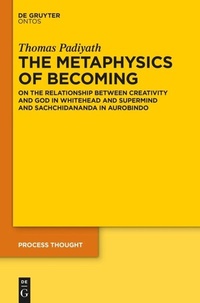
The Metaphysics of Becoming
Description

This study attempts to elucidate a possible meeting point of the traditions of Eastern and Western metaphysical thinking. In discussing Whitehead's and Aurobindo's views on being and becoming, it seeks the possibility of a better engagement between the East and the West in the light of the philosophical insights.
It is an initiation into the Sitz im Leben of Whitehead's philosophy and his general thought pattern. It carries a perceptive analysis to show the clear primacy of Becoming or Process in Whitehead that extends even to the Divine.
It also highlights Aurobindo as a unique Indian Philosopher, who articulated Indian thought in Western categories. He was able to integrate the evolutionary theory of the West with the Indian understanding of becoming. The relationship between God and Creativity and Sachchidananda and the Supermind is studied within the context of Enlightenment and Modernity and the way of doing philosophy in the West and in the East.
More details
Other editions
Additional editions
Person
Content
2 - General Introduction [Seite 27]
3 - Part One: Whitehead's Metaphysics of Becoming [Seite 43]
3.1 - 1 Metaphysics of Becoming: Setting the Context [Seite 47]
3.1.1 - 1.1 Greek Philosophy to Scientific Materialism [Seite 48]
3.1.2 - 1.2 Whitehead's Response to the Greek Outlook of Nature [Seite 49]
3.1.2.1 - 1.2.1 The Emergence of Materialism in Modernity [Seite 51]
3.1.2.1.1 - 1.2.1.1 The Doctrine of Simple Location [Seite 54]
3.1.2.1.2 - 1.2.1.2 Whitehead and Classical Physics [Seite 55]
3.1.2.1.3 - 1.2.1.3 The Metaphysical Dualism of 'Res Extensa and Res Cogitans' [Seite 57]
3.1.2.1.4 - 1.2.1.4 Newton's Mechanistic View of the Universe [Seite 60]
3.1.2.2 - 1.2.2 Whitehead's Response to Scientific Materialism [Seite 61]
3.1.3 - 1.3 The Positive Influences [Seite 64]
3.1.3.1 - 1.3.1 The Re-construction of Physical Sciences [Seite 64]
3.1.3.2 - 1.3.2 The Romantic Movement [Seite 65]
3.1.3.3 - 1.3.3 An Inevitable Shift in Methodology [Seite 67]
3.2 - 2 Whitehead's Metaphysics of Indefinite Pluralities in Becoming [Seite 71]
3.2.1 - 2.1 Being to Beingness in Becoming [Seite 71]
3.2.1.1 - 2.1.1 The Fundamental Principle of Becoming [Seite 73]
3.2.1.2 - 2.1.2 The Enigma of Becoming [Seite 75]
3.2.2 - 2.2 Fundamental Reality in Whitehead [Seite 77]
3.2.2.1 - 2.2.1 Actual Occasion: the Dynamic Subject [Seite 79]
3.2.2.2 - 2.2.2 The Constitution of an Actual Occasion [Seite 80]
3.2.2.2.1 - 2.2.2.1 The Theory of Concrescence [Seite 81]
3.2.2.2.2 - 2.2.2.2 The Concept of Prehension [Seite 82]
3.2.2.2.3 - 2.2.2.3 Satisfaction [Seite 87]
3.2.3 - 2.3 The Characteristics of Actual Occasion [Seite 89]
3.2.3.1 - 2.3.1 Actual Occasion: A Unity of the Physical and Mental Poles [Seite 90]
3.2.3.1.1 - 2.3.1.1 The Physical Pole [Seite 91]
3.2.3.1.2 - 2.3.1.2 The Conceptual Pole [Seite 91]
3.2.3.2 - 2.3.2 Actual Occasion: A Self-actualising Concrescence [Seite 92]
3.2.3.3 - 2.3.3 Actual Occasion: An Experience of Being Subject-Superject [Seite 95]
3.2.4 - 2.4 The Eternal Objects: Pure Potentials for Actual Occasion [Seite 96]
3.2.4.1 - 2.4.1 The Ontological Necessity of the Eternal Objects [Seite 97]
3.2.4.2 - 2.4.2 The Complimentarity of the Actual and the Eternal [Seite 99]
3.3 - 3 Creativity: The Raison d'être of Becoming [Seite 101]
3.3.1 - 3.1 The Distinctive Features of Creativity [Seite 101]
3.3.1.1 - 3.1.1 The Emergence of the Concept Creativity [Seite 102]
3.3.1.2 - 3.1.2 Creativity: The Pure Notion of the Activity [Seite 104]
3.3.1.3 - 3.1.3 Creativity: A Meta-theoretical Concept [Seite 105]
3.3.2 - 3.2 Creativity: the Metaphysical Ultimate in Whitehead [Seite 107]
3.3.3 - 3.3 Different Interpretations of Creativity [Seite 109]
3.3.3.1 - 3.3.1 Creativity: The Self-Caused Subjective Feeling [Seite 109]
3.3.3.2 - 3.3.2 Creativity: Monistic or Pluralistic? [Seite 110]
3.3.3.3 - 3.3.3 Creativity as Eternal Object [Seite 112]
3.3.3.4 - 3.3.4 Creativity as Future Becoming [Seite 113]
3.3.4 - 3.4 Creativity: The Raison d'être of Becoming [Seite 115]
3.3.4.1 - 3.4.1 Creativity: the Innate Nature of Every Actuality [Seite 115]
3.3.4.2 - 3.4.2 Creativity: the Principle of Creative Advance [Seite 117]
3.3.4.3 - 3.4.3 Creativity: the Principle of Novelty [Seite 119]
3.4 - 4 God and the Metaphysics of Becoming [Seite 122]
3.4.1 - 4.1 God and the Metaphysical Principles [Seite 122]
3.4.2 - 4.2 God and the Metaphysics of Becoming [Seite 124]
3.4.2.1 - 4.2.1 God: A Metaphysical Necessity [Seite 125]
3.4.2.2 - 4.2.2 God: An Actual Entity [Seite 127]
3.4.2.3 - 4.2.3 The Dipolar Nature of God [Seite 127]
3.4.2.3.1 - 4.2.3.1 The Primordial Nature of God [Seite 129]
3.4.2.3.2 - 4.2.3.2 The Consequent Nature of God [Seite 130]
3.4.2.4 - 4.2.4 God: The Principle of Limitation [Seite 134]
3.4.2.5 - 4.2.5 The Vindication of the Refuted [Seite 136]
3.4.3 - 4.3 God-World Relation in Whitehead's Metaphysics of Becoming [Seite 140]
3.4.3.1 - 4.3.1 God the Creator and the Metaphysics of Becoming [Seite 141]
3.4.3.2 - 4.3.2 God: the Reservoir of Potentiality [Seite 143]
3.4.3.3 - 4.3.3 God: the Source of Novelty [Seite 145]
3.4.3.4 - 4.3.4 God: the Principle of Order and Harmony [Seite 146]
3.4.3.5 - 4.3.5 God: the Source of the Initial Aim [Seite 147]
3.4.4 - 4.4 The Religious Significance of Whitehead's God [Seite 149]
3.4.4.1 - 4.4.1 The Complexity of the Subject [Seite 150]
3.4.4.2 - 4.4.2 The Goodness of God versus the Will of God [Seite 153]
3.4.4.3 - 4.4.3 God: the Wisdom that Permeates the Universe [Seite 156]
3.4.4.4 - 4.4.4 Metaphysics of Becoming without God [Seite 158]
4 - Part Two: Aurobindo's Integral Advaita and the Metaphysics of Becoming [Seite 163]
4.1 - 5 Integral Advaita: Its Place within the Indian Philosophical Tradition [Seite 167]
4.1.1 - 5.1 Fundamental Presuppositions of Aurobindo's Metaphysics [Seite 168]
4.1.2 - 5.2 Aurobindo and Vedanta Philosophy [Seite 170]
4.1.2.1 - 5.2.1 Aurobindo and Advaita Philosophy of Shankara [Seite 171]
4.1.2.1.1 - 5.2.1.1 Shankara's Theory of Reality [Seite 172]
4.1.2.1.2 - 5.2.1.2 Aurobindo's Response to Absolute Non-Dualism [Seite 175]
4.1.2.2 - 5.2.2 Aurobindo and the Vishishtadvaita of Ramanuja [Seite 177]
4.1.2.2.1 - 5.2.2.1 Ramanuja's Theory of Reality [Seite 177]
4.1.2.2.2 - 5.2.2.2 Aurobindo's Response to Qualified Non-Dualism [Seite 180]
4.1.2.3 - 5.2.3 Dvaitavata of Madhva [Seite 181]
4.1.2.3.1 - 5.2.3.1 Theory of Difference and Dependence [Seite 182]
4.1.2.3.2 - 5.2.3.2 The Ontology of Madhva [Seite 183]
4.1.2.3.3 - 5.2.3.3 Aurobindo and Absolute Dualism [Seite 184]
4.1.3 - 5.3 Aurobindo and Different Theories of Existence [Seite 186]
4.1.3.1 - 5.3.1 The Supracosmic View [Seite 186]
4.1.3.1.1 - 5.3.1.1 The Distinctive Nature of the Supracosmic View [Seite 187]
4.1.3.1.2 - 5.3.1.2 The Supracosmic View and Integral Advaitism of Aurobindo [Seite 188]
4.1.3.2 - 5.3.2 The Cosmic-terrestrial View [Seite 189]
4.1.3.2.1 - 5.3.2.1 The Distinctiveness of the Cosmic-terrestrial View [Seite 189]
4.1.3.2.2 - 5.3.2.2 The Cosmic-terrestrial View and Integral Advaitism [Seite 190]
4.1.3.3 - 5.3.3 The Supraterrestrial View [Seite 192]
4.1.3.3.1 - 5.3.3.1 Distinguishing Features of the Supra-terrestrial View [Seite 193]
4.1.3.3.2 - 5.3.3.2 Aurobindo's Response to the Theories of Existence [Seite 193]
4.2 - 6 Integral Advaita: A Metaphysics of Becoming [Seite 196]
4.2.1 - 6.1 The Integral Advaitic View of Existence [Seite 196]
4.2.1.1 - 6.1.1 The Name Integral Advaita [Seite 197]
4.2.1.2 - 6.1.2 Distinctiveness of Integral Yoga [Seite 199]
4.2.2 - 6.2 Aurobindo's Interpretation of the Concept of Maya [Seite 201]
4.2.2.1 - 6.2.1 Maya: the Power of Becoming in Indian Philosophy [Seite 203]
4.2.2.2 - 6.2.2 Maya: The Self's Experience of Its Being [Seite 206]
4.2.2.3 - 6.2.3 Maya: Not a Passive Notion but a Dynamic Notion [Seite 207]
4.2.3 - 6.3 Dipolar Nature of the Reality [Seite 210]
4.2.3.1 - 6.3.1 Matter as the Foundational Substratum of Existence [Seite 211]
4.2.3.2 - 6.3.2 The Relation between Matter and Spirit [Seite 212]
4.2.3.3 - 6.3.3 Dipolarity is Not Dichotomy [Seite 214]
4.2.4 - 6.4 The Concept of Evolution: A Process Toward Integral Unity [Seite 216]
4.2.4.1 - 6.4.1 The Idea of Evolution in Indian Philosophy [Seite 216]
4.2.4.2 - 6.4.2 Aurobindo's Vision of Evolution [Seite 217]
4.2.4.2.1 - 6.4.2.1 Distinctiveness of Aurobindo's Concept of Evolution [Seite 218]
4.2.4.2.2 - 6.4.2.2 Teleology Central to Aurobindo's Concept of Evolution [Seite 219]
4.2.5 - 6.5 Cosmic Consciousness: the Locus of Becoming [Seite 222]
4.2.5.1 - 6.5.1 The Individual and the Efficacy of Cosmic Consciousness [Seite 223]
4.2.5.2 - 6.5.2 Cosmic Consciousness: the Source of Reconciliation [Seite 224]
4.2.6 - 6.6 The One and the Many: The Way of Being in Becoming [Seite 226]
4.2.6.1 - 6.6.1 The Absolute: Unity Manifesting Multiplicity [Seite 226]
4.2.6.2 - 6.6.2 The Infinite: the Locus of Unity [Seite 228]
4.3 - 7 Sachchidananda and the Metaphysics of Becoming [Seite 231]
4.3.1 - 7.1 The Concept of the Absolute in Philosophy [Seite 231]
4.3.1.1 - 7.1.1 Brahman: the Absolute in Indian Philosophy [Seite 232]
4.3.1.2 - 7.1.2 Aurobindo's Understanding of the Absolute [Seite 233]
4.3.2 - 7.2 The Understanding of God in Indian Philosophy [Seite 236]
4.3.2.1 - 7.2.1 The Subjective Dimension of Brahman [Seite 236]
4.3.2.2 - 7.2.2 The Objective Dimension of Brahman [Seite 239]
4.3.3 - 7.3 Sachchidananda: The Absolute in Aurobindo [Seite 242]
4.3.3.1 - 7.3.1 Sachchidananda: The Greatest Achievement of Vedanta [Seite 243]
4.3.3.2 - 7.3.2 The Trinity of Sachchidananda [Seite 244]
4.3.3.2.1 - 7.3.2.1 The Absolute as Pure Existence (Sat) [Seite 245]
4.3.3.2.2 - 7.3.2.2 The Absolute as Consciousness-Force (Cit-Shakti) [Seite 247]
4.3.3.2.3 - 7.3.2.3 The Absolute as Bliss (Ananda) [Seite 249]
4.3.3.2.4 - 7.3.2.4 The Inter-dependent Nature of the Trilogy [Seite 251]
4.3.4 - 7.4 Sachchidananda and the Metaphysics of Becoming [Seite 253]
4.3.4.1 - 7.4.1 The Involution of the Absolute [Seite 254]
4.3.4.1.1 - 7.4.1.1 Why Involution or the Becoming? [Seite 255]
4.3.4.1.2 - 7.4.1.2 Involution: The Becoming of the Absolute [Seite 258]
4.3.4.2 - 7.4.2 The Effects of Involution [Seite 260]
4.3.4.2.1 - 7.4.2.1 Theory of World as the Manifestation [Seite 261]
4.3.4.2.2 - 7.4.2.2 Sachchidananda: The Substratum and the Cause of the Universe [Seite 264]
4.4 - 8 The Supermind: The Raison d'être of Becoming [Seite 267]
4.4.1 - 8.1 The Supermind [Seite 267]
4.4.1.1 - 8.1.1 Vedic Roots of the Supermind [Seite 268]
4.4.1.2 - 8.1.2 The Distinctive Nature of the Supermind [Seite 270]
4.4.1.3 - 8.1.3 The Triple Status of the Supermind [Seite 271]
4.4.1.3.1 - 8.1.3.1 Comprehending Consciousness or Transcendent Status [Seite 272]
4.4.1.3.2 - 8.1.3.2 The Apprehending Consciousness [Seite 273]
4.4.1.3.3 - 8.1.3.3 The Projecting Consciousness [Seite 274]
4.4.1.3.4 - 8.1.3.4 Combined Activity - The Way of Being-Becoming [Seite 274]
4.4.2 - 8.2 The Mind and the Supermind [Seite 276]
4.4.2.1 - 8.2.1 In the Realm of Epistemology [Seite 277]
4.4.2.2 - 8.2.2 Spatio-temporal Limitation of the Mind [Seite 278]
4.4.2.3 - 8.2.3 Supermind: Identity of the Ideal and Actual [Seite 279]
4.4.2.4 - 8.2.4 The Transformative Ascent from Mind to the Supermind [Seite 280]
4.4.2.4.1 - 8.2.4.1 The Higher Mind [Seite 282]
4.4.2.4.2 - 8.2.4.2 The Illumined Mind [Seite 283]
4.4.2.4.3 - 8.2.4.3 The Intuitive Mind [Seite 283]
4.4.2.4.4 - 8.2.4.4 The Overmind [Seite 285]
4.4.2.5 - 8.2.5 The Supramental Transformation [Seite 287]
4.4.3 - 8.3 The Supermind: Its Role, Relevance and Ultimacy [Seite 288]
4.4.3.1 - 8.3.1 Supermind: An Onto-logical Necessity [Seite 288]
4.4.3.2 - 8.3.2 Supermind: The Intermediate Link [Seite 289]
4.4.3.3 - 8.3.3 Supermind: The Creative Principle [Seite 291]
4.4.3.4 - 8.3.4 Supermind: Principle of Reconciliation [Seite 292]
4.4.3.5 - 8.3.5 Supermind: The Ordering and Harmonising Principle [Seite 294]
4.4.3.6 - 8.3.6 Supermind: The Raison d'être of Becoming [Seite 297]
5 - Part Three: On the Relationship between Creativity and God and Supermind and Sachchidananda [Seite 303]
5.1 - 9 On the Relationship between God and Creativity in Whitehead and Sachchidananda and Supermind in Aurobindo [Seite 307]
5.1.1 - 9.1 The Ultimacy of God and Creativity [Seite 308]
5.1.1.1 - 9.1.1 God and Creativity Clearly Distinguished [Seite 309]
5.1.1.2 - 9.1.2 Different Approaches and Re-configurings [Seite 313]
5.1.1.2.1 - 9.1.2.1 The Identification of Creativity and God [Seite 313]
5.1.1.2.2 - 9.1.2.2 God: the Source of Creativity [Seite 315]
5.1.1.2.3 - 9.1.2.3 The Immanent Interdependence of God and Creativity [Seite 318]
5.1.2 - 9.2 The Ultimacy of Sachchidananda and the Supermind [Seite 321]
5.1.2.1 - 9.2.1 One in Essence and Dipolar in Existence [Seite 321]
5.1.2.2 - 9.2.2 Supermind: The Icon of Sachchidananda [Seite 323]
5.1.2.2.1 - 9.2.2.1 Supermind: The God Aspect of Sachchidananda [Seite 324]
5.1.2.2.2 - 9.2.2.2 Supermind: The Truth-Consciousness of Sachchidananda [Seite 326]
5.1.3 - 9.3 The Raison d'être for the Distinction of God and Creativity [Seite 328]
5.1.3.1 - 9.3.1 On the Demand of the Question of Evil [Seite 329]
5.1.3.2 - 9.3.2 On the Demand of Freedom [Seite 335]
5.1.4 - 9.4 The Sine qua non for the Interdependence of Sachchidananda and Supermind [Seite 337]
5.1.4.1 - 9.4.1 On the Ground of Theism and Monism [Seite 338]
5.1.4.2 - 9.4.2 The Problem of Evil [Seite 340]
5.1.4.2.1 - 9.4.2.1 The Complexity of the Problem [Seite 341]
5.1.4.2.2 - 9.4.2.2 God the Creator and the Enigma of Evil [Seite 342]
5.1.4.2.3 - 9.4.2.3 Evil and Divine Bliss [Seite 344]
5.1.4.2.4 - 9.4.2.4 The Interplay of Good and Evil [Seite 346]
5.1.4.2.5 - 9.4.2.5 Evil and Divine Economy [Seite 347]
5.2 - 10 Toward an East-West Intermediation in the Metaphysics of Becoming in the Context of the Distinction between Metaphysics and Religion [Seite 350]
5.2.1 - 10.1 The Distinctiveness of the West in Doing Philosophy [Seite 351]
5.2.1.1 - 10.1.1 Reason: Central to Western Philosophy [Seite 352]
5.2.1.2 - 10.1.2 Medieval Philosophy: A Combination of Faith and Reason [Seite 356]
5.2.2 - 10.2 The Influence of the Enlightenment and Modernity [Seite 358]
5.2.2.1 - 10.2.1 Modernity and Rationality [Seite 360]
5.2.2.1.1 - 10.2.1.1 Modernity and the Question of Transcendence [Seite 361]
5.2.2.1.2 - 10.2.1.2 The Emergence of Immanent Transcendence [Seite 364]
5.2.2.2 - 10.2.2 The Separation of Metaphysics and Religion in the West [Seite 367]
5.2.3 - 10.3 Whitehead's Distance from Modernity [Seite 372]
5.2.3.1 - 10.3.1 Religious and Metaphysical Ultimate as Distinct [Seite 372]
5.2.3.2 - 10.3.2 The Metaphysical and the Religious Ultimate are Different [Seite 377]
5.2.4 - 10.4 The Way of Doing Philosophy in the East [Seite 380]
5.2.4.1 - 10.4.1 The Distinctiveness of the East [Seite 381]
5.2.4.1.1 - 10.4.1.1 Darsna Versus Weltanschauung [Seite 382]
5.2.4.1.2 - 10.4.1.2 Existence Is Value [Seite 384]
5.2.4.1.3 - 10.4.1.3 Sense of Transcendence [Seite 387]
5.2.4.2 - 10.4.2 Religion and Philosophy: Two Modes of Expressions [Seite 389]
5.2.4.2.1 - 10.4.2.1 Religion, Philosophy and Freedom [Seite 391]
5.2.4.2.2 - 10.4.2.2 Philosophy and Religion: Distinct but not Separate [Seite 391]
5.2.4.3 - 10.4.3 The Complimentarity of Faith and Reason [Seite 395]
5.2.4.3.1 - 10.4.3.1 The Role and the Limitations of Reason [Seite 396]
5.2.4.3.2 - 10.4.3.2 Human Reason: A Mediator not an Angel [Seite 398]
5.2.4.3.3 - 10.4.3.3 Reason Transcending to the Realm of Intuition [Seite 400]
5.2.5 - 10.5 The Middle Way of Whitehead and Aurobindo [Seite 403]
5.3 - 11 General Conclusion [Seite 406]
5.3.1 - 11.1 Resumé [Seite 406]
5.3.2 - 11.2 Whitehead and Aurobindo and East-West Dialogue [Seite 409]
5.3.2.1 - 11.2.1 Being and Becoming: an Attempt to Think them Together [Seite 409]
5.3.2.2 - 11.2.2 A Synthetic Approach to Matter and Spirit [Seite 417]
5.3.2.3 - 11.2.3 The Realism of Whitehead and Aurobindo [Seite 419]
5.3.2.4 - 11.2.4 Teleology and Purpose versus Nihilism [Seite 421]
5.3.2.5 - 11.2.5 Religion and Philosophy: Distinction Versus Separation [Seite 424]
5.3.2.6 - 11.2.6 Reason and Intuition: Two Sources of Philosophy [Seite 426]
5.3.2.7 - 11.2.7 Reason and Experience Combined: A New Paradigm [Seite 428]
5.3.3 - 11.3 An Attitude of Engagement Rather than Estrangement [Seite 437]
6 - References [Seite 444]
