

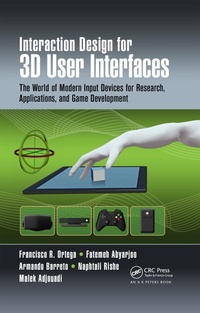
Interaction Design for 3D User Interfaces
The World of Modern Input Devices for Research, Applications, and Game Development
Published on 6. January 2016
805 pages
978-1-4822-1695-0 (ISBN)
Description

This book addresses the new interaction modalities that are becoming possible with new devices by looking at user interfaces from an input perspective. It deals with modern input devices and user interaction and design covering in-depth theory, advanced topics for noise reduction using Kalman Filters, a case study, and multiple chapters showing hands-on approaches to relevant technology, including modern devices such as the Leap-Motion, Xbox One Kinect, inertial measurement units, and multi-touch technology. It also discusses theories behind interaction and navigation, past and current techniques, and practical topics about input devices.
More details
Language
English
Place of publication
Natick
United States
Publishing group
Taylor & Francis Inc
Target group
Professional and scholarly
Illustrations
261 s/w Abbildungen, 24 farbige Abbildungen, 23 s/w Tabellen
261 b/w images, 24 color images, 23 tables and 350
File size
22,24 MB
ISBN-13
978-1-4822-1695-0 (9781482216950)
Copyright in bibliographic data and cover images is held by Nielsen Book Services Limited or by the publishers or by their respective licensors: all rights reserved.
Schweitzer Classification
Other editions
Additional editions
Francisco R. Ortega | Fatemeh Abyarjoo | Armando Barreto
Interaction Design for 3D User Interfaces
The World of Modern Input Devices for Research, Applications, and Game Development
Book
12/2021
1st Edition
Taylor & Francis
€76.10
Shipment within 10-20 days
Francisco R. Ortega | Fatemeh Abyarjoo | Armando Barreto
Interaction Design for 3D User Interfaces
The World of Modern Input Devices for Research, Applications, and Game Development
Book
01/2016
1st Edition
Apple Academic Press Inc.
€128.50
Article not available for order
Persons
Francisco R. Ortega, PhD, is a postdoctorate research fellow at Florida International University, Miami, where he received his PhD in computer science. He is the current director of the Open Human-Interface Device Laboratory at Florida International University (http://openhid.com). He was a member of the Digital Signal Processing Laboratory at FIU, and has over 17 years of experience in software development and systems integration. His interests are in 3D user interfaces, input devices, human-computer interaction, 3D navigation, and input modeling, among other interests. He has multiple publications in journals, lecture notes, and conference proceedings.
Fatemeh Abyarjoo, PhD, received her PhD in Electrical engineering from Florida International University, Miami, where she was also a research assistant in the Digital Signal Processing Laboratory, focusing on sensor fusion for human motion tracking. She is currently a Fraud Risk Data Scientist, focusing on financial data analyzing. Her research interests are data mining, data analysis, statistical modeling, sensor fusion and wearable devices. She is a former Open Science Data Cloud PIRE National Science Foundation Fellow.
Armando Barreto, PhD, is a faculty member of the Electrical and Computer Engineering Department at Florida International University, Miami, as well as the director of FIU's Digital Signal Processing Laboratory. He earned his PhD in electrical engineering from the University of Florida, Gainesville. His work has focused on applying DSP techniques to the facilitation of human-computer interactions, particularly for the benefit of individuals with disabilities. He has developed human-computer interfaces based on the processing of signals and has developed a system that adds spatialized sounds to the icons in a computer interface to facilitate access by individuals with "low vision." He is a senior member of the Institute of E
Fatemeh Abyarjoo, PhD, received her PhD in Electrical engineering from Florida International University, Miami, where she was also a research assistant in the Digital Signal Processing Laboratory, focusing on sensor fusion for human motion tracking. She is currently a Fraud Risk Data Scientist, focusing on financial data analyzing. Her research interests are data mining, data analysis, statistical modeling, sensor fusion and wearable devices. She is a former Open Science Data Cloud PIRE National Science Foundation Fellow.
Armando Barreto, PhD, is a faculty member of the Electrical and Computer Engineering Department at Florida International University, Miami, as well as the director of FIU's Digital Signal Processing Laboratory. He earned his PhD in electrical engineering from the University of Florida, Gainesville. His work has focused on applying DSP techniques to the facilitation of human-computer interactions, particularly for the benefit of individuals with disabilities. He has developed human-computer interfaces based on the processing of signals and has developed a system that adds spatialized sounds to the icons in a computer interface to facilitate access by individuals with "low vision." He is a senior member of the Institute of E
Content
THEORY. Introduction. Input Interfaces. Output Interfaces and Displays. Computer Graphics. 3D Interaction. 3D Navigation. Descriptive and Predictive Models. Multi-Touch. Multi-Touch for Stereoscopic Displays. Pen and Multi-Touch Modeling and Recognition. Using Multi-Touch with PetriNets. Eye Gaze Tracking as Input in Human-Computer Interaction. Brain-Computer Interfaces: Considerations for the Next Frontier in Interactive Graphics and Games. ADVANCED TOPICS. 3D Input Math Basics. Introduction to Digital Signal Processing. Three Dimensional Rotations. MEMS Inertial Sensors and Magnetic Sensors. Kalman Filters. Quaternions and Sensor Fusion. HANDS-ON. Hands-On: Inertial Sensors for 3D Input. Simple Hands-On Project with Unity3D and Oculus Rift. Hands-On Approach with Leap Motion. Hands-On Approach with Kinect Sensor v2. Creating Home-Brew Devices with Arduino Microcontrollers. Autonomous Bicycle with Gyroscope Sensor. Input Implementation Details. CASE STUDY: SPEECH AS INPUT. Multimodal Human-Like Conversational Interfaces. Adaptive Dialogue Systems for Health. CONTENTS OF ONLINE SUPPLEMENTARY MATERIAL. The World of Gesture Recognition. Input Frameworks and Development Considerations for Input Technologies. Hands-On: Multi-Touch and Pen Using Microsoft Windows 8 and Windows 10 with Microsoft Surface Pro. Hands-on: Intel RealSense SDK. APPENDICES. Displays. Creating Your Own Virtual Reality Headset.
