

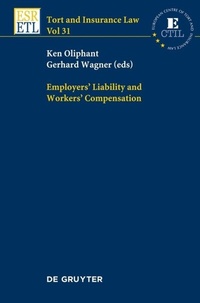
Employers' Liability and Workers' Compensation
1st Edition
Published on 30. October 2012
XL, 620 pages
978-3-11-027021-1 (ISBN)
Description

This large-scale comparative study analyses the two principal mechanisms employed in modern legal systems to deal with the social problem of occupational illness and injury, namely, employers' liability and workers' compensation. It provides a detailed description of the systems in operation in twelve countries around the world, investigating the complex legal structures and the interaction with other social institutions, as well as their inter-jurisdictional coordination through private international law. Current international trends are identified and assessed and the fundamental political issues highlighted and explored. The study's ultimate goals are not only descriptive but also to answer the question of how compensation and liability systems can best be adapted to meet society's needs in the 21st century. The countries covered are: Australia (Mark Lunney), Austria (Ernst Karner/Felix Kernbichler), Denmark (Vibe Ulfbeck), England and Wales (Richard Lewis), France (Florence G'Sell/Isabelle Veillard), Germany (Raimund Waltermann), Italy (Alessandro P Scarso/Massimo Foglia), Japan (Keizo Yamamoto/Tomohiro Yoshimasa), the Netherlands (Siewert D Lindenbergh), Poland (Domenika Dörre-Nowak), Romania (Christian Alunaru/Lucian Bojin) and the United States of America (Michael D Green/Daniel S Murdock). The book is completed by three concluding essays that address general themes: Thomas Thiede, The European Coordination of Employers' Liability and Workers' Compensation Ken Oliphant, The Changing Landscape of Work Injury Claims: Challenges for Employers' Liability and Workers' Compensation Gerhard Wagner, New Perspectives on Employers' Liability - Basic Policy Issues
More details
Other editions
Additional editions
Oliphant/Wagner
Employers' Liability and Workers' Compensation
Book
10/2012
1st Edition
De Gruyter
€189.95
Shipment within 7-9 days
Ken Oliphant | Gerhard Wagner
Employers' Liability and Workers' Compensation
Book
01/2012
1st Edition
De Gruyter
€289.00
Article exhausted; check different version
Persons
Ken Oliphant, Institute for European Tort Law, Vienna, Austria; Gerhard Wagner, University of Chicago, Chicago, USA.
Content
1 - Preface [Seite 5]
2 - List of Contributors [Seite 27]
3 - Introduction [Seite 29]
4 - Employers' Liability and Workers' Compensation: Australia [Seite 41]
4.1 - I. Introduction [Seite 41]
4.1.1 - A. Basic system of compensation and liability [Seite 41]
4.1.2 - B. Interaction with other institutions [Seite 43]
4.1.3 - C. Empirical evidence [Seite 44]
4.2 - II. Workers' Compensation [Seite 45]
4.2.1 - A. Scope of cover [Seite 45]
4.2.1.1 - 1. When can workers' compensation be claimed? [Seite 47]
4.2.1.2 - 2. Spatial and temporal dimensions of course of employment [Seite 48]
4.2.2 - B. Compensation trigger [Seite 50]
4.2.3 - C. Scope of protection [Seite 54]
4.2.4 - D. Heads and levels of benefit [Seite 55]
4.2.4.1 - 1. Medical care [Seite 55]
4.2.4.2 - 2. Rehabilitation assistance [Seite 56]
4.2.4.3 - 3. Lost earnings [Seite 57]
4.2.4.4 - 4. Non-pecuniary losses [Seite 59]
4.2.4.5 - 5. Dependents' benefits [Seite 60]
4.2.4.6 - 6. Comparison with damages in tort [Seite 62]
4.2.4.7 - 7. Lump sum or periodical payments? [Seite 63]
4.2.5 - E. Funding systems [Seite 65]
4.2.5.1 - 1. Types of system [Seite 65]
4.2.5.2 - 2. Contribution to the workers' compensation fund [Seite 67]
4.2.5.3 - 3. Incentives [Seite 67]
4.2.6 - F. Administration and adjudication of claims [Seite 68]
4.2.6.1 - 1. Organisational framework of workers' compensation institutions [Seite 68]
4.2.6.2 - 2. Who decides claims for benefits [Seite 68]
4.2.6.3 - 3. Reviews and appeals: special tribunals or general civil justice system? [Seite 69]
4.2.6.4 - 4. Speed of claims' resolution and administrative costs [Seite 70]
4.2.7 - G. Rights of recourse of workers' compensation institutions [Seite 72]
4.2.7.1 - 1. Recourse against employer [Seite 72]
4.2.7.2 - 2. Recourse against a co-worker [Seite 72]
4.2.7.3 - 3. Recourse against third parties [Seite 73]
4.2.8 - H. Interaction with general social welfare provision and private insurance [Seite 74]
4.2.8.1 - 1. Fund of first resort? [Seite 74]
4.2.8.2 - 2. Deductibility of benefits [Seite 74]
4.2.8.3 - 3. Recourse of social welfare agencies, social health insurance, private health insurers against workers' compensation institutions [Seite 75]
4.2.9 - I. Interaction with employers' liability [Seite 76]
4.2.9.1 - 1. Availability of damages in addition to workers' compensation benefits [Seite 76]
4.2.9.2 - 2. Deductibility of benefits provided by workers' compensation in action against employer [Seite 77]
4.2.9.3 - 3. Subrogation of workers' compensation into the claim of worker against employer [Seite 78]
4.3 - III. Employers' Liability [Seite 78]
4.3.1 - A. Classification [Seite 78]
4.3.1.1 - 1. Contract or tort? [Seite 78]
4.3.1.2 - 2. General law or a special category [Seite 79]
4.3.2 - B. Elements of liability [Seite 79]
4.3.2.1 - 1. Liability of employers for their own acts or omissions [Seite 79]
4.3.2.2 - 2. Liability of employers for the acts or omissions of their employees and others [Seite 79]
4.3.2.3 - 3. Relevance of health and safety legislation in establishing liability [Seite 80]
4.3.2.4 - 4. Overall a fault-based or strict liability system [Seite 81]
4.3.2.5 - 5. Causation [Seite 81]
4.3.2.6 - 6. Effect of victim's contributory conduct [Seite 81]
4.3.3 - C. Scope of protection [Seite 82]
4.3.4 - D. Heads and levels of damages [Seite 83]
4.3.4.1 - 1. Same level as in other cases of personal injury [Seite 83]
4.3.4.2 - 2. Heads of recoverable damage [Seite 84]
4.3.4.3 - 3. Costs of medical care [Seite 84]
4.3.4.4 - 4. Costs of rehabilitation assistance [Seite 84]
4.3.4.5 - 5. Lost earnings, loss of earning capacity, and loss of pension entitlements [Seite 85]
4.3.4.6 - 6. Non-pecuniary loss [Seite 85]
4.3.4.7 - 7. Dependents [Seite 86]
4.3.4.8 - 8. Form of payment [Seite 86]
4.3.5 - E. Administration of claims [Seite 87]
4.3.5.1 - 1. Courts or specialised tribunals [Seite 87]
4.3.5.2 - 2. General civil procedure or special procedures? [Seite 87]
4.3.5.3 - 3. Reviews and appeals [Seite 88]
4.3.5.4 - 4. Speed of claims' resolution and administrative costs [Seite 88]
4.3.6 - F. Rights of recourse [Seite 89]
4.3.6.1 - 1. Against other employees or their liability insurer? [Seite 89]
4.3.6.2 - 2. Against third parties [Seite 89]
4.3.7 - G. Interaction with social welfare systems and private insurance [Seite 90]
4.3.7.1 - 1. Deductibility of benefits received from social welfare agencies [Seite 90]
4.3.7.2 - 2. Recourse of social welfare agencies and private insurers against the employer [Seite 90]
4.3.8 - H. Insurance [Seite 91]
4.3.8.1 - 1. Voluntary or mandatory? [Seite 91]
4.3.8.2 - 2. General liability insurance or special policy [Seite 91]
4.3.8.3 - 3. Basic principles of employers' liability insurance [Seite 92]
4.4 - IV. Evaluation and Conclusions [Seite 93]
4.4.1 - A. Compensation [Seite 93]
4.4.2 - B. Prevention [Seite 94]
4.4.3 - C. Overall costs [Seite 95]
4.4.4 - D. Interaction between workers' compensation and private law [Seite 95]
4.4.5 - E. Plans for reform [Seite 96]
4.4.6 - F. Overall quality of each system independently and in combination [Seite 98]
5 - Employers' Liability and Workers' Compensation: Austria [Seite 103]
5.1 - I. Introduction [Seite 103]
5.1.1 - A. Basic system of compensation and liability [Seite 103]
5.1.1.1 - 1. Historical development [Seite 103]
5.1.1.2 - 2. Basic system [Seite 105]
5.1.1.3 - 3. Relation to private law remedies [Seite 106]
5.1.2 - B. Interaction with other institutions [Seite 107]
5.1.3 - C. Empirical evidence [Seite 108]
5.2 - II. Workers' Compensation [Seite 108]
5.2.1 - A. Scope of cover [Seite 108]
5.2.1.1 - 1. Protected sphere of life [Seite 109]
5.2.1.2 - 2. Attribution [Seite 110]
5.2.2 - B. Compensation trigger [Seite 112]
5.2.3 - C. Scope of protection [Seite 113]
5.2.3.1 - 1. Personal injury [Seite 113]
5.2.3.2 - 2. Sexual harassment [Seite 113]
5.2.3.3 - 3. Dignitary injuries [Seite 114]
5.2.3.4 - 4. Property damage and pure economic loss [Seite 114]
5.2.4 - D. Heads and levels of benefit [Seite 115]
5.2.4.1 - 1. Benefits in kind [Seite 115]
5.2.4.2 - 2. Cash benefits [Seite 116]
5.2.5 - E. Funding systems [Seite 121]
5.2.5.1 - 1. Funding through contributions [Seite 121]
5.2.5.2 - 2. Financial equalisation (Finanzausgleich) [Seite 123]
5.2.6 - F. Administration and adjudication of claims [Seite 123]
5.2.7 - G. Rights of recourse of workers' compensation institutions [Seite 127]
5.2.7.1 - 1. General [Seite 127]
5.2.7.2 - 2. Recourse against the employer [Seite 129]
5.2.7.3 - 3. Recourse against a colleague? [Seite 130]
5.2.7.4 - 4. Recourse against third parties [Seite 131]
5.2.8 - H. Interaction with general social welfare provision and private insurance [Seite 131]
5.2.8.1 - 1. Relationship between health and accident insurance [Seite 131]
5.2.8.2 - 2. Relationship between Social Insurance and Minimum Insurance [Seite 133]
5.2.9 - I. Interaction with employers' liability [Seite 133]
5.3 - III. Employers' Liability [Seite 134]
5.3.1 - A. Classification [Seite 134]
5.3.1.1 - 1. General tortious fault-based and the employer's liability privilege [Seite 134]
5.3.1.2 - 2. Work accidents caused by vehicles for which there is enhanced liability [Seite 138]
5.3.2 - B. Elements of liability [Seite 138]
5.3.2.1 - 1. Fault-based liability [Seite 138]
5.3.2.2 - 2. Strict liability [Seite 140]
5.3.2.3 - 3. Liability for risks without fault [Seite 141]
5.3.3 - C. Scope of protection [Seite 143]
5.3.4 - D. Heads and levels of damages [Seite 143]
5.3.4.1 - 1. Personal injuries [Seite 143]
5.3.4.2 - 2. Material damages [Seite 144]
5.3.5 - E. Administration of claims [Seite 144]
5.3.6 - F. Rights of recourse [Seite 145]
5.3.7 - G. Interaction with social welfare systems and private insurance [Seite 145]
5.3.8 - H. Insurance [Seite 145]
5.4 - IV. Evaluation and Conclusions [Seite 146]
5.4.1 - A. Compensation [Seite 146]
5.4.2 - B. Prevention [Seite 146]
5.4.3 - C. Overall costs [Seite 147]
5.4.4 - D. Interaction between workers' compensation and private law [Seite 147]
5.4.5 - E. Plans for reform [Seite 149]
5.4.6 - F. Overall quality of each system independently and in combination [Seite 150]
6 - Employers' Liability and Workers' Compensation: Denmark [Seite 151]
6.1 - I. Introduction [Seite 151]
6.1.1 - A. Basic system of compensation and liability [Seite 151]
6.1.2 - B. Interaction with other institutions [Seite 152]
6.1.3 - C. Empirical evidence [Seite 152]
6.2 - II. Workers' Compensation [Seite 152]
6.2.1 - A. Scope of cover [Seite 152]
6.2.2 - B. Compensation trigger [Seite 155]
6.2.3 - C. Scope of protection [Seite 157]
6.2.4 - D. Heads and levels of benefit [Seite 158]
6.2.5 - E. Funding systems [Seite 160]
6.2.6 - F. Administration and adjudication of claims [Seite 160]
6.2.7 - G. Rights of recourse of workers' compensation institutions [Seite 161]
6.2.8 - H. Interaction with general social welfare provision and private insurance [Seite 162]
6.2.9 - I. Interaction with employers' liability [Seite 163]
6.3 - III. Employers' Liability [Seite 164]
6.3.1 - A. Classification [Seite 164]
6.3.2 - B. Elements of liability [Seite 165]
6.3.3 - C. Scope of protection [Seite 167]
6.3.4 - D. Heads and levels of damages [Seite 168]
6.3.5 - E. Administration of claims [Seite 170]
6.3.6 - F. Rights of recourse [Seite 171]
6.3.7 - G. Interaction with social welfare systems and private insurance [Seite 172]
6.3.8 - H. Insurance [Seite 173]
6.4 - IV. Evaluation and Conclusions [Seite 174]
6.4.1 - A. Compensation [Seite 174]
6.4.2 - B. Prevention [Seite 174]
6.4.3 - C. Overall costs [Seite 175]
6.4.4 - D. Interaction between workers' compensation and private law [Seite 175]
6.4.5 - E. Plans for reform [Seite 175]
6.4.6 - F. Overall quality of each system independently and in combination [Seite 175]
7 - Employers' Liability and Workers' Compensation: England and Wales [Seite 177]
7.1 - I. Introduction [Seite 177]
7.1.1 - A. The basic system of compensation and liability [Seite 177]
7.1.1.1 - 1. Tort [Seite 178]
7.1.1.2 - 2. Workers' compensation [Seite 180]
7.1.1.3 - 3. Why preferential compensation for workers? [Seite 181]
7.1.2 - B. Interaction with other institutions [Seite 183]
7.1.3 - C. Empirical evidence [Seite 183]
7.2 - II. Workers' Compensation [Seite 184]
7.2.1 - A. Scope of cover [Seite 184]
7.2.1.1 - 1. Workers covered [Seite 184]
7.2.1.2 - 2. Spatial, temporal and other limitations [Seite 185]
7.2.1.3 - 3. Effect of the victim's contributory negligence [Seite 192]
7.2.2 - B. Compensation trigger [Seite 193]
7.2.2.1 - 1. Accidents [Seite 194]
7.2.2.2 - 2. Disease [Seite 196]
7.2.3 - C. Scope of protection [Seite 199]
7.2.3.1 - 1. Personal injury [Seite 199]
7.2.3.2 - 2. Other than personal injury [Seite 201]
7.2.4 - D. Heads and levels of benefit [Seite 201]
7.2.4.1 - 1. Assessment [Seite 203]
7.2.4.2 - 2. Rate of payment [Seite 205]
7.2.4.3 - 3. Comparison of the industrial injuries pension with damages in tort [Seite 206]
7.2.5 - E. Funding systems [Seite 207]
7.2.6 - F. Administration and adjudication of claims [Seite 208]
7.2.6.1 - 1. Claims and appeals [Seite 208]
7.2.6.2 - 2. Tribunals not courts [Seite 209]
7.2.6.3 - 3. Administrative cost [Seite 209]
7.2.7 - G. Right of recourse of workers' compensation institutions [Seite 210]
7.2.7.1 - 1. Rights of recourse against the employer [Seite 210]
7.2.7.2 - 2. Rights of recourse against a co-worker or third party [Seite 211]
7.2.8 - H. Interaction with general social welfare provision and private insurance [Seite 211]
7.2.8.1 - 1. The sources of funding [Seite 211]
7.2.8.2 - 2. Deductibility of benefits [Seite 212]
7.2.9 - I. Interaction with employers' liability [Seite 213]
7.3 - III. Employers' Liability [Seite 214]
7.3.1 - A. Classification [Seite 214]
7.3.2 - B. Elements of liability [Seite 214]
7.3.2.1 - 1. Vicarious liability [Seite 215]
7.3.2.2 - 2. Breach of common law duty [Seite 217]
7.3.2.3 - 3. Breach of statutory duty [Seite 218]
7.3.2.4 - 4. Effect of the victim's contributory conduct [Seite 219]
7.3.3 - C. Scope of protection [Seite 220]
7.3.3.1 - 1. Accidents and disease [Seite 220]
7.3.3.2 - 2. Personal injury [Seite 221]
7.3.3.3 - 3. Other than personal injury [Seite 222]
7.3.4 - D. Heads and levels of damages [Seite 224]
7.3.5 - E. Administration of claims [Seite 225]
7.3.5.1 - 1. Number and cost of claims [Seite 226]
7.3.5.2 - 2. Insurers and the administration of the tort system [Seite 227]
7.3.5.3 - 3. The speed of settlement [Seite 229]
7.3.5.4 - 4. The administrative cost of tort [Seite 229]
7.3.6 - F. Rights of recourse [Seite 230]
7.3.6.1 - 1. Rights of recourse against other employees [Seite 230]
7.3.6.2 - 2. Rights of recourse against third parties [Seite 231]
7.3.7 - G. Interaction with social welfare systems and private insurance [Seite 231]
7.3.7.1 - 1. Recourse of social security agency against the employer [Seite 231]
7.3.7.2 - 2. Reducing damages to take account of the benefits paid [Seite 233]
7.3.7.3 - 3. Recovering the cost of National Health Service treatment [Seite 233]
7.3.8 - H. Insurance [Seite 234]
7.3.8.1 - 1. The scope of compulsory insurance [Seite 234]
7.3.8.2 - 2. Policy limits and insurance triggers [Seite 235]
7.3.8.3 - 3. Apportionment [Seite 236]
7.4 - IV. Evaluation and Conclusions [Seite 237]
7.4.1 - A. Compensation [Seite 237]
7.4.1.1 - 1. Scope of each scheme [Seite 237]
7.4.1.2 - 2. Amount and purpose of compensation [Seite 237]
7.4.1.3 - 3. Fault and no-fault [Seite 239]
7.4.2 - B. Prevention [Seite 239]
7.4.3 - C. Overall costs [Seite 240]
7.4.4 - D. Interaction between workers'compensation and private law [Seite 241]
7.4.5 - E. Plans for reform [Seite 241]
7.4.6 - F. Overall quality of each system independently and in combination [Seite 242]
8 - Employers' Liability and Workers' Compensation: France [Seite 243]
8.1 - I. Introduction [Seite 243]
8.1.1 - A. Basic system of compensation and liability [Seite 243]
8.1.2 - B. Interaction with other institutions [Seite 244]
8.1.3 - C. Empirical evidence [Seite 244]
8.2 - II. Workers' Compensation [Seite 246]
8.2.1 - A. Scope of cover [Seite 246]
8.2.1.1 - 1. Workers covered [Seite 246]
8.2.1.2 - 2. Spatial, temporal and other limitations [Seite 247]
8.2.1.3 - 3. Effects of the victim's contributory conduct [Seite 252]
8.2.2 - B. Compensation trigger [Seite 253]
8.2.2.1 - 1. Accidents [Seite 253]
8.2.2.2 - 2. Diseases [Seite 254]
8.2.3 - C. Scope of protection [Seite 257]
8.2.3.1 - 1. Personal injury [Seite 257]
8.2.3.2 - 2. Pure economic loss [Seite 258]
8.2.3.3 - 3. Property damage [Seite 260]
8.2.3.4 - 4. Sexual harassment - dignitary injuries [Seite 260]
8.2.4 - D. Heads and levels of benefit [Seite 261]
8.2.4.1 - 1. Medical care and rehabilitation assistance [Seite 261]
8.2.4.2 - 2. Lost earnings [Seite 263]
8.2.4.3 - 3. Dependents' benefits [Seite 263]
8.2.4.4 - 4. Comparison with damages in tort [Seite 263]
8.2.4.5 - 5. Lump sum or periodical payments? [Seite 264]
8.2.5 - E. Funding systems [Seite 264]
8.2.6 - F. Administration and adjudication of claims [Seite 266]
8.2.6.1 - 1. Accident [Seite 266]
8.2.6.2 - 2. Disease [Seite 267]
8.2.6.3 - 3. Litigation [Seite 267]
8.2.6.4 - 4. Speed of claims' resolution and administrative costs [Seite 268]
8.2.7 - G. Rights of recourse of workers' compensation institutions [Seite 268]
8.2.7.1 - 1. Recourse of workers' compensation institutions against employers [Seite 269]
8.2.7.2 - 2. Recourse of workers' compensation institutions against co-employees [Seite 270]
8.2.7.3 - 3. Recourse of workers' compensation institutions against third parties [Seite 270]
8.2.8 - H. Interaction with general social welfare provision and private insurance [Seite 270]
8.2.8.1 - 1. Fund of first resort [Seite 270]
8.2.8.2 - 2. Deductibility of benefits [Seite 271]
8.2.8.3 - 3. Recourse of social welfare agencies, social health insurance, private health insurers, etc, against workers' compensation institutions? [Seite 272]
8.2.9 - I. Interaction with employers' liability [Seite 272]
8.2.9.1 - 1. Availability of damages in addition to workers' compensation benefits? [Seite 272]
8.2.9.2 - 2. Deductibility of benefits provided by workers' compensation institutions from claim against employer (collateral source rule) [Seite 273]
8.2.9.3 - 3. Subrogation of workers' compensation institutions into the claim of workers against employer [Seite 274]
8.3 - III. Employers' Liability [Seite 274]
8.3.1 - A. Classification [Seite 274]
8.3.1.1 - 1. Inexcusable negligence (art L 452-1 Social Security Code, CSS) [Seite 275]
8.3.1.2 - 2. Wilful misconduct (art L 452-5 CSS) [Seite 276]
8.3.1.3 - 3. Liability of a third party (art L 454-1 CSS) [Seite 277]
8.3.1.4 - 4. Traffic accident [Seite 278]
8.3.1.5 - 5. Criminal offence [Seite 278]
8.3.2 - B. Elements of liability [Seite 281]
8.3.2.1 - 1. Liability of employers for their own acts or omissions [Seite 281]
8.3.2.2 - 2. Liability of employers for the acts or omissions of their employees and others (the scope of vicarious liability [Seite 284]
8.3.2.3 - 3. Relevance of health and safety legislation in establishing liability [Seite 285]
8.3.2.4 - 4. Overall a fault-based or strict liability? [Seite 286]
8.3.2.5 - 5. Causation [Seite 286]
8.3.2.6 - 6. Effect of the victim's contributory conduct [Seite 287]
8.3.3 - C. Scope of protection [Seite 288]
8.3.3.1 - 1. Inexcusable negligence on the part of the employer [Seite 288]
8.3.3.2 - 2. General civil liability [Seite 289]
8.3.4 - D. Heads and levels of damages [Seite 291]
8.3.4.1 - 1. Inexcusable negligence of the employer [Seite 291]
8.3.4.2 - 2. General civil liability [Seite 291]
8.3.5 - E. Administration of claims [Seite 294]
8.3.5.1 - 1. Inexcusable negligence [Seite 294]
8.3.5.2 - 2. Civil liability [Seite 295]
8.3.6 - F. Rights of recourse [Seite 295]
8.3.6.1 - 1. In case of employers' liability [Seite 295]
8.3.6.2 - 2. In case of a third party's liability [Seite 297]
8.3.7 - G. Interaction with social welfare systems and private insurance [Seite 297]
8.3.8 - H. Insurance [Seite 299]
8.4 - IV. Evaluation and Conclusions [Seite 299]
8.4.1 - A. Compensation [Seite 299]
8.4.2 - B. Prevention [Seite 300]
8.4.3 - C. Overall costs [Seite 301]
8.4.4 - D. Interaction between workers' compensation and private law [Seite 302]
8.4.5 - E. Plans for reform [Seite 303]
8.4.6 - F. Overall quality of each system independently and in combination [Seite 304]
9 - Employers' Liability and Workers' Compensation: Germany [Seite 305]
9.1 - I. Introduction [Seite 305]
9.1.1 - A. Basic system of compensation and liability [Seite 305]
9.1.1.1 - 1. History and expansions [Seite 305]
9.1.1.2 - 2. Insurance and liability [Seite 306]
9.1.2 - B. Interaction with other institutions [Seite 306]
9.1.3 - C. Empirical evidence [Seite 306]
9.2 - II. Workers' Compensation [Seite 307]
9.2.1 - A. Scope of cover [Seite 307]
9.2.2 - B. Compensation trigger [Seite 308]
9.2.2.1 - 1. Accidents [Seite 308]
9.2.2.2 - 2. Diseases [Seite 308]
9.2.3 - C. Scope of protection [Seite 309]
9.2.3.1 - 1. Occupational accident [Seite 309]
9.2.3.2 - 2. Occupational disease [Seite 310]
9.2.3.3 - 3. Insured 'categories of damage' [Seite 310]
9.2.4 - D. Heads and levels of benefit [Seite 310]
9.2.5 - E. Funding systems [Seite 314]
9.2.6 - F. Administration and adjudication of claims [Seite 315]
9.2.7 - G. Rights of recourse of workers' compensation institutions [Seite 316]
9.2.8 - H. Interaction with general social welfare provision and private insurance [Seite 317]
9.2.9 - I. Interaction with employers' liability [Seite 317]
9.3 - III. Employers' Liability [Seite 320]
9.3.1 - A. Classification [Seite 321]
9.3.2 - B. Elements of liability [Seite 321]
9.3.3 - C. Scope of protection [Seite 323]
9.3.4 - D. Heads and levels of damages [Seite 325]
9.3.4.1 - 1. Personal injuries [Seite 325]
9.3.4.2 - 2. Material damages [Seite 327]
9.3.4.3 - 3. Liability agreements [Seite 327]
9.3.5 - E. Administration of claims [Seite 327]
9.3.6 - F. Rights of recourse [Seite 328]
9.3.6.1 - 1. Against other employees who caused the harm [Seite 328]
9.3.6.2 - 2. Against third parties (eg equipment/component manufacturers, suppliers of raw materials, etc) [Seite 328]
9.3.7 - G. Interaction with social welfare systems and private insurance [Seite 329]
9.3.7.1 - 1. Problems concerning the extended exemption from liability [Seite 329]
9.3.7.2 - 2. Are benefits received from social welfare agencies deducted from claims against the employer? [Seite 329]
9.3.7.3 - 3. Recourse of social welfare agencies and private insurers against the employer [Seite 330]
9.3.8 - H. Insurance [Seite 330]
9.4 - IV. Evaluation and Conclusions [Seite 331]
9.4.1 - A. Compensation [Seite 331]
9.4.2 - B. Prevention [Seite 332]
9.4.3 - C. Overall costs [Seite 333]
9.4.4 - D. Interaction between workers' compensation and private law [Seite 333]
9.4.5 - E. Plans for reform [Seite 334]
9.4.6 - F. Overall quality of each system independently and in combination [Seite 334]
9.4.6.1 - 1. Statutory accident insurance [Seite 334]
9.4.6.2 - 2. Employers' liability [Seite 336]
10 - Employers' Liability and Workers' Compensation: Italy [Seite 337]
10.1 - I. Introduction [Seite 337]
10.1.1 - A. Basic system of compensation and liability [Seite 337]
10.1.2 - B. Interaction with other institutions [Seite 339]
10.1.3 - C. Empirical evidence [Seite 339]
10.2 - II. Workers' Compensation [Seite 341]
10.2.1 - A. Scope of cover [Seite 341]
10.2.2 - B. Compensation trigger [Seite 344]
10.2.3 - C. Scope of protection [Seite 345]
10.2.4 - D. Heads and levels of benefit [Seite 346]
10.2.4.1 - 1. Medical care and rehabilitation assistance [Seite 346]
10.2.4.2 - 2. Non-pecuniary losses [Seite 347]
10.2.4.3 - 3. Dependent's benefits and benefits to their relatives [Seite 350]
10.2.4.4 - 4. Comparison with damages in tort [Seite 350]
10.2.4.5 - 5. Lump sums or periodical payments? [Seite 351]
10.2.5 - E. Funding systems [Seite 352]
10.2.6 - F. Administration and adjudication of claims [Seite 353]
10.2.7 - G. Rights of recourse of workers' compensation institutions [Seite 355]
10.2.8 - H. Interaction with general social welfare provision and private insurance [Seite 356]
10.2.9 - I. Interaction with employers' liability [Seite 356]
10.3 - III. Employers' Liability [Seite 357]
10.3.1 - A. Classification [Seite 357]
10.3.2 - B. Elements of liability [Seite 358]
10.3.3 - C. Scope of protection [Seite 362]
10.3.4 - D. Heads and levels of damages [Seite 363]
10.3.5 - E. Administration of claims [Seite 366]
10.3.6 - F. Rights of recourse [Seite 366]
10.3.7 - G. Interaction with social welfare systems and private insurance [Seite 367]
10.3.8 - H. Insurance [Seite 368]
10.4 - IV. Evaluation and Conclusions [Seite 368]
10.4.1 - A. Compensation [Seite 368]
10.4.2 - B. Prevention [Seite 368]
10.4.3 - C. Overall costs [Seite 369]
10.4.4 - D. Interaction between workers' compensation and private law [Seite 370]
10.4.5 - E. Plans for reform [Seite 370]
10.4.6 - F. Overall quality of each system independently and in combination [Seite 371]
11 - Employers' Liability and Workers' Compensation: Japan [Seite 373]
11.1 - I. Introduction [Seite 373]
11.1.1 - A. Basic system of compensation and liability [Seite 373]
11.1.2 - B. Interaction with other institutions [Seite 374]
11.1.3 - C. Empirical evidence [Seite 374]
11.2 - II. Workers' Compensation [Seite 375]
11.2.1 - A. Scope of cover [Seite 375]
11.2.2 - B. Compensation trigger [Seite 375]
11.2.3 - C. Scope of protection [Seite 376]
11.2.4 - D. Heads and levels of benefit [Seite 376]
11.2.4.1 - 1. Medical compensation [Seite 376]
11.2.4.2 - 2. Compensation for absence from work [Seite 377]
11.2.4.3 - 3. Compensation for disabilities [Seite 377]
11.2.4.4 - 4. Compensation for bereaved family [Seite 378]
11.2.4.5 - 5. Non-pecuniary losses [Seite 378]
11.2.4.6 - 6. Medical examination benefits [Seite 378]
11.2.5 - E. Funding systems [Seite 379]
11.2.6 - F. Administration and adjudication of claims [Seite 379]
11.2.7 - G. Right of recourse of workers' compensation institutions [Seite 380]
11.2.8 - H. Interaction with general social welfare provision and private insurance [Seite 380]
11.2.8.1 - 1. Interaction with general social welfare provision [Seite 380]
11.2.8.2 - 2. Interaction with private insurance [Seite 382]
11.2.9 - I. Interaction with employers' liability [Seite 382]
11.3 - III. Employers' Liability [Seite 383]
11.3.1 - A. Classification [Seite 383]
11.3.2 - B. Elements of liability [Seite 384]
11.3.3 - C. Scope of protection [Seite 385]
11.3.4 - D. Heads and levels of damages [Seite 385]
11.3.5 - E. Administration of claims [Seite 386]
11.3.6 - F. Rights of recourse [Seite 386]
11.3.6.1 - 1. Against another employee [Seite 386]
11.3.6.2 - 2. Against third parties [Seite 387]
11.3.7 - G. Interaction with social welfare systems and private insurance [Seite 387]
11.3.8 - H. Insurance [Seite 388]
11.4 - IV. Evaluation and Conclusions [Seite 388]
11.4.1 - A. Compensation [Seite 388]
11.4.2 - B. Prevention [Seite 389]
11.4.3 - C. Overall costs [Seite 389]
11.4.4 - D. Interaction between workers' compensation and private law [Seite 390]
11.4.5 - E. Plans for reform [Seite 390]
11.4.6 - F. Overall quality of each system independently and in combination [Seite 390]
12 - Employers' Liability and Workers' Compensation: The Netherlands [Seite 391]
12.1 - I. Introduction [Seite 391]
12.1.1 - A. Basic system of compensation and liability [Seite 391]
12.1.2 - B. Interaction with other institutions [Seite 391]
12.1.3 - C. Empirical evidence [Seite 393]
12.2 - II. Workers' Compensation [Seite 393]
12.3 - III. Employers' Liability [Seite 395]
12.3.1 - A. Classification [Seite 395]
12.3.2 - B. Elements of liability [Seite 397]
12.3.3 - C. Scope of protection [Seite 401]
12.3.4 - D. Heads and levels of damages [Seite 402]
12.3.5 - E. Administration of claims [Seite 403]
12.3.6 - F. Rights of recourse [Seite 403]
12.3.7 - G. Interaction with social welfare systems and private insurance [Seite 404]
12.3.8 - H. Insurance [Seite 404]
12.4 - IV. Evaluation and Conclusions [Seite 405]
12.4.1 - A. Compensation [Seite 405]
12.4.2 - B. Prevention [Seite 406]
12.4.3 - C. Overall costs [Seite 406]
12.4.4 - D. Interaction between workers' compensation and private law [Seite 407]
12.4.5 - E. Plans for reform [Seite 407]
12.4.6 - F. Overall quality of each system independently and in combination [Seite 408]
13 - Employers' Liability and Workers' Compensation: Poland [Seite 409]
13.1 - I. Introduction [Seite 409]
13.1.1 - A. Basic system of compensation and liability [Seite 409]
13.1.2 - B. Interaction with other institutions [Seite 410]
13.1.3 - C. Empirical evidence [Seite 410]
13.2 - II. Workers' Compensation [Seite 410]
13.2.1 - A. Scope of cover [Seite 410]
13.2.1.1 - 1. Workers covered [Seite 410]
13.2.1.2 - 2. Spatial, temporal and other limitations [Seite 411]
13.2.1.3 - 3. Effect of the victim's contributory conduct [Seite 411]
13.2.2 - B. Compensation trigger [Seite 413]
13.2.2.1 - 1. Accidents [Seite 413]
13.2.2.2 - 2. Disease (occupational diseases) [Seite 419]
13.2.3 - C. Scope of protection [Seite 421]
13.2.3.1 - 1. Personal injury [Seite 421]
13.2.3.2 - 2. Sexual harassment [Seite 421]
13.2.3.3 - 3. Property damage [Seite 421]
13.2.3.4 - 4. Pure economic loss [Seite 421]
13.2.4 - D. Heads and levels of benefit [Seite 421]
13.2.4.1 - 1. Medical care [Seite 421]
13.2.4.2 - 2. Rehabilitation assistance [Seite 423]
13.2.4.3 - 3. Lost earnings, loss of earning capacity and loss of pension entitlements [Seite 423]
13.2.4.4 - 4. Non-pecuniary losses [Seite 423]
13.2.4.5 - 5. Dependant's benefits [Seite 423]
13.2.4.6 - 6. Comparison with damages in tort [Seite 424]
13.2.4.7 - 7. Lump sum or periodical payments [Seite 424]
13.2.5 - E. Funding systems [Seite 424]
13.2.5.1 - 1. Type of system [Seite 424]
13.2.5.2 - 2. Incentives [Seite 426]
13.2.6 - F. Administration and adjudication of claims [Seite 426]
13.2.6.1 - 1. Organisational framework of workers' compensation institutions [Seite 426]
13.2.6.2 - 2. Reviews and appeals: Special tribunals or general civil justice system? [Seite 426]
13.2.6.3 - 3. Speed of claims' resolution and administrative costs [Seite 427]
13.2.7 - G. Rights of recourse of workers' compensation institutions [Seite 427]
13.2.8 - H. Interaction with general social welfare provision and private insurance [Seite 427]
13.2.9 - I. Interaction with employers' liability [Seite 427]
13.3 - III. Employers' Liability [Seite 428]
13.3.1 - A. Classification [Seite 428]
13.3.1.1 - 1. Contract or tort? [Seite 428]
13.3.1.2 - 2. General law or special category? [Seite 428]
13.3.2 - B. Elements of liability [Seite 428]
13.3.2.1 - 1. Liability of employers for their own acts and omissions [Seite 428]
13.3.2.2 - 2. Liability of employers for the acts or omissions of their employees and others [Seite 429]
13.3.2.3 - 3. Overall a fault-based or strict liability? [Seite 429]
13.3.2.4 - 4. Causation [Seite 429]
13.3.2.5 - 5. Effect of the victim's contributory conduct [Seite 429]
13.3.3 - C. Scope of protection [Seite 429]
13.3.3.1 - 1. Personal injury [Seite 429]
13.3.3.2 - 2. Sexual harassment [Seite 430]
13.3.3.3 - 3. Dignitary injuries [Seite 431]
13.3.3.4 - 4. Property damage [Seite 431]
13.3.3.5 - 5. Pure economic loss [Seite 432]
13.3.4 - D. Heads and levels of damages [Seite 432]
13.3.4.1 - 1. Main heads of recoverable damages [Seite 432]
13.3.4.2 - 2. Costs of medical care [Seite 432]
13.3.4.3 - 3. Costs of rehabilitation assistance [Seite 433]
13.3.4.4 - 4. Lost earnings, loss of earning capacity and loss of pension entitlements [Seite 433]
13.3.4.5 - 5. Dependents' benefits [Seite 433]
13.3.4.6 - 6. Non-pecuniary losses [Seite 433]
13.3.4.7 - 7. Form of payment [Seite 433]
13.3.5 - E. Administration of claims [Seite 434]
13.3.5.1 - 1. Courts or specialised tribunals? [Seite 434]
13.3.5.2 - 2. General civil procedure or special procedures [Seite 434]
13.3.5.3 - 3. Reviews and appeals [Seite 434]
13.3.5.4 - 4. Speed of claims' resolution and administrative cost [Seite 434]
13.3.6 - F. Rights of recourse [Seite 435]
13.3.6.1 - 1. Against employees [Seite 435]
13.3.6.2 - 2. Against third parties [Seite 435]
13.3.7 - G. Interaction with social welfare systems and private insurance [Seite 435]
13.3.8 - H. Insurance [Seite 435]
13.3.8.1 - 1. Voluntary or mandatory? [Seite 435]
13.3.8.2 - 2. General liability insurance or special policy? [Seite 435]
13.3.8.3 - 3. Basic principles of employers' liability insurance [Seite 436]
13.4 - IV. Evaluation and Conclusions [Seite 436]
13.4.1 - A. Compensation [Seite 436]
13.4.2 - B. Prevention [Seite 436]
13.4.3 - C. Overall costs [Seite 437]
13.4.4 - D. Interaction between workers' compensation and private law [Seite 437]
13.4.5 - E. Plans for reform [Seite 437]
13.4.6 - F. Overall quality of each system independently and in combination [Seite 437]
14 - Employers' Liability and Workers' Compensation: Romania [Seite 439]
14.1 - I. Introduction [Seite 439]
14.1.1 - A. Basic system of compensation and liability [Seite 439]
14.1.2 - B. Interaction with other institutions [Seite 440]
14.1.3 - C. Empirical evidence [Seite 441]
14.2 - II. Workers' Compensation [Seite 442]
14.2.1 - A. Scope of cover [Seite 442]
14.2.1.1 - 1. Spatial limits [Seite 443]
14.2.1.2 - 2. Temporal limitations [Seite 444]
14.2.2 - B. Compensation trigger [Seite 444]
14.2.3 - C. Scope of protection [Seite 446]
14.2.3.1 - 1. Personal injury [Seite 446]
14.2.3.2 - 2. Sexual harassment and injury to one's dignity [Seite 447]
14.2.3.3 - 3. Property damage and pure economic loss [Seite 448]
14.2.4 - D. Heads and levels of benefit [Seite 449]
14.2.4.1 - 1. Medical care [Seite 449]
14.2.4.2 - 2. Rehabilitation assistance [Seite 450]
14.2.4.3 - 3. Lost earnings, loss of earning capacity and loss of pension entitlements [Seite 451]
14.2.4.4 - 4. Expenses refund [Seite 452]
14.2.4.5 - 5. Non-pecuniary losses [Seite 453]
14.2.4.6 - 6. Dependants' benefit [Seite 453]
14.2.4.7 - 7. Comparison with damages in tort [Seite 454]
14.2.4.8 - 8. Form of payment [Seite 454]
14.2.5 - E. Funding systems [Seite 454]
14.2.5.1 - 1. Type of system [Seite 454]
14.2.5.2 - 2. Contributions to the workers' compensation fund [Seite 455]
14.2.5.3 - 3. Risk-rating of contribution [Seite 455]
14.2.6 - F. Administration and adjudication of claims [Seite 456]
14.2.6.1 - 1. Organisational framework of workers compensation institutions [Seite 456]
14.2.6.2 - 2. Who decides over claims for benefits? [Seite 457]
14.2.6.3 - 3. Reviews and appeals: special tribunals or general civil justice system? [Seite 458]
14.2.6.4 - 4. Speed of claims resolution and administrative costs [Seite 459]
14.2.7 - G. Rights of recourse of workers' compensation institutions [Seite 459]
14.2.7.1 - 1. Recourse against the employer [Seite 459]
14.2.7.2 - 2. Recourse against a co-worker or against third parties [Seite 460]
14.2.8 - H. Interaction with general social welfare provisions and private insurance [Seite 460]
14.2.9 - I. Interaction with employers' liability [Seite 461]
14.3 - III. Employers' Liability [Seite 461]
14.3.1 - A. Classification [Seite 461]
14.3.2 - B. Elements of liability [Seite 462]
14.3.2.1 - 1. Liability of employers for their own acts or omissions [Seite 462]
14.3.2.2 - 2. Liability of employers for the acts or omissions of their employees and others [Seite 463]
14.3.2.3 - 3. Relevance of health and safety legislation in establishing liability [Seite 464]
14.3.2.4 - 4. Overall a fault-based or strict liability system? [Seite 464]
14.3.2.5 - 5. Causation [Seite 465]
14.3.2.6 - 6. Effect of the victim's contributory conduct [Seite 466]
14.3.3 - C. Scope of protection [Seite 466]
14.3.3.1 - 1. Personal injury [Seite 467]
14.3.3.2 - 2. Sexual harassment and injuries to dignity [Seite 467]
14.3.3.3 - 3. Property damage and pure economic loss [Seite 468]
14.3.4 - D. Heads and levels of damages [Seite 468]
14.3.5 - E. Administration of claims [Seite 470]
14.3.6 - F. Rights of recourse [Seite 470]
14.3.7 - G. Interaction with the social welfare system and private insurance [Seite 471]
14.3.8 - H. Insurance [Seite 471]
14.4 - IV. Evaluation and Conclusions [Seite 472]
14.4.1 - A. Compensation [Seite 472]
14.4.2 - B. Prevention [Seite 473]
14.4.3 - C. Overall costs [Seite 474]
14.4.4 - D. Interaction between workers' compensation and private law [Seite 474]
14.4.5 - E. Plans for reform [Seite 474]
14.4.6 - F. Overall quality of each system independently and in combination [Seite 475]
15 - Employers' Liability and Workers' Compensation: United States. [Seite 477]
15.1 - I. Introduction [Seite 477]
15.1.1 - A. Basic system of compensation and liability [Seite 477]
15.1.2 - B. Interaction with other institutions [Seite 478]
15.1.3 - C. Empirical evidence [Seite 478]
15.2 - II. Worker's Compensation [Seite 479]
15.2.1 - A. Scope of cover [Seite 479]
15.2.2 - B. Compensation trigger [Seite 481]
15.2.2.1 - 1. The 'accident' requirement [Seite 481]
15.2.2.2 - 2. Arising out of and in the course of employment [Seite 482]
15.2.2.3 - 3. Occupational Disease [Seite 484]
15.2.3 - C. Scope of protection [Seite 486]
15.2.3.1 - 1. Sexual Harassment [Seite 487]
15.2.3.2 - 2. Dignitary Injuries [Seite 489]
15.2.3.3 - 3. Property Damage [Seite 489]
15.2.3.4 - 4. Pure Economic Loss [Seite 490]
15.2.4 - D. Heads and levels of benefit [Seite 490]
15.2.4.1 - 1. Medical Care [Seite 490]
15.2.4.2 - 2. Rehabilitation [Seite 493]
15.2.4.3 - 3. Lost Earnings [Seite 495]
15.2.4.4 - 4. Non-Pecuniary Losses [Seite 499]
15.2.4.5 - 5. Dependents' Benefits [Seite 499]
15.2.4.6 - 6. Comparison with Tort [Seite 501]
15.2.4.7 - 7. Lump Sum Payments [Seite 502]
15.2.5 - E. Funding systems [Seite 503]
15.2.6 - F. Administration and adjudication of claims [Seite 505]
15.2.7 - G. Rights of recourse of workers' compensation institutions [Seite 507]
15.2.8 - H. Interaction with general social welfare provision and private insurance [Seite 508]
15.2.9 - I. Interaction with employers' liability [Seite 510]
15.3 - III. Employers' Liability [Seite 510]
15.3.1 - A. Classification [Seite 510]
15.3.2 - B. Elements of liability [Seite 511]
15.3.3 - C. Scope of protection [Seite 513]
15.3.4 - D. Heads and levels of damages [Seite 514]
15.3.5 - E. Administration of claims [Seite 514]
15.3.6 - F. Rights of recourse [Seite 515]
15.3.7 - G. Interaction with social welfare systems and private insurance [Seite 515]
15.3.8 - H. Insurance [Seite 516]
15.4 - IV. Evaluation and Conclusions [Seite 516]
15.4.1 - A. Compensation [Seite 517]
15.4.2 - B. Prevention [Seite 518]
15.4.3 - C. Overall costs [Seite 519]
15.4.4 - D. Interaction between workers' compensation and private law [Seite 520]
15.4.5 - E. Plans for reform [Seite 521]
15.4.6 - F. Overall quality of each system independently and in combination [Seite 521]
16 - The European Coordination of Employers' Liability and Workers' Compensation [Seite 525]
16.1 - I. Introduction [Seite 525]
16.2 - II. Empirical Evidence [Seite 526]
16.3 - III. Workers' Compensation [Seite 527]
16.3.1 - A. Limitation to national territory [Seite 527]
16.3.2 - B. European coordination of social security systems [Seite 528]
16.3.3 - C. Sources of law [Seite 529]
16.3.4 - D. Scope of cover [Seite 531]
16.3.5 - E. General rules for determining the legislation applicable [Seite 532]
16.3.5.1 - 1. General application of the law of the country of employment [Seite 532]
16.3.5.2 - 2. Special provisions for determining the legislation applicable [Seite 533]
16.3.5.3 - 3. Pursuit of activities in two or more Member States [Seite 534]
16.3.5.4 - 4. Freedom of choice [Seite 535]
16.3.6 - F. Special provisions for determining the legislation applicable in cases of accidents at work and occupational diseases [Seite 536]
16.3.7 - G. Administration and adjudication of claims [Seite 537]
16.3.8 - H. Rights of recourse of workers' compensation institutions and interaction with employers' liability [Seite 538]
16.4 - IV. Employers' Liability [Seite 541]
16.4.1 - A. Classification [Seite 541]
16.4.2 - B. The Law applicable to contractual duties [Seite 545]
16.4.2.1 - 1. Source of law [Seite 545]
16.4.2.2 - 2. Scope of protection [Seite 545]
16.4.2.3 - 3. General rules for determining the legislation applicable [Seite 546]
16.4.2.4 - 4. Special provisions for individual employment contracts [Seite 548]
16.4.3 - C. The Law applicable to extra-contractual duties [Seite 550]
16.4.3.1 - 1. Source of law [Seite 550]
16.4.3.2 - 2. Scope of protection [Seite 550]
16.4.3.3 - 3. General rule [Seite 550]
16.4.3.4 - 4. Escape clause [Seite 551]
16.4.4 - D. Adjudication of claims [Seite 552]
16.4.4.1 - 1. Source of law [Seite 552]
16.4.4.2 - 2. Scope [Seite 552]
16.4.4.3 - 3. Rules for international jurisdiction in relation to contracts of employment [Seite 553]
16.4.5 - E. Rights of recourse and interaction between employers' liability and workers' compensation [Seite 555]
16.5 - V. Alternatives, Evaluation and Conclusions [Seite 555]
17 - The Changing Landscape of Work Injury Claims: Challenges for Employers' Liability and Workers' Compensation [Seite 559]
17.1 - I. Introduction [Seite 559]
17.1.1 - A. The Changing Landscape of Work Injury Claims [Seite 559]
17.1.2 - B. The social construction of injury claims [Seite 561]
17.1.3 - C. The compensation and liability framework [Seite 563]
17.1.3.1 - 1. Workers' compensation [Seite 563]
17.1.3.2 - 2. Employers'liability [Seite 564]
17.1.4 - D. Plan [Seite 566]
17.2 - II. Recognition issues ('naming problems') [Seite 566]
17.2.1 - A. Issues for Workers' Compensation [Seite 566]
17.2.1.1 - 1. An accident preference [Seite 566]
17.2.1.2 - 2. Disease [Seite 569]
17.2.1.3 - 3. Mental illness [Seite 573]
17.2.1.4 - 4. Harassment and discrimination [Seite 576]
17.2.2 - B. Issues for employers' liability [Seite 577]
17.2.2.1 - 1. An accident preference [Seite 577]
17.2.2.2 - 2. Disease [Seite 579]
17.2.2.3 - 3. Mental illness [Seite 579]
17.2.2.4 - 4. Harassment and discrimination [Seite 580]
17.3 - III. Attribution issues ('blaming problems') [Seite 582]
17.3.1 - A. Issues for employers' liability [Seite 582]
17.3.1.1 - 1. A violation of the required standard of care [Seite 583]
17.3.1.2 - 2. Causation [Seite 585]
17.3.1.3 - 3. Time limits (prescription) [Seite 586]
17.3.1.4 - 4. Insurance [Seite 588]
17.3.1.5 - 5. The risk of insolvency [Seite 589]
17.3.2 - B. Issues for workers' compensation [Seite 590]
17.4 - IV. Challenges for Employers' Liability and Workers' Compensation [Seite 592]
17.4.1 - A. Introduction [Seite 592]
17.4.2 - B. Challenges for Workers' Compensation [Seite 593]
17.4.3 - C. Challenges for Employers' Liability [Seite 593]
17.4.4 - D. Coordination of the two systems [Seite 596]
17.5 - V. Conclusion [Seite 598]
18 - New Perspectives on Employers'Liability - Basic Policy Issues [Seite 601]
18.1 - I. Introduction [Seite 601]
18.2 - II. Systems of Workers' Compensation: Basic Features [Seite 603]
18.2.1 - A. Compensation regardless of fault of employer and contributory fault of employee [Seite 603]
18.2.2 - B. Insurance or collectivisation of claims [Seite 604]
18.2.3 - C. Scope of protection [Seite 604]
18.2.4 - D. Limited compensation, simplified assessment [Seite 605]
18.2.5 - E. Resolution of disputes out of court [Seite 607]
18.2.6 - F. Immunity of employers from damages suits [Seite 607]
18.3 - III. Employers' Liability: Basic Features [Seite 608]
18.3.1 - A. Bases of liability [Seite 608]
18.3.2 - B. Central features of private liability regimes [Seite 609]
18.3.3 - C. Thresholds for establishing civil liability [Seite 609]
18.4 - IV. The Revival of Employers' Liability [Seite 610]
18.4.1 - A. Against the industrial preference [Seite 610]
18.4.2 - B. The promise of social security [Seite 612]
18.4.3 - C. The failure of social security [Seite 613]
18.4.4 - D. Conclusion [Seite 616]
18.5 - V. Functional Analysis [Seite 616]
18.5.1 - A. Compensation [Seite 617]
18.5.1.1 - 1. Needs-based interpretation of the compensation goal [Seite 617]
18.5.1.2 - 2. Corrective justice interpretation of the compensation goal [Seite 618]
18.5.2 - B. Deterrence [Seite 619]
18.5.2.1 - 1. Strict liability vs fault-based liability [Seite 619]
18.5.2.2 - 2. Insuring against liability [Seite 620]
18.5.2.3 - 3. Conclusion [Seite 622]
18.5.3 - C. Administrative Costs [Seite 623]
18.5.4 - D. Conclusion [Seite 626]
18.6 - VI. Challenges for Workers' Compensation Systems [Seite 626]
18.6.1 - A. The common root of current challenges [Seite 626]
18.6.2 - B. Inroads into the immunity principle [Seite 627]
18.6.2.1 - 1. The expansion of aggravated fault [Seite 627]
18.6.2.2 - 2. The substantive issues: Full income replacement and damages for non-pecuniary losses? [Seite 628]
18.6.2.3 - 3. The administrative issue: upgrading workers' compensation benefits vs private suits against employers [Seite 631]
18.6.3 - C. Claims against third parties [Seite 633]
18.6.3.1 - 1. The US experience [Seite 633]
18.6.3.2 - 2. Explanation [Seite 634]
18.6.3.3 - 3. Evaluation [Seite 636]
18.7 - VII. Final Remarks [Seite 637]
19 - Index [Seite 639]
20 - Publications [Seite 649]
2 - List of Contributors [Seite 27]
3 - Introduction [Seite 29]
4 - Employers' Liability and Workers' Compensation: Australia [Seite 41]
4.1 - I. Introduction [Seite 41]
4.1.1 - A. Basic system of compensation and liability [Seite 41]
4.1.2 - B. Interaction with other institutions [Seite 43]
4.1.3 - C. Empirical evidence [Seite 44]
4.2 - II. Workers' Compensation [Seite 45]
4.2.1 - A. Scope of cover [Seite 45]
4.2.1.1 - 1. When can workers' compensation be claimed? [Seite 47]
4.2.1.2 - 2. Spatial and temporal dimensions of course of employment [Seite 48]
4.2.2 - B. Compensation trigger [Seite 50]
4.2.3 - C. Scope of protection [Seite 54]
4.2.4 - D. Heads and levels of benefit [Seite 55]
4.2.4.1 - 1. Medical care [Seite 55]
4.2.4.2 - 2. Rehabilitation assistance [Seite 56]
4.2.4.3 - 3. Lost earnings [Seite 57]
4.2.4.4 - 4. Non-pecuniary losses [Seite 59]
4.2.4.5 - 5. Dependents' benefits [Seite 60]
4.2.4.6 - 6. Comparison with damages in tort [Seite 62]
4.2.4.7 - 7. Lump sum or periodical payments? [Seite 63]
4.2.5 - E. Funding systems [Seite 65]
4.2.5.1 - 1. Types of system [Seite 65]
4.2.5.2 - 2. Contribution to the workers' compensation fund [Seite 67]
4.2.5.3 - 3. Incentives [Seite 67]
4.2.6 - F. Administration and adjudication of claims [Seite 68]
4.2.6.1 - 1. Organisational framework of workers' compensation institutions [Seite 68]
4.2.6.2 - 2. Who decides claims for benefits [Seite 68]
4.2.6.3 - 3. Reviews and appeals: special tribunals or general civil justice system? [Seite 69]
4.2.6.4 - 4. Speed of claims' resolution and administrative costs [Seite 70]
4.2.7 - G. Rights of recourse of workers' compensation institutions [Seite 72]
4.2.7.1 - 1. Recourse against employer [Seite 72]
4.2.7.2 - 2. Recourse against a co-worker [Seite 72]
4.2.7.3 - 3. Recourse against third parties [Seite 73]
4.2.8 - H. Interaction with general social welfare provision and private insurance [Seite 74]
4.2.8.1 - 1. Fund of first resort? [Seite 74]
4.2.8.2 - 2. Deductibility of benefits [Seite 74]
4.2.8.3 - 3. Recourse of social welfare agencies, social health insurance, private health insurers against workers' compensation institutions [Seite 75]
4.2.9 - I. Interaction with employers' liability [Seite 76]
4.2.9.1 - 1. Availability of damages in addition to workers' compensation benefits [Seite 76]
4.2.9.2 - 2. Deductibility of benefits provided by workers' compensation in action against employer [Seite 77]
4.2.9.3 - 3. Subrogation of workers' compensation into the claim of worker against employer [Seite 78]
4.3 - III. Employers' Liability [Seite 78]
4.3.1 - A. Classification [Seite 78]
4.3.1.1 - 1. Contract or tort? [Seite 78]
4.3.1.2 - 2. General law or a special category [Seite 79]
4.3.2 - B. Elements of liability [Seite 79]
4.3.2.1 - 1. Liability of employers for their own acts or omissions [Seite 79]
4.3.2.2 - 2. Liability of employers for the acts or omissions of their employees and others [Seite 79]
4.3.2.3 - 3. Relevance of health and safety legislation in establishing liability [Seite 80]
4.3.2.4 - 4. Overall a fault-based or strict liability system [Seite 81]
4.3.2.5 - 5. Causation [Seite 81]
4.3.2.6 - 6. Effect of victim's contributory conduct [Seite 81]
4.3.3 - C. Scope of protection [Seite 82]
4.3.4 - D. Heads and levels of damages [Seite 83]
4.3.4.1 - 1. Same level as in other cases of personal injury [Seite 83]
4.3.4.2 - 2. Heads of recoverable damage [Seite 84]
4.3.4.3 - 3. Costs of medical care [Seite 84]
4.3.4.4 - 4. Costs of rehabilitation assistance [Seite 84]
4.3.4.5 - 5. Lost earnings, loss of earning capacity, and loss of pension entitlements [Seite 85]
4.3.4.6 - 6. Non-pecuniary loss [Seite 85]
4.3.4.7 - 7. Dependents [Seite 86]
4.3.4.8 - 8. Form of payment [Seite 86]
4.3.5 - E. Administration of claims [Seite 87]
4.3.5.1 - 1. Courts or specialised tribunals [Seite 87]
4.3.5.2 - 2. General civil procedure or special procedures? [Seite 87]
4.3.5.3 - 3. Reviews and appeals [Seite 88]
4.3.5.4 - 4. Speed of claims' resolution and administrative costs [Seite 88]
4.3.6 - F. Rights of recourse [Seite 89]
4.3.6.1 - 1. Against other employees or their liability insurer? [Seite 89]
4.3.6.2 - 2. Against third parties [Seite 89]
4.3.7 - G. Interaction with social welfare systems and private insurance [Seite 90]
4.3.7.1 - 1. Deductibility of benefits received from social welfare agencies [Seite 90]
4.3.7.2 - 2. Recourse of social welfare agencies and private insurers against the employer [Seite 90]
4.3.8 - H. Insurance [Seite 91]
4.3.8.1 - 1. Voluntary or mandatory? [Seite 91]
4.3.8.2 - 2. General liability insurance or special policy [Seite 91]
4.3.8.3 - 3. Basic principles of employers' liability insurance [Seite 92]
4.4 - IV. Evaluation and Conclusions [Seite 93]
4.4.1 - A. Compensation [Seite 93]
4.4.2 - B. Prevention [Seite 94]
4.4.3 - C. Overall costs [Seite 95]
4.4.4 - D. Interaction between workers' compensation and private law [Seite 95]
4.4.5 - E. Plans for reform [Seite 96]
4.4.6 - F. Overall quality of each system independently and in combination [Seite 98]
5 - Employers' Liability and Workers' Compensation: Austria [Seite 103]
5.1 - I. Introduction [Seite 103]
5.1.1 - A. Basic system of compensation and liability [Seite 103]
5.1.1.1 - 1. Historical development [Seite 103]
5.1.1.2 - 2. Basic system [Seite 105]
5.1.1.3 - 3. Relation to private law remedies [Seite 106]
5.1.2 - B. Interaction with other institutions [Seite 107]
5.1.3 - C. Empirical evidence [Seite 108]
5.2 - II. Workers' Compensation [Seite 108]
5.2.1 - A. Scope of cover [Seite 108]
5.2.1.1 - 1. Protected sphere of life [Seite 109]
5.2.1.2 - 2. Attribution [Seite 110]
5.2.2 - B. Compensation trigger [Seite 112]
5.2.3 - C. Scope of protection [Seite 113]
5.2.3.1 - 1. Personal injury [Seite 113]
5.2.3.2 - 2. Sexual harassment [Seite 113]
5.2.3.3 - 3. Dignitary injuries [Seite 114]
5.2.3.4 - 4. Property damage and pure economic loss [Seite 114]
5.2.4 - D. Heads and levels of benefit [Seite 115]
5.2.4.1 - 1. Benefits in kind [Seite 115]
5.2.4.2 - 2. Cash benefits [Seite 116]
5.2.5 - E. Funding systems [Seite 121]
5.2.5.1 - 1. Funding through contributions [Seite 121]
5.2.5.2 - 2. Financial equalisation (Finanzausgleich) [Seite 123]
5.2.6 - F. Administration and adjudication of claims [Seite 123]
5.2.7 - G. Rights of recourse of workers' compensation institutions [Seite 127]
5.2.7.1 - 1. General [Seite 127]
5.2.7.2 - 2. Recourse against the employer [Seite 129]
5.2.7.3 - 3. Recourse against a colleague? [Seite 130]
5.2.7.4 - 4. Recourse against third parties [Seite 131]
5.2.8 - H. Interaction with general social welfare provision and private insurance [Seite 131]
5.2.8.1 - 1. Relationship between health and accident insurance [Seite 131]
5.2.8.2 - 2. Relationship between Social Insurance and Minimum Insurance [Seite 133]
5.2.9 - I. Interaction with employers' liability [Seite 133]
5.3 - III. Employers' Liability [Seite 134]
5.3.1 - A. Classification [Seite 134]
5.3.1.1 - 1. General tortious fault-based and the employer's liability privilege [Seite 134]
5.3.1.2 - 2. Work accidents caused by vehicles for which there is enhanced liability [Seite 138]
5.3.2 - B. Elements of liability [Seite 138]
5.3.2.1 - 1. Fault-based liability [Seite 138]
5.3.2.2 - 2. Strict liability [Seite 140]
5.3.2.3 - 3. Liability for risks without fault [Seite 141]
5.3.3 - C. Scope of protection [Seite 143]
5.3.4 - D. Heads and levels of damages [Seite 143]
5.3.4.1 - 1. Personal injuries [Seite 143]
5.3.4.2 - 2. Material damages [Seite 144]
5.3.5 - E. Administration of claims [Seite 144]
5.3.6 - F. Rights of recourse [Seite 145]
5.3.7 - G. Interaction with social welfare systems and private insurance [Seite 145]
5.3.8 - H. Insurance [Seite 145]
5.4 - IV. Evaluation and Conclusions [Seite 146]
5.4.1 - A. Compensation [Seite 146]
5.4.2 - B. Prevention [Seite 146]
5.4.3 - C. Overall costs [Seite 147]
5.4.4 - D. Interaction between workers' compensation and private law [Seite 147]
5.4.5 - E. Plans for reform [Seite 149]
5.4.6 - F. Overall quality of each system independently and in combination [Seite 150]
6 - Employers' Liability and Workers' Compensation: Denmark [Seite 151]
6.1 - I. Introduction [Seite 151]
6.1.1 - A. Basic system of compensation and liability [Seite 151]
6.1.2 - B. Interaction with other institutions [Seite 152]
6.1.3 - C. Empirical evidence [Seite 152]
6.2 - II. Workers' Compensation [Seite 152]
6.2.1 - A. Scope of cover [Seite 152]
6.2.2 - B. Compensation trigger [Seite 155]
6.2.3 - C. Scope of protection [Seite 157]
6.2.4 - D. Heads and levels of benefit [Seite 158]
6.2.5 - E. Funding systems [Seite 160]
6.2.6 - F. Administration and adjudication of claims [Seite 160]
6.2.7 - G. Rights of recourse of workers' compensation institutions [Seite 161]
6.2.8 - H. Interaction with general social welfare provision and private insurance [Seite 162]
6.2.9 - I. Interaction with employers' liability [Seite 163]
6.3 - III. Employers' Liability [Seite 164]
6.3.1 - A. Classification [Seite 164]
6.3.2 - B. Elements of liability [Seite 165]
6.3.3 - C. Scope of protection [Seite 167]
6.3.4 - D. Heads and levels of damages [Seite 168]
6.3.5 - E. Administration of claims [Seite 170]
6.3.6 - F. Rights of recourse [Seite 171]
6.3.7 - G. Interaction with social welfare systems and private insurance [Seite 172]
6.3.8 - H. Insurance [Seite 173]
6.4 - IV. Evaluation and Conclusions [Seite 174]
6.4.1 - A. Compensation [Seite 174]
6.4.2 - B. Prevention [Seite 174]
6.4.3 - C. Overall costs [Seite 175]
6.4.4 - D. Interaction between workers' compensation and private law [Seite 175]
6.4.5 - E. Plans for reform [Seite 175]
6.4.6 - F. Overall quality of each system independently and in combination [Seite 175]
7 - Employers' Liability and Workers' Compensation: England and Wales [Seite 177]
7.1 - I. Introduction [Seite 177]
7.1.1 - A. The basic system of compensation and liability [Seite 177]
7.1.1.1 - 1. Tort [Seite 178]
7.1.1.2 - 2. Workers' compensation [Seite 180]
7.1.1.3 - 3. Why preferential compensation for workers? [Seite 181]
7.1.2 - B. Interaction with other institutions [Seite 183]
7.1.3 - C. Empirical evidence [Seite 183]
7.2 - II. Workers' Compensation [Seite 184]
7.2.1 - A. Scope of cover [Seite 184]
7.2.1.1 - 1. Workers covered [Seite 184]
7.2.1.2 - 2. Spatial, temporal and other limitations [Seite 185]
7.2.1.3 - 3. Effect of the victim's contributory negligence [Seite 192]
7.2.2 - B. Compensation trigger [Seite 193]
7.2.2.1 - 1. Accidents [Seite 194]
7.2.2.2 - 2. Disease [Seite 196]
7.2.3 - C. Scope of protection [Seite 199]
7.2.3.1 - 1. Personal injury [Seite 199]
7.2.3.2 - 2. Other than personal injury [Seite 201]
7.2.4 - D. Heads and levels of benefit [Seite 201]
7.2.4.1 - 1. Assessment [Seite 203]
7.2.4.2 - 2. Rate of payment [Seite 205]
7.2.4.3 - 3. Comparison of the industrial injuries pension with damages in tort [Seite 206]
7.2.5 - E. Funding systems [Seite 207]
7.2.6 - F. Administration and adjudication of claims [Seite 208]
7.2.6.1 - 1. Claims and appeals [Seite 208]
7.2.6.2 - 2. Tribunals not courts [Seite 209]
7.2.6.3 - 3. Administrative cost [Seite 209]
7.2.7 - G. Right of recourse of workers' compensation institutions [Seite 210]
7.2.7.1 - 1. Rights of recourse against the employer [Seite 210]
7.2.7.2 - 2. Rights of recourse against a co-worker or third party [Seite 211]
7.2.8 - H. Interaction with general social welfare provision and private insurance [Seite 211]
7.2.8.1 - 1. The sources of funding [Seite 211]
7.2.8.2 - 2. Deductibility of benefits [Seite 212]
7.2.9 - I. Interaction with employers' liability [Seite 213]
7.3 - III. Employers' Liability [Seite 214]
7.3.1 - A. Classification [Seite 214]
7.3.2 - B. Elements of liability [Seite 214]
7.3.2.1 - 1. Vicarious liability [Seite 215]
7.3.2.2 - 2. Breach of common law duty [Seite 217]
7.3.2.3 - 3. Breach of statutory duty [Seite 218]
7.3.2.4 - 4. Effect of the victim's contributory conduct [Seite 219]
7.3.3 - C. Scope of protection [Seite 220]
7.3.3.1 - 1. Accidents and disease [Seite 220]
7.3.3.2 - 2. Personal injury [Seite 221]
7.3.3.3 - 3. Other than personal injury [Seite 222]
7.3.4 - D. Heads and levels of damages [Seite 224]
7.3.5 - E. Administration of claims [Seite 225]
7.3.5.1 - 1. Number and cost of claims [Seite 226]
7.3.5.2 - 2. Insurers and the administration of the tort system [Seite 227]
7.3.5.3 - 3. The speed of settlement [Seite 229]
7.3.5.4 - 4. The administrative cost of tort [Seite 229]
7.3.6 - F. Rights of recourse [Seite 230]
7.3.6.1 - 1. Rights of recourse against other employees [Seite 230]
7.3.6.2 - 2. Rights of recourse against third parties [Seite 231]
7.3.7 - G. Interaction with social welfare systems and private insurance [Seite 231]
7.3.7.1 - 1. Recourse of social security agency against the employer [Seite 231]
7.3.7.2 - 2. Reducing damages to take account of the benefits paid [Seite 233]
7.3.7.3 - 3. Recovering the cost of National Health Service treatment [Seite 233]
7.3.8 - H. Insurance [Seite 234]
7.3.8.1 - 1. The scope of compulsory insurance [Seite 234]
7.3.8.2 - 2. Policy limits and insurance triggers [Seite 235]
7.3.8.3 - 3. Apportionment [Seite 236]
7.4 - IV. Evaluation and Conclusions [Seite 237]
7.4.1 - A. Compensation [Seite 237]
7.4.1.1 - 1. Scope of each scheme [Seite 237]
7.4.1.2 - 2. Amount and purpose of compensation [Seite 237]
7.4.1.3 - 3. Fault and no-fault [Seite 239]
7.4.2 - B. Prevention [Seite 239]
7.4.3 - C. Overall costs [Seite 240]
7.4.4 - D. Interaction between workers'compensation and private law [Seite 241]
7.4.5 - E. Plans for reform [Seite 241]
7.4.6 - F. Overall quality of each system independently and in combination [Seite 242]
8 - Employers' Liability and Workers' Compensation: France [Seite 243]
8.1 - I. Introduction [Seite 243]
8.1.1 - A. Basic system of compensation and liability [Seite 243]
8.1.2 - B. Interaction with other institutions [Seite 244]
8.1.3 - C. Empirical evidence [Seite 244]
8.2 - II. Workers' Compensation [Seite 246]
8.2.1 - A. Scope of cover [Seite 246]
8.2.1.1 - 1. Workers covered [Seite 246]
8.2.1.2 - 2. Spatial, temporal and other limitations [Seite 247]
8.2.1.3 - 3. Effects of the victim's contributory conduct [Seite 252]
8.2.2 - B. Compensation trigger [Seite 253]
8.2.2.1 - 1. Accidents [Seite 253]
8.2.2.2 - 2. Diseases [Seite 254]
8.2.3 - C. Scope of protection [Seite 257]
8.2.3.1 - 1. Personal injury [Seite 257]
8.2.3.2 - 2. Pure economic loss [Seite 258]
8.2.3.3 - 3. Property damage [Seite 260]
8.2.3.4 - 4. Sexual harassment - dignitary injuries [Seite 260]
8.2.4 - D. Heads and levels of benefit [Seite 261]
8.2.4.1 - 1. Medical care and rehabilitation assistance [Seite 261]
8.2.4.2 - 2. Lost earnings [Seite 263]
8.2.4.3 - 3. Dependents' benefits [Seite 263]
8.2.4.4 - 4. Comparison with damages in tort [Seite 263]
8.2.4.5 - 5. Lump sum or periodical payments? [Seite 264]
8.2.5 - E. Funding systems [Seite 264]
8.2.6 - F. Administration and adjudication of claims [Seite 266]
8.2.6.1 - 1. Accident [Seite 266]
8.2.6.2 - 2. Disease [Seite 267]
8.2.6.3 - 3. Litigation [Seite 267]
8.2.6.4 - 4. Speed of claims' resolution and administrative costs [Seite 268]
8.2.7 - G. Rights of recourse of workers' compensation institutions [Seite 268]
8.2.7.1 - 1. Recourse of workers' compensation institutions against employers [Seite 269]
8.2.7.2 - 2. Recourse of workers' compensation institutions against co-employees [Seite 270]
8.2.7.3 - 3. Recourse of workers' compensation institutions against third parties [Seite 270]
8.2.8 - H. Interaction with general social welfare provision and private insurance [Seite 270]
8.2.8.1 - 1. Fund of first resort [Seite 270]
8.2.8.2 - 2. Deductibility of benefits [Seite 271]
8.2.8.3 - 3. Recourse of social welfare agencies, social health insurance, private health insurers, etc, against workers' compensation institutions? [Seite 272]
8.2.9 - I. Interaction with employers' liability [Seite 272]
8.2.9.1 - 1. Availability of damages in addition to workers' compensation benefits? [Seite 272]
8.2.9.2 - 2. Deductibility of benefits provided by workers' compensation institutions from claim against employer (collateral source rule) [Seite 273]
8.2.9.3 - 3. Subrogation of workers' compensation institutions into the claim of workers against employer [Seite 274]
8.3 - III. Employers' Liability [Seite 274]
8.3.1 - A. Classification [Seite 274]
8.3.1.1 - 1. Inexcusable negligence (art L 452-1 Social Security Code, CSS) [Seite 275]
8.3.1.2 - 2. Wilful misconduct (art L 452-5 CSS) [Seite 276]
8.3.1.3 - 3. Liability of a third party (art L 454-1 CSS) [Seite 277]
8.3.1.4 - 4. Traffic accident [Seite 278]
8.3.1.5 - 5. Criminal offence [Seite 278]
8.3.2 - B. Elements of liability [Seite 281]
8.3.2.1 - 1. Liability of employers for their own acts or omissions [Seite 281]
8.3.2.2 - 2. Liability of employers for the acts or omissions of their employees and others (the scope of vicarious liability [Seite 284]
8.3.2.3 - 3. Relevance of health and safety legislation in establishing liability [Seite 285]
8.3.2.4 - 4. Overall a fault-based or strict liability? [Seite 286]
8.3.2.5 - 5. Causation [Seite 286]
8.3.2.6 - 6. Effect of the victim's contributory conduct [Seite 287]
8.3.3 - C. Scope of protection [Seite 288]
8.3.3.1 - 1. Inexcusable negligence on the part of the employer [Seite 288]
8.3.3.2 - 2. General civil liability [Seite 289]
8.3.4 - D. Heads and levels of damages [Seite 291]
8.3.4.1 - 1. Inexcusable negligence of the employer [Seite 291]
8.3.4.2 - 2. General civil liability [Seite 291]
8.3.5 - E. Administration of claims [Seite 294]
8.3.5.1 - 1. Inexcusable negligence [Seite 294]
8.3.5.2 - 2. Civil liability [Seite 295]
8.3.6 - F. Rights of recourse [Seite 295]
8.3.6.1 - 1. In case of employers' liability [Seite 295]
8.3.6.2 - 2. In case of a third party's liability [Seite 297]
8.3.7 - G. Interaction with social welfare systems and private insurance [Seite 297]
8.3.8 - H. Insurance [Seite 299]
8.4 - IV. Evaluation and Conclusions [Seite 299]
8.4.1 - A. Compensation [Seite 299]
8.4.2 - B. Prevention [Seite 300]
8.4.3 - C. Overall costs [Seite 301]
8.4.4 - D. Interaction between workers' compensation and private law [Seite 302]
8.4.5 - E. Plans for reform [Seite 303]
8.4.6 - F. Overall quality of each system independently and in combination [Seite 304]
9 - Employers' Liability and Workers' Compensation: Germany [Seite 305]
9.1 - I. Introduction [Seite 305]
9.1.1 - A. Basic system of compensation and liability [Seite 305]
9.1.1.1 - 1. History and expansions [Seite 305]
9.1.1.2 - 2. Insurance and liability [Seite 306]
9.1.2 - B. Interaction with other institutions [Seite 306]
9.1.3 - C. Empirical evidence [Seite 306]
9.2 - II. Workers' Compensation [Seite 307]
9.2.1 - A. Scope of cover [Seite 307]
9.2.2 - B. Compensation trigger [Seite 308]
9.2.2.1 - 1. Accidents [Seite 308]
9.2.2.2 - 2. Diseases [Seite 308]
9.2.3 - C. Scope of protection [Seite 309]
9.2.3.1 - 1. Occupational accident [Seite 309]
9.2.3.2 - 2. Occupational disease [Seite 310]
9.2.3.3 - 3. Insured 'categories of damage' [Seite 310]
9.2.4 - D. Heads and levels of benefit [Seite 310]
9.2.5 - E. Funding systems [Seite 314]
9.2.6 - F. Administration and adjudication of claims [Seite 315]
9.2.7 - G. Rights of recourse of workers' compensation institutions [Seite 316]
9.2.8 - H. Interaction with general social welfare provision and private insurance [Seite 317]
9.2.9 - I. Interaction with employers' liability [Seite 317]
9.3 - III. Employers' Liability [Seite 320]
9.3.1 - A. Classification [Seite 321]
9.3.2 - B. Elements of liability [Seite 321]
9.3.3 - C. Scope of protection [Seite 323]
9.3.4 - D. Heads and levels of damages [Seite 325]
9.3.4.1 - 1. Personal injuries [Seite 325]
9.3.4.2 - 2. Material damages [Seite 327]
9.3.4.3 - 3. Liability agreements [Seite 327]
9.3.5 - E. Administration of claims [Seite 327]
9.3.6 - F. Rights of recourse [Seite 328]
9.3.6.1 - 1. Against other employees who caused the harm [Seite 328]
9.3.6.2 - 2. Against third parties (eg equipment/component manufacturers, suppliers of raw materials, etc) [Seite 328]
9.3.7 - G. Interaction with social welfare systems and private insurance [Seite 329]
9.3.7.1 - 1. Problems concerning the extended exemption from liability [Seite 329]
9.3.7.2 - 2. Are benefits received from social welfare agencies deducted from claims against the employer? [Seite 329]
9.3.7.3 - 3. Recourse of social welfare agencies and private insurers against the employer [Seite 330]
9.3.8 - H. Insurance [Seite 330]
9.4 - IV. Evaluation and Conclusions [Seite 331]
9.4.1 - A. Compensation [Seite 331]
9.4.2 - B. Prevention [Seite 332]
9.4.3 - C. Overall costs [Seite 333]
9.4.4 - D. Interaction between workers' compensation and private law [Seite 333]
9.4.5 - E. Plans for reform [Seite 334]
9.4.6 - F. Overall quality of each system independently and in combination [Seite 334]
9.4.6.1 - 1. Statutory accident insurance [Seite 334]
9.4.6.2 - 2. Employers' liability [Seite 336]
10 - Employers' Liability and Workers' Compensation: Italy [Seite 337]
10.1 - I. Introduction [Seite 337]
10.1.1 - A. Basic system of compensation and liability [Seite 337]
10.1.2 - B. Interaction with other institutions [Seite 339]
10.1.3 - C. Empirical evidence [Seite 339]
10.2 - II. Workers' Compensation [Seite 341]
10.2.1 - A. Scope of cover [Seite 341]
10.2.2 - B. Compensation trigger [Seite 344]
10.2.3 - C. Scope of protection [Seite 345]
10.2.4 - D. Heads and levels of benefit [Seite 346]
10.2.4.1 - 1. Medical care and rehabilitation assistance [Seite 346]
10.2.4.2 - 2. Non-pecuniary losses [Seite 347]
10.2.4.3 - 3. Dependent's benefits and benefits to their relatives [Seite 350]
10.2.4.4 - 4. Comparison with damages in tort [Seite 350]
10.2.4.5 - 5. Lump sums or periodical payments? [Seite 351]
10.2.5 - E. Funding systems [Seite 352]
10.2.6 - F. Administration and adjudication of claims [Seite 353]
10.2.7 - G. Rights of recourse of workers' compensation institutions [Seite 355]
10.2.8 - H. Interaction with general social welfare provision and private insurance [Seite 356]
10.2.9 - I. Interaction with employers' liability [Seite 356]
10.3 - III. Employers' Liability [Seite 357]
10.3.1 - A. Classification [Seite 357]
10.3.2 - B. Elements of liability [Seite 358]
10.3.3 - C. Scope of protection [Seite 362]
10.3.4 - D. Heads and levels of damages [Seite 363]
10.3.5 - E. Administration of claims [Seite 366]
10.3.6 - F. Rights of recourse [Seite 366]
10.3.7 - G. Interaction with social welfare systems and private insurance [Seite 367]
10.3.8 - H. Insurance [Seite 368]
10.4 - IV. Evaluation and Conclusions [Seite 368]
10.4.1 - A. Compensation [Seite 368]
10.4.2 - B. Prevention [Seite 368]
10.4.3 - C. Overall costs [Seite 369]
10.4.4 - D. Interaction between workers' compensation and private law [Seite 370]
10.4.5 - E. Plans for reform [Seite 370]
10.4.6 - F. Overall quality of each system independently and in combination [Seite 371]
11 - Employers' Liability and Workers' Compensation: Japan [Seite 373]
11.1 - I. Introduction [Seite 373]
11.1.1 - A. Basic system of compensation and liability [Seite 373]
11.1.2 - B. Interaction with other institutions [Seite 374]
11.1.3 - C. Empirical evidence [Seite 374]
11.2 - II. Workers' Compensation [Seite 375]
11.2.1 - A. Scope of cover [Seite 375]
11.2.2 - B. Compensation trigger [Seite 375]
11.2.3 - C. Scope of protection [Seite 376]
11.2.4 - D. Heads and levels of benefit [Seite 376]
11.2.4.1 - 1. Medical compensation [Seite 376]
11.2.4.2 - 2. Compensation for absence from work [Seite 377]
11.2.4.3 - 3. Compensation for disabilities [Seite 377]
11.2.4.4 - 4. Compensation for bereaved family [Seite 378]
11.2.4.5 - 5. Non-pecuniary losses [Seite 378]
11.2.4.6 - 6. Medical examination benefits [Seite 378]
11.2.5 - E. Funding systems [Seite 379]
11.2.6 - F. Administration and adjudication of claims [Seite 379]
11.2.7 - G. Right of recourse of workers' compensation institutions [Seite 380]
11.2.8 - H. Interaction with general social welfare provision and private insurance [Seite 380]
11.2.8.1 - 1. Interaction with general social welfare provision [Seite 380]
11.2.8.2 - 2. Interaction with private insurance [Seite 382]
11.2.9 - I. Interaction with employers' liability [Seite 382]
11.3 - III. Employers' Liability [Seite 383]
11.3.1 - A. Classification [Seite 383]
11.3.2 - B. Elements of liability [Seite 384]
11.3.3 - C. Scope of protection [Seite 385]
11.3.4 - D. Heads and levels of damages [Seite 385]
11.3.5 - E. Administration of claims [Seite 386]
11.3.6 - F. Rights of recourse [Seite 386]
11.3.6.1 - 1. Against another employee [Seite 386]
11.3.6.2 - 2. Against third parties [Seite 387]
11.3.7 - G. Interaction with social welfare systems and private insurance [Seite 387]
11.3.8 - H. Insurance [Seite 388]
11.4 - IV. Evaluation and Conclusions [Seite 388]
11.4.1 - A. Compensation [Seite 388]
11.4.2 - B. Prevention [Seite 389]
11.4.3 - C. Overall costs [Seite 389]
11.4.4 - D. Interaction between workers' compensation and private law [Seite 390]
11.4.5 - E. Plans for reform [Seite 390]
11.4.6 - F. Overall quality of each system independently and in combination [Seite 390]
12 - Employers' Liability and Workers' Compensation: The Netherlands [Seite 391]
12.1 - I. Introduction [Seite 391]
12.1.1 - A. Basic system of compensation and liability [Seite 391]
12.1.2 - B. Interaction with other institutions [Seite 391]
12.1.3 - C. Empirical evidence [Seite 393]
12.2 - II. Workers' Compensation [Seite 393]
12.3 - III. Employers' Liability [Seite 395]
12.3.1 - A. Classification [Seite 395]
12.3.2 - B. Elements of liability [Seite 397]
12.3.3 - C. Scope of protection [Seite 401]
12.3.4 - D. Heads and levels of damages [Seite 402]
12.3.5 - E. Administration of claims [Seite 403]
12.3.6 - F. Rights of recourse [Seite 403]
12.3.7 - G. Interaction with social welfare systems and private insurance [Seite 404]
12.3.8 - H. Insurance [Seite 404]
12.4 - IV. Evaluation and Conclusions [Seite 405]
12.4.1 - A. Compensation [Seite 405]
12.4.2 - B. Prevention [Seite 406]
12.4.3 - C. Overall costs [Seite 406]
12.4.4 - D. Interaction between workers' compensation and private law [Seite 407]
12.4.5 - E. Plans for reform [Seite 407]
12.4.6 - F. Overall quality of each system independently and in combination [Seite 408]
13 - Employers' Liability and Workers' Compensation: Poland [Seite 409]
13.1 - I. Introduction [Seite 409]
13.1.1 - A. Basic system of compensation and liability [Seite 409]
13.1.2 - B. Interaction with other institutions [Seite 410]
13.1.3 - C. Empirical evidence [Seite 410]
13.2 - II. Workers' Compensation [Seite 410]
13.2.1 - A. Scope of cover [Seite 410]
13.2.1.1 - 1. Workers covered [Seite 410]
13.2.1.2 - 2. Spatial, temporal and other limitations [Seite 411]
13.2.1.3 - 3. Effect of the victim's contributory conduct [Seite 411]
13.2.2 - B. Compensation trigger [Seite 413]
13.2.2.1 - 1. Accidents [Seite 413]
13.2.2.2 - 2. Disease (occupational diseases) [Seite 419]
13.2.3 - C. Scope of protection [Seite 421]
13.2.3.1 - 1. Personal injury [Seite 421]
13.2.3.2 - 2. Sexual harassment [Seite 421]
13.2.3.3 - 3. Property damage [Seite 421]
13.2.3.4 - 4. Pure economic loss [Seite 421]
13.2.4 - D. Heads and levels of benefit [Seite 421]
13.2.4.1 - 1. Medical care [Seite 421]
13.2.4.2 - 2. Rehabilitation assistance [Seite 423]
13.2.4.3 - 3. Lost earnings, loss of earning capacity and loss of pension entitlements [Seite 423]
13.2.4.4 - 4. Non-pecuniary losses [Seite 423]
13.2.4.5 - 5. Dependant's benefits [Seite 423]
13.2.4.6 - 6. Comparison with damages in tort [Seite 424]
13.2.4.7 - 7. Lump sum or periodical payments [Seite 424]
13.2.5 - E. Funding systems [Seite 424]
13.2.5.1 - 1. Type of system [Seite 424]
13.2.5.2 - 2. Incentives [Seite 426]
13.2.6 - F. Administration and adjudication of claims [Seite 426]
13.2.6.1 - 1. Organisational framework of workers' compensation institutions [Seite 426]
13.2.6.2 - 2. Reviews and appeals: Special tribunals or general civil justice system? [Seite 426]
13.2.6.3 - 3. Speed of claims' resolution and administrative costs [Seite 427]
13.2.7 - G. Rights of recourse of workers' compensation institutions [Seite 427]
13.2.8 - H. Interaction with general social welfare provision and private insurance [Seite 427]
13.2.9 - I. Interaction with employers' liability [Seite 427]
13.3 - III. Employers' Liability [Seite 428]
13.3.1 - A. Classification [Seite 428]
13.3.1.1 - 1. Contract or tort? [Seite 428]
13.3.1.2 - 2. General law or special category? [Seite 428]
13.3.2 - B. Elements of liability [Seite 428]
13.3.2.1 - 1. Liability of employers for their own acts and omissions [Seite 428]
13.3.2.2 - 2. Liability of employers for the acts or omissions of their employees and others [Seite 429]
13.3.2.3 - 3. Overall a fault-based or strict liability? [Seite 429]
13.3.2.4 - 4. Causation [Seite 429]
13.3.2.5 - 5. Effect of the victim's contributory conduct [Seite 429]
13.3.3 - C. Scope of protection [Seite 429]
13.3.3.1 - 1. Personal injury [Seite 429]
13.3.3.2 - 2. Sexual harassment [Seite 430]
13.3.3.3 - 3. Dignitary injuries [Seite 431]
13.3.3.4 - 4. Property damage [Seite 431]
13.3.3.5 - 5. Pure economic loss [Seite 432]
13.3.4 - D. Heads and levels of damages [Seite 432]
13.3.4.1 - 1. Main heads of recoverable damages [Seite 432]
13.3.4.2 - 2. Costs of medical care [Seite 432]
13.3.4.3 - 3. Costs of rehabilitation assistance [Seite 433]
13.3.4.4 - 4. Lost earnings, loss of earning capacity and loss of pension entitlements [Seite 433]
13.3.4.5 - 5. Dependents' benefits [Seite 433]
13.3.4.6 - 6. Non-pecuniary losses [Seite 433]
13.3.4.7 - 7. Form of payment [Seite 433]
13.3.5 - E. Administration of claims [Seite 434]
13.3.5.1 - 1. Courts or specialised tribunals? [Seite 434]
13.3.5.2 - 2. General civil procedure or special procedures [Seite 434]
13.3.5.3 - 3. Reviews and appeals [Seite 434]
13.3.5.4 - 4. Speed of claims' resolution and administrative cost [Seite 434]
13.3.6 - F. Rights of recourse [Seite 435]
13.3.6.1 - 1. Against employees [Seite 435]
13.3.6.2 - 2. Against third parties [Seite 435]
13.3.7 - G. Interaction with social welfare systems and private insurance [Seite 435]
13.3.8 - H. Insurance [Seite 435]
13.3.8.1 - 1. Voluntary or mandatory? [Seite 435]
13.3.8.2 - 2. General liability insurance or special policy? [Seite 435]
13.3.8.3 - 3. Basic principles of employers' liability insurance [Seite 436]
13.4 - IV. Evaluation and Conclusions [Seite 436]
13.4.1 - A. Compensation [Seite 436]
13.4.2 - B. Prevention [Seite 436]
13.4.3 - C. Overall costs [Seite 437]
13.4.4 - D. Interaction between workers' compensation and private law [Seite 437]
13.4.5 - E. Plans for reform [Seite 437]
13.4.6 - F. Overall quality of each system independently and in combination [Seite 437]
14 - Employers' Liability and Workers' Compensation: Romania [Seite 439]
14.1 - I. Introduction [Seite 439]
14.1.1 - A. Basic system of compensation and liability [Seite 439]
14.1.2 - B. Interaction with other institutions [Seite 440]
14.1.3 - C. Empirical evidence [Seite 441]
14.2 - II. Workers' Compensation [Seite 442]
14.2.1 - A. Scope of cover [Seite 442]
14.2.1.1 - 1. Spatial limits [Seite 443]
14.2.1.2 - 2. Temporal limitations [Seite 444]
14.2.2 - B. Compensation trigger [Seite 444]
14.2.3 - C. Scope of protection [Seite 446]
14.2.3.1 - 1. Personal injury [Seite 446]
14.2.3.2 - 2. Sexual harassment and injury to one's dignity [Seite 447]
14.2.3.3 - 3. Property damage and pure economic loss [Seite 448]
14.2.4 - D. Heads and levels of benefit [Seite 449]
14.2.4.1 - 1. Medical care [Seite 449]
14.2.4.2 - 2. Rehabilitation assistance [Seite 450]
14.2.4.3 - 3. Lost earnings, loss of earning capacity and loss of pension entitlements [Seite 451]
14.2.4.4 - 4. Expenses refund [Seite 452]
14.2.4.5 - 5. Non-pecuniary losses [Seite 453]
14.2.4.6 - 6. Dependants' benefit [Seite 453]
14.2.4.7 - 7. Comparison with damages in tort [Seite 454]
14.2.4.8 - 8. Form of payment [Seite 454]
14.2.5 - E. Funding systems [Seite 454]
14.2.5.1 - 1. Type of system [Seite 454]
14.2.5.2 - 2. Contributions to the workers' compensation fund [Seite 455]
14.2.5.3 - 3. Risk-rating of contribution [Seite 455]
14.2.6 - F. Administration and adjudication of claims [Seite 456]
14.2.6.1 - 1. Organisational framework of workers compensation institutions [Seite 456]
14.2.6.2 - 2. Who decides over claims for benefits? [Seite 457]
14.2.6.3 - 3. Reviews and appeals: special tribunals or general civil justice system? [Seite 458]
14.2.6.4 - 4. Speed of claims resolution and administrative costs [Seite 459]
14.2.7 - G. Rights of recourse of workers' compensation institutions [Seite 459]
14.2.7.1 - 1. Recourse against the employer [Seite 459]
14.2.7.2 - 2. Recourse against a co-worker or against third parties [Seite 460]
14.2.8 - H. Interaction with general social welfare provisions and private insurance [Seite 460]
14.2.9 - I. Interaction with employers' liability [Seite 461]
14.3 - III. Employers' Liability [Seite 461]
14.3.1 - A. Classification [Seite 461]
14.3.2 - B. Elements of liability [Seite 462]
14.3.2.1 - 1. Liability of employers for their own acts or omissions [Seite 462]
14.3.2.2 - 2. Liability of employers for the acts or omissions of their employees and others [Seite 463]
14.3.2.3 - 3. Relevance of health and safety legislation in establishing liability [Seite 464]
14.3.2.4 - 4. Overall a fault-based or strict liability system? [Seite 464]
14.3.2.5 - 5. Causation [Seite 465]
14.3.2.6 - 6. Effect of the victim's contributory conduct [Seite 466]
14.3.3 - C. Scope of protection [Seite 466]
14.3.3.1 - 1. Personal injury [Seite 467]
14.3.3.2 - 2. Sexual harassment and injuries to dignity [Seite 467]
14.3.3.3 - 3. Property damage and pure economic loss [Seite 468]
14.3.4 - D. Heads and levels of damages [Seite 468]
14.3.5 - E. Administration of claims [Seite 470]
14.3.6 - F. Rights of recourse [Seite 470]
14.3.7 - G. Interaction with the social welfare system and private insurance [Seite 471]
14.3.8 - H. Insurance [Seite 471]
14.4 - IV. Evaluation and Conclusions [Seite 472]
14.4.1 - A. Compensation [Seite 472]
14.4.2 - B. Prevention [Seite 473]
14.4.3 - C. Overall costs [Seite 474]
14.4.4 - D. Interaction between workers' compensation and private law [Seite 474]
14.4.5 - E. Plans for reform [Seite 474]
14.4.6 - F. Overall quality of each system independently and in combination [Seite 475]
15 - Employers' Liability and Workers' Compensation: United States. [Seite 477]
15.1 - I. Introduction [Seite 477]
15.1.1 - A. Basic system of compensation and liability [Seite 477]
15.1.2 - B. Interaction with other institutions [Seite 478]
15.1.3 - C. Empirical evidence [Seite 478]
15.2 - II. Worker's Compensation [Seite 479]
15.2.1 - A. Scope of cover [Seite 479]
15.2.2 - B. Compensation trigger [Seite 481]
15.2.2.1 - 1. The 'accident' requirement [Seite 481]
15.2.2.2 - 2. Arising out of and in the course of employment [Seite 482]
15.2.2.3 - 3. Occupational Disease [Seite 484]
15.2.3 - C. Scope of protection [Seite 486]
15.2.3.1 - 1. Sexual Harassment [Seite 487]
15.2.3.2 - 2. Dignitary Injuries [Seite 489]
15.2.3.3 - 3. Property Damage [Seite 489]
15.2.3.4 - 4. Pure Economic Loss [Seite 490]
15.2.4 - D. Heads and levels of benefit [Seite 490]
15.2.4.1 - 1. Medical Care [Seite 490]
15.2.4.2 - 2. Rehabilitation [Seite 493]
15.2.4.3 - 3. Lost Earnings [Seite 495]
15.2.4.4 - 4. Non-Pecuniary Losses [Seite 499]
15.2.4.5 - 5. Dependents' Benefits [Seite 499]
15.2.4.6 - 6. Comparison with Tort [Seite 501]
15.2.4.7 - 7. Lump Sum Payments [Seite 502]
15.2.5 - E. Funding systems [Seite 503]
15.2.6 - F. Administration and adjudication of claims [Seite 505]
15.2.7 - G. Rights of recourse of workers' compensation institutions [Seite 507]
15.2.8 - H. Interaction with general social welfare provision and private insurance [Seite 508]
15.2.9 - I. Interaction with employers' liability [Seite 510]
15.3 - III. Employers' Liability [Seite 510]
15.3.1 - A. Classification [Seite 510]
15.3.2 - B. Elements of liability [Seite 511]
15.3.3 - C. Scope of protection [Seite 513]
15.3.4 - D. Heads and levels of damages [Seite 514]
15.3.5 - E. Administration of claims [Seite 514]
15.3.6 - F. Rights of recourse [Seite 515]
15.3.7 - G. Interaction with social welfare systems and private insurance [Seite 515]
15.3.8 - H. Insurance [Seite 516]
15.4 - IV. Evaluation and Conclusions [Seite 516]
15.4.1 - A. Compensation [Seite 517]
15.4.2 - B. Prevention [Seite 518]
15.4.3 - C. Overall costs [Seite 519]
15.4.4 - D. Interaction between workers' compensation and private law [Seite 520]
15.4.5 - E. Plans for reform [Seite 521]
15.4.6 - F. Overall quality of each system independently and in combination [Seite 521]
16 - The European Coordination of Employers' Liability and Workers' Compensation [Seite 525]
16.1 - I. Introduction [Seite 525]
16.2 - II. Empirical Evidence [Seite 526]
16.3 - III. Workers' Compensation [Seite 527]
16.3.1 - A. Limitation to national territory [Seite 527]
16.3.2 - B. European coordination of social security systems [Seite 528]
16.3.3 - C. Sources of law [Seite 529]
16.3.4 - D. Scope of cover [Seite 531]
16.3.5 - E. General rules for determining the legislation applicable [Seite 532]
16.3.5.1 - 1. General application of the law of the country of employment [Seite 532]
16.3.5.2 - 2. Special provisions for determining the legislation applicable [Seite 533]
16.3.5.3 - 3. Pursuit of activities in two or more Member States [Seite 534]
16.3.5.4 - 4. Freedom of choice [Seite 535]
16.3.6 - F. Special provisions for determining the legislation applicable in cases of accidents at work and occupational diseases [Seite 536]
16.3.7 - G. Administration and adjudication of claims [Seite 537]
16.3.8 - H. Rights of recourse of workers' compensation institutions and interaction with employers' liability [Seite 538]
16.4 - IV. Employers' Liability [Seite 541]
16.4.1 - A. Classification [Seite 541]
16.4.2 - B. The Law applicable to contractual duties [Seite 545]
16.4.2.1 - 1. Source of law [Seite 545]
16.4.2.2 - 2. Scope of protection [Seite 545]
16.4.2.3 - 3. General rules for determining the legislation applicable [Seite 546]
16.4.2.4 - 4. Special provisions for individual employment contracts [Seite 548]
16.4.3 - C. The Law applicable to extra-contractual duties [Seite 550]
16.4.3.1 - 1. Source of law [Seite 550]
16.4.3.2 - 2. Scope of protection [Seite 550]
16.4.3.3 - 3. General rule [Seite 550]
16.4.3.4 - 4. Escape clause [Seite 551]
16.4.4 - D. Adjudication of claims [Seite 552]
16.4.4.1 - 1. Source of law [Seite 552]
16.4.4.2 - 2. Scope [Seite 552]
16.4.4.3 - 3. Rules for international jurisdiction in relation to contracts of employment [Seite 553]
16.4.5 - E. Rights of recourse and interaction between employers' liability and workers' compensation [Seite 555]
16.5 - V. Alternatives, Evaluation and Conclusions [Seite 555]
17 - The Changing Landscape of Work Injury Claims: Challenges for Employers' Liability and Workers' Compensation [Seite 559]
17.1 - I. Introduction [Seite 559]
17.1.1 - A. The Changing Landscape of Work Injury Claims [Seite 559]
17.1.2 - B. The social construction of injury claims [Seite 561]
17.1.3 - C. The compensation and liability framework [Seite 563]
17.1.3.1 - 1. Workers' compensation [Seite 563]
17.1.3.2 - 2. Employers'liability [Seite 564]
17.1.4 - D. Plan [Seite 566]
17.2 - II. Recognition issues ('naming problems') [Seite 566]
17.2.1 - A. Issues for Workers' Compensation [Seite 566]
17.2.1.1 - 1. An accident preference [Seite 566]
17.2.1.2 - 2. Disease [Seite 569]
17.2.1.3 - 3. Mental illness [Seite 573]
17.2.1.4 - 4. Harassment and discrimination [Seite 576]
17.2.2 - B. Issues for employers' liability [Seite 577]
17.2.2.1 - 1. An accident preference [Seite 577]
17.2.2.2 - 2. Disease [Seite 579]
17.2.2.3 - 3. Mental illness [Seite 579]
17.2.2.4 - 4. Harassment and discrimination [Seite 580]
17.3 - III. Attribution issues ('blaming problems') [Seite 582]
17.3.1 - A. Issues for employers' liability [Seite 582]
17.3.1.1 - 1. A violation of the required standard of care [Seite 583]
17.3.1.2 - 2. Causation [Seite 585]
17.3.1.3 - 3. Time limits (prescription) [Seite 586]
17.3.1.4 - 4. Insurance [Seite 588]
17.3.1.5 - 5. The risk of insolvency [Seite 589]
17.3.2 - B. Issues for workers' compensation [Seite 590]
17.4 - IV. Challenges for Employers' Liability and Workers' Compensation [Seite 592]
17.4.1 - A. Introduction [Seite 592]
17.4.2 - B. Challenges for Workers' Compensation [Seite 593]
17.4.3 - C. Challenges for Employers' Liability [Seite 593]
17.4.4 - D. Coordination of the two systems [Seite 596]
17.5 - V. Conclusion [Seite 598]
18 - New Perspectives on Employers'Liability - Basic Policy Issues [Seite 601]
18.1 - I. Introduction [Seite 601]
18.2 - II. Systems of Workers' Compensation: Basic Features [Seite 603]
18.2.1 - A. Compensation regardless of fault of employer and contributory fault of employee [Seite 603]
18.2.2 - B. Insurance or collectivisation of claims [Seite 604]
18.2.3 - C. Scope of protection [Seite 604]
18.2.4 - D. Limited compensation, simplified assessment [Seite 605]
18.2.5 - E. Resolution of disputes out of court [Seite 607]
18.2.6 - F. Immunity of employers from damages suits [Seite 607]
18.3 - III. Employers' Liability: Basic Features [Seite 608]
18.3.1 - A. Bases of liability [Seite 608]
18.3.2 - B. Central features of private liability regimes [Seite 609]
18.3.3 - C. Thresholds for establishing civil liability [Seite 609]
18.4 - IV. The Revival of Employers' Liability [Seite 610]
18.4.1 - A. Against the industrial preference [Seite 610]
18.4.2 - B. The promise of social security [Seite 612]
18.4.3 - C. The failure of social security [Seite 613]
18.4.4 - D. Conclusion [Seite 616]
18.5 - V. Functional Analysis [Seite 616]
18.5.1 - A. Compensation [Seite 617]
18.5.1.1 - 1. Needs-based interpretation of the compensation goal [Seite 617]
18.5.1.2 - 2. Corrective justice interpretation of the compensation goal [Seite 618]
18.5.2 - B. Deterrence [Seite 619]
18.5.2.1 - 1. Strict liability vs fault-based liability [Seite 619]
18.5.2.2 - 2. Insuring against liability [Seite 620]
18.5.2.3 - 3. Conclusion [Seite 622]
18.5.3 - C. Administrative Costs [Seite 623]
18.5.4 - D. Conclusion [Seite 626]
18.6 - VI. Challenges for Workers' Compensation Systems [Seite 626]
18.6.1 - A. The common root of current challenges [Seite 626]
18.6.2 - B. Inroads into the immunity principle [Seite 627]
18.6.2.1 - 1. The expansion of aggravated fault [Seite 627]
18.6.2.2 - 2. The substantive issues: Full income replacement and damages for non-pecuniary losses? [Seite 628]
18.6.2.3 - 3. The administrative issue: upgrading workers' compensation benefits vs private suits against employers [Seite 631]
18.6.3 - C. Claims against third parties [Seite 633]
18.6.3.1 - 1. The US experience [Seite 633]
18.6.3.2 - 2. Explanation [Seite 634]
18.6.3.3 - 3. Evaluation [Seite 636]
18.7 - VII. Final Remarks [Seite 637]
19 - Index [Seite 639]
20 - Publications [Seite 649]
