

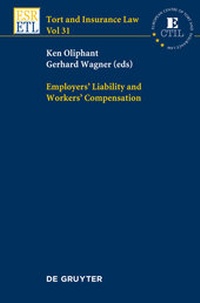
Employers' Liability and Workers' Compensation
1st Edition
Published on 15. October 2012
Book
Hardback
XL, 620 pages
978-3-11-026996-3 (ISBN)
Description
The European Centre of Tort and Insurance Law (ECTIL) with support by the Institute for European Tort Law embarked already in 2009 on a Comparative Project on Employers' Liability and Workers' Compensation.
The study - conducted in English and led by Ken Oliphant (Institute for European Tort Law, Vienna) and Gerhard Wagner (University of Bonn) - will consist of reports from Austria, Australia, Denmark, France, Germany, Italy, Japan, the Netherlands, Poland, Rumania, the United States of America and the United Kingdom. With regard to content the study will focus on the compensation of occupational diseases and accidents. Issues like discrimination, moral or sexual harassment and other damages claims of employees against their employer will be dealt with in the reports for countries where these issues are seen as a part of Employers' Liability (e.g. UK, USA), but not in detail. Major aspects of the reports will be a description of different existing compensation schemes, interactions between Employers' Liability and Workers' Compensation, a comparison of both systems and their respective efficiency.
Informationen zur Reihe:
Tort and Insurance Law
Bde. 1-26 bei Springer Science+Business Media ersch.
Liability law is rapidly changing in quite a number of countries. This is due to various factors, which are interrelated to a large extent: changing case law and legislation as well as increased and still increasing technical and medical knowledge. As a result, various occupational diseases can, for example, be attributed to working conditions or personal injury to specific products. From the very moment that causation can be proven, the question arises of whether or not liability can be established - with far-reaching economic consequences for all parties involved.
The rise of phenomena such as mass torts, multiple causation, joint and several liability or various heads of damages (like ecological damage and several diseases and affections) rapidly increases the interest in tort law. In the context of the interrelation between liability and insurance, attention must be paid to the question of whether certain liabilities are still coverable or not, and, if they are, to what amounts.
(The question of jurisdictions is of growing importance as is the question of whether a specific liability can be covered by insurance. In this context, one should bear in mind that the affordability of tort law also requires safe and sound insurers. The recent past has shown that there is a limit to their financial stability.)
The study - conducted in English and led by Ken Oliphant (Institute for European Tort Law, Vienna) and Gerhard Wagner (University of Bonn) - will consist of reports from Austria, Australia, Denmark, France, Germany, Italy, Japan, the Netherlands, Poland, Rumania, the United States of America and the United Kingdom. With regard to content the study will focus on the compensation of occupational diseases and accidents. Issues like discrimination, moral or sexual harassment and other damages claims of employees against their employer will be dealt with in the reports for countries where these issues are seen as a part of Employers' Liability (e.g. UK, USA), but not in detail. Major aspects of the reports will be a description of different existing compensation schemes, interactions between Employers' Liability and Workers' Compensation, a comparison of both systems and their respective efficiency.
Informationen zur Reihe:
Tort and Insurance Law
Bde. 1-26 bei Springer Science+Business Media ersch.
Liability law is rapidly changing in quite a number of countries. This is due to various factors, which are interrelated to a large extent: changing case law and legislation as well as increased and still increasing technical and medical knowledge. As a result, various occupational diseases can, for example, be attributed to working conditions or personal injury to specific products. From the very moment that causation can be proven, the question arises of whether or not liability can be established - with far-reaching economic consequences for all parties involved.
The rise of phenomena such as mass torts, multiple causation, joint and several liability or various heads of damages (like ecological damage and several diseases and affections) rapidly increases the interest in tort law. In the context of the interrelation between liability and insurance, attention must be paid to the question of whether certain liabilities are still coverable or not, and, if they are, to what amounts.
(The question of jurisdictions is of growing importance as is the question of whether a specific liability can be covered by insurance. In this context, one should bear in mind that the affordability of tort law also requires safe and sound insurers. The recent past has shown that there is a limit to their financial stability.)

More details
Product info
GB
Series
Edition
1. Auflage 2012
Language
English
Place of publication
Berlin
Germany
Target group
Insurers, People working with or for Insurers, Lawyers, Practitioners, Researchers
Dimensions
Height: 230 mm
Width: 155 mm
Thickness: 41 mm
Weight
1077 gr
ISBN-13
978-3-11-026996-3 (9783110269963)
Schweitzer Classification
Other editions
Additional editions
Ken Oliphant | Gerhard Wagner
Employers' Liability and Workers' Compensation
E-Book
10/2012
1st Edition
De Gruyter
€189.95
Available for download
Ken Oliphant | Gerhard Wagner
Employers' Liability and Workers' Compensation
Book
01/2012
1st Edition
De Gruyter
€289.00
Article exhausted; check different version
Persons
Ken Oliphant, Institute for European Tort Law, Vienna, Austria; Gerhard Wagner, University of Chicago, Chicago, USA.