

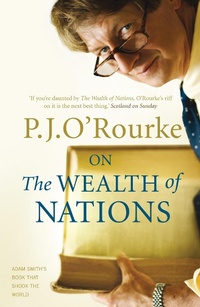
On The Wealth of Nations
A Book that Shook the World
Published on 1. October 2009
256 pages
978-1-84887-257-8 (ISBN)
Description

A New York Times Bestseller
As P. J. O'Rourke says, 'It's as if Smith, having proved that we can all have more money, then went on to prove that money doesn't buy happiness. And it doesn't. It rents it.'
Adam Smith's The Wealth of Nations was first published in 1776 and almost instantly was recognized as fundamental to an understanding of economics. It was also recognized as being really long and as P. J. O'Rourke points out, to understand The Wealth of Nations, the cornerstone of free-market thinking and a book that shapes the world to this day, you also need to peruse Smith's earlier doorstopper,The Theory of Moral Sentiments. But now you don't have to read either, because P. J. has done it for you.
In this hilarious work P. J. shows us why Smith is still relevant, why what seems obvious now was once revolutionary, and how the division of labour, freedom of trade and pursuit of self-interest espoused by Smith are not only vital to the welfare of mankind, they're funny too. He goes on to establish that far from being an avatar of capitalism, Smith was actually a moralist of liberty. As P. J. says, 'It's as if Smith, having proved that we can all have more money, then went on to prove that money doesn't buy happiness. And it doesn't. It rents it.'
As P. J. O'Rourke says, 'It's as if Smith, having proved that we can all have more money, then went on to prove that money doesn't buy happiness. And it doesn't. It rents it.'
Adam Smith's The Wealth of Nations was first published in 1776 and almost instantly was recognized as fundamental to an understanding of economics. It was also recognized as being really long and as P. J. O'Rourke points out, to understand The Wealth of Nations, the cornerstone of free-market thinking and a book that shapes the world to this day, you also need to peruse Smith's earlier doorstopper,The Theory of Moral Sentiments. But now you don't have to read either, because P. J. has done it for you.
In this hilarious work P. J. shows us why Smith is still relevant, why what seems obvious now was once revolutionary, and how the division of labour, freedom of trade and pursuit of self-interest espoused by Smith are not only vital to the welfare of mankind, they're funny too. He goes on to establish that far from being an avatar of capitalism, Smith was actually a moralist of liberty. As P. J. says, 'It's as if Smith, having proved that we can all have more money, then went on to prove that money doesn't buy happiness. And it doesn't. It rents it.'
More details
Series
Edition
Main
Language
English
Place of publication
London
United Kingdom
Target group
Professional and scholarly
College/higher education
File size
0,86 MB
ISBN-13
978-1-84887-257-8 (9781848872578)
Copyright in bibliographic data and cover images is held by Nielsen Book Services Limited or by the publishers or by their respective licensors: all rights reserved.
Schweitzer Classification
Other editions
Additional editions
Book
03/2008
Atlantic Books
€41.07
Article not available at the moment
Book
07/2007
Atlantic Books
€38.59
Article exhausted; check different version
Person
P. J. O'Rourke wrote more than twenty books on subjects as diverse as politics and cars and etiquette and economics. Parliament of Whores and Give War a Chance both reached #1 on the New York Times bestseller list. He was a contributing editor at the Weekly Standard, H. L. Mencken Research Fellow at the Cato Institute, a regular panellist on NPR's Wait Wait . . . Don't Tell Me, and editor-in-chief of the web magazine American Consequences. Long a resident of rural New England, as far away from the things he wrote about as he could get, he died in 2022 at the age of 74.
Content
- Intro
- Also by P. J. O'Rourke
- CONTENTS
- ACKNOWLEDGMENTS
- CHAPTER 1 An Inquiry into An Inquiry into the Nature and Causes of the Wealth of Nations
- Adam Smith's Simple Principles
- Why an Inquiry into Adam Smith's Simple Principles Is Not an Inquiry, First, into Adam Smith
- Adam Smith's Less Simple Principles
- Adam Smith's More Complicated Principles
- Adam Smith's Principles: Their Principal Effect
- CHAPTER 2 Why Is The Wealth of Nations So Damn Long?
- CHAPTER 3 The Theory of Moral Sentiments In the Augean Stables of the Human Condition, Adam Smith Tries to Muck Out the Stalls
- CHAPTER 4 The Wealth of Nations, Book 1 How the High Price of Freedom Makes the Best Things in Life Free
- The Wealth of Nations, Book 1
- The Divisibility of Labor
- The Indivisibility of Price
- Adam Smith, Capitalism's Scourge
- Adam Smith, Capitalism's Champion
- Adam Smith, Capitalism's Original Money Maven
- Adam Smith, Capitalism's Therapist
- CHAPTER 5 The Wealth of Nations, Book 2 'Of the Nature, Accumulation, and Employment of Stock' Let Adam Smith Be Your Market Guru
- Central Banking for Dummies
- What the Heck Is Money Anyway?
- And What Is a Bank?
- So What Are Banks Really Good For?
- So We Need to, Like, Regulate Banks
- What Is a 'Central' Bank?
- The Adam Smith Plan for Increased Wealth (of Nations): How Central Banks Can Use Paper Money to Make the Great Instrument of Commerce Work Cheap
- So There Are Limitations to What Private Banks and Central Banks Can Do to Improve the Economy, but Can't Institutions Like the World Bank Provide the Economic Stimulus We Need to Eliminate Poverty and Aid Developing Nations?
- CHAPTER 6 The Wealth of Nations, Book 2, Continued: Adam Smith, Un-Motivational Speaker
- The 13 Habits of Highly (It Is to Be Hoped) Ineffective Government Economic Planners
- 1. Be vulgar and obvious.
- 2. Let John Q. Citizen do all the work.
- 3. Make the whole government as unproductive as the economic planners are.
- 4. Keep government spending in check. Let other spending run wild.
- 5. Wreck the balance of trade.
- 6. Everybody hates lower trade barriers. Lower them anyway.
- 7. Human capital - it ain't just PhDs.
- 8. Buy retail.
- 9. Modern life is stressful, overscheduled, and job-obsessed - keep it that way.
- 10. Don't put your money in a safe place.
- 11. Get all confused about globalization.
- 12. Ignore the experts.
- 13. Especially, ignore the economists.
- CHAPTER 7 The Wealth of Nations, Book 3 'Of the different Progress of Opulence in different Nations' and How We Have the Stupidity of the Powerful to Thank for It
- CHAPTER 8 The Wealth of Nations, Book 4 'Of Systems of Political Economy' Adam Smith Tackles the Chinese Trade Menace
- CHAPTER 9 The Wealth of Nations, Book 4, Continued: Adam Smith versus the Ideological Swine When They Were Still Cute, Squealing Piglets
- CHAPTER 10 Adam Smith, America's Founding Dutch Uncle
- CHAPTER 11 The Wealth of Nations, Book 5 'Of the Revenue of the Sovereign or Commonwealth' Adam Smith, Policy Wonk
- 'Of the Expence of Justice'
- 'Of the Public Works and Institutions for facilitating the Commerce of Society'
- 'Of the Expence of the Institutions for the Instruction of People of all Ages'
- 'Of Taxes'
- CHAPTER 12 Adam Smith's Lost Book
- CHAPTER 13 An Inquiry into Adam Smith
- Who Adam Smith Really Was, and to What Extent It's None of Our Business
- Adam Smith's Life - A Very Economical Sketch
- CHAPTER 14 Adam Smith in Heaven
- APPENDIX
- NOTES
- BIBLIOGRPHY
- Works of Adam Smith
- Modern Library Editions
- The Glasgow Editions
- Other Books and Articles
- INDEX
