

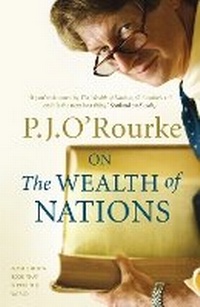
On The Wealth of Nations
A Book that Shook the World
Will be published approx. on 1. March 2008
Book
Paperback/Softback
256 pages
978-1-84354-389-3 (ISBN)
Description
A New York Times Bestseller
As P. J. O'Rourke says, 'It's as if Smith, having proved that we can all have more money, then went on to prove that money doesn't buy happiness. And it doesn't. It rents it.'
Adam Smith's The Wealth of Nations was first published in 1776 and almost instantly was recognized as fundamental to an understanding of economics. It was also recognized as being really long and as P. J. O'Rourke points out, to understand The Wealth of Nations, the cornerstone of free-market thinking and a book that shapes the world to this day, you also need to peruse Smith's earlier doorstopper, The Theory of Moral Sentiments. But now you don't have to read either, because P. J. has done it for you.
In this hilarious work P. J. shows us why Smith is still relevant, why what seems obvious now was once revolutionary, and how the division of labour, freedom of trade and pursuit of self-interest espoused by Smith are not only vital to the welfare of mankind, they're funny too. He goes on to establish that far from being an avatar of capitalism, Smith was actually a moralist of liberty.
As P. J. O'Rourke says, 'It's as if Smith, having proved that we can all have more money, then went on to prove that money doesn't buy happiness. And it doesn't. It rents it.'
Adam Smith's The Wealth of Nations was first published in 1776 and almost instantly was recognized as fundamental to an understanding of economics. It was also recognized as being really long and as P. J. O'Rourke points out, to understand The Wealth of Nations, the cornerstone of free-market thinking and a book that shapes the world to this day, you also need to peruse Smith's earlier doorstopper, The Theory of Moral Sentiments. But now you don't have to read either, because P. J. has done it for you.
In this hilarious work P. J. shows us why Smith is still relevant, why what seems obvious now was once revolutionary, and how the division of labour, freedom of trade and pursuit of self-interest espoused by Smith are not only vital to the welfare of mankind, they're funny too. He goes on to establish that far from being an avatar of capitalism, Smith was actually a moralist of liberty.
Reviews / Votes
O'Rourke is a glittering writer, light but punchy, wry and impassioned, witheringly witty one moment and rambunctiously sarcastic the next... This is a judicious, finely written book... consistently funny, with cracking asides and snarky interjections. If you're daunted by Wealth of Nations, O'Rourke's riff on it is the next best thing. -- Stuart Kelly * Scotland on Sunday * Pithy, forceful and deliberately anachronistic... A witty book. -- Andrew McKie * Daily Telegraph * P J O'Rourke has done the hard work for you by taking the 900-page masterpiece and compressing its ideas into a little over 200 breezy pages... razor sharp. -- Alex Moffatt * Irish Times * Sophisticated and comprehensive. -- Allister Heath * Literary Review *More details
Series
Edition
Main - Print on Demand
Language
English
Place of publication
London
United Kingdom
Dimensions
Height: 196 mm
Width: 130 mm
Thickness: 19 mm
Weight
211 gr
ISBN-13
978-1-84354-389-3 (9781843543893)
Copyright in bibliographic data and cover images is held by Nielsen Book Services Limited or by the publishers or by their respective licensors: all rights reserved.
Schweitzer Classification
Other editions
Additional editions
E-Book
10/2009
Atlantic Books
€11.49
Available for download
Person
P. J. O'Rourke wrote more than twenty books on subjects as diverse as politics and cars and etiquette and economics. Parliament of Whores and Give War a Chance both reached #1 on the New York Times bestseller list. He was a contributing editor at the Weekly Standard, H. L. Mencken Research Fellow at the Cato Institute, a regular panellist on NPR's Wait Wait . . . Don't Tell Me, and editor-in-chief of the web magazine American Consequences. Long a resident of rural New England, as far away from the things he wrote about as he could get, he died in 2022 at the age of 74.