

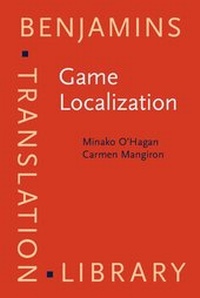
Game Localization
Translating for the global digital entertainment industry
1st Edition
Published on 29. August 2013
XII, 374 pages
978-90-272-7186-0 (ISBN)
Description

Video games are part of the growing digital entertainment industry for which game localization has become pivotal in serving international markets. As well as addressing the practical needs of the industry to facilitate translator and localizer training, this book seeks to conceptualize game localization in an attempt to locate it in Translation Studies in the context of the technologization of contemporary translation practices. Designed to provide a comprehensive introduction to the topic of game localization the book draws on the literature in Game Studies as well as Translation Studies. The book's readership is intended to be translation scholars, game localization practitioners and those in Game Studies developing research interest in the international dimensions of the digital entertainment industry. The book aims to provide a road map for the dynamic professional practices of game localization and to help readers visualize the expanding role of translation in one of the 21st century's key global industries.
More details
Other editions
Additional editions
Minako O'Hagan | Carme Mangiron
Game Localization
Translating for the global digital entertainment industry
Book
08/2013
John Benjamins Publishing Co
€38.16
Shipment within 10-15 days
Minako O'Hagan | Carme Mangiron
Game Localization
Translating for the global digital entertainment industry
Book
08/2013
John Benjamins Publishing Co
€104.94
Shipment within 10-15 days
Persons
Content
- Game Localization
- Editorial page
- Title page
- LCC page
- Table of contents
- Figures and tables
- Acknowledgements
- About this book
- Aim and structure of the book
- Target readers
- Conventions used in this book
- Glossary
- Prologue
- Introduction
- Rationale
- Context
- An overview of translation studies research trajectories in game localization
- General trends in game localization research
- Key research areas
- Approach
- 1. The video game and translation
- Introduction
- 1.1 A historical sketch of video game localization
- 1.1.1 Early days: Before the mid-1980s
- 1.1.2 Growth phase: The mid-1980s to mid-1990s
- 1.1.3 Development phase: The mid- to late 1990s
- 1.1.4 Maturing phase: Early 2000 to 2005
- 1.1.5 Advancing phase: 2005 to the present
- 1.2 Video games: Domain, terminology and characteristics
- 1.2.1 Key terminology: Video game vs. computer game
- 1.2.2 Defining a video game
- 1.2.3 Game genres
- 1.2.4 Video games as transmedia
- 1.2.5 Video game theory: Narrative theory versus play theory
- 1.3 The structure of the video game industry
- 2. The localization paradigm: Localization versus translation
- Introduction
- 2.1 Software localization defined by practice: Internationalization
- 2.2 New dimensions of localization
- 2.2.1 Cultural representations and adaptation required in software localization
- 2.2.2 Localization facilitated by technology
- 2.3 Localization in Translation Studies
- 2.4 Game localization or game translation?
- 2.5 An absence of agency in localization speak
- 3. Game localization: A practical dimension
- Introduction
- 3.1 Video games and GILT: Localization-friendly game development
- 3.2 Game localization models
- 3.2.1 Outsourcing model
- 3.2.2 In-house model
- 3.3 Game assets requiring localization
- 3.3.1 In-game text
- 3.3.2 Art assets
- 3.3.3 Audio and cinematic assets
- 3.3.4 Printed materials
- 3.4 The localization process
- 3.4.1 Pre-localization
- 3.4.2 Translation
- 3.4.3 Editing
- 3.4.4 Recording
- 3.4.5 Post-localization
- 3.4.6 Submission of release candidate version
- 3.4.7 Production and distribution
- 3.4.8 Game localization scenario
- 3.5 Levels of localization
- 3.6 Tools used in game translation
- 4. Translating video games: New vistas for transcreation
- Introduction
- 4.1 Game text taxonomy and text function
- 4.1.1 Game text: Play and narrative dimensions
- 4.1.2 Game text taxonomy and translation
- 4.2 Translation strategies applied in game localization
- 4.2.1 Translation strategies for pragmatic translation problems
- 4.2.2 Translation strategies for interlingual translation problems
- 4.3 A brief case study of Square Enix
- 4.3.1 Overview
- 4.3.2 Examples of innovation and appropriation of translation
- 4.4 The translator as a creative agent: Game localization as transcreation
- 4.4.1 Internal knowledge versus external knowledge as professional norms versus expectancy norms
- 4.4.2 Translator's agency and transcreation
- 5. Cultural contexts of game production: Patronage and rewriting in the digital age
- Introduction
- 5.1 Video games as cultural products
- 5.1.1 Game culture: Japan versus the US
- 5.1.2 Cultural content in games and cultural localization
- 5.2 Cultural adjustments
- 5.2.1 Mandatory requirements for changes
- 5.2.2 Market-driven adjustments: Market relevance and preferences
- 5.3 Culture of game production: Power game
- 5.4 Game localization as rewriting
- 6. Pedagogical issues in training game localizers
- Introduction
- 6.1 Game localization as an emerging professional translation activity
- 6.2 Training future game localizers
- 6.2.1 Game localizers' competence
- 6.2.2 Course design
- 6.2.3 Assessment
- 6.3 Teaching materials and human resources
- 6.3.1 The eCoLoMedia game localization course
- 6.4 Pedagogy in game localization: A vocational or an academic focus?
- 7. Game localization research in Translation Studies
- Introduction
- 7.1 Game localization and accessibility research
- 7.1.1 Game accessibility and accessibility barriers in video games
- 7.1.2 Benefits of game accessibility
- 7.1.3 Research on game accessibility
- 7.2 Game localization and fan studies: Fans as co-creators
- 7.2.1 Fan culture represented in the form of fan work
- 7.2.2 Fan translation: Translation hacking and crowdsourcing
- 7.2.3 Fan translator expertise versus professional expertise
- 7.3 A new research direction in Translation Studies: User-focused empirical research
- 7.3.1 Player experience studies
- 7.3.2 Natural language interaction through AI, chatbot, and speech recognition
- Conclusion
- Game localization, game translation or game transcreation?
- Translation quality and users
- Localization directionality and regional variations of language
- International game design and internationalization
- Technology applications and the future of game localization
- References
- Gameography
- Appendix. Postgraduate courses in game localization in Spain
- Index
