

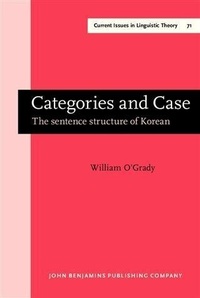
Categories and Case
The sentence structure of Korean
1st Edition
Published on 8. May 1991
VII, 294 pages
978-90-272-7795-4 (ISBN)
Description

The principal objective of this book is to provide a unified treatment of morphological case in Korean. Focussing on the nominative, accusative and dative suffixes, the author seeks to show that each of these morphemes consistently encodes a corresponding combinatorial relation in the 'surface' form of sentences.In support of his analysis, the author discusses a broad and representative range of Korean case marking patterns, providing one of the more complete treatments of case available for any language. This book should therefore be useful not only to Koreanists but also to researchers interested in the case systems of other languages.Written in a style that makes it accessible to readers from a variety of backgrounds in linguistics and other disciplines, Categories and Case also provides a good introduction to many important syntactic phenomena in the Korean language.
More details
Other editions
Additional editions
Book
05/1991
John Benjamins Publishing Co
€127.20
Shipment within 10-15 days
Content
- CATEGORIES AND CASE THE SENTENCE STRUCTURE OF KOREAN
- Editorial page
- Title page
- Copyright page
- Table of contents
- Acknowledgements
- List of Abbreviations
- The Yale System of Romanization
- 1. The Problem
- The Case Suffixes of Korean
- The Status of the Dative Marker
- The Status of the Topic Marker
- Theoretical Objectives
- Concluding Remarks
- 2. The Grammar
- Sentence Structure
- 3. Grammatical Relations and Thematic Roles
- THEMATIC ROLES
- 4. The Case System
- The Dative Postposition
- The Genitive Suffix
- The Topic Suffix
- 5. Passivization and Dative Advancement
- Passives
- Dative Advancement
- The Interaction between Passivization and Recipient Conversion
- 6. Possessor Ascension
- Ascension to Direct Object
- Ascension to Subject
- The Interaction between Possessor Ascension and Passivization
- Case Marking of Other Nonterm NPs
- 7. Inversion Constructions
- Inversion Structures
- The Noninversion Pattern
- 8. FocusConstructions
- Focus Structures vs. Judgment Structures
- Some Residual Matters
- The Interaction of Passivization and Focus Constructions
- 9. Subject-to-Object Raising
- Interaction with 'Possessor Ascension'
- Functional composition
- 10. Lexical Causatives
- A Proposal for Lexical Causatives
- Causativization and Passivization
- 11. Syntactic Causatives
- The Nominative-Nominative-Accusative Pattern
- The Nominative-Dative-Accusative Pattern
- The Nominative-Accusative-Accusative Pattern
- Cohesion in Causative Constructions
- Passivization in Syntactic Causatives
- The Emphatic Ku Construction
- 12. Case and Word Order
- Evidence from Pronoun Interpretation
- Evidence from Quantifier Interpretation
- 13. Floated Quantifiers
- The Interpretation of Floated Quantifiers
- Some Interactions with Other Rules
- 14. Some Special Challenges
- Accusative-marked Locatives
- Some Possible Extensions
- Ha-ta Constructions
- The Toy-ta Passive
- 15. The Acquisition Problem
- The Acquisition of Syntactic Structure
- STEP 1: THE ACQUISITION OF THE CASE CONVENTIONS
- Step 2: The Use of Case Conventions in Subsequent Acquisition
- 16. Concluding Remarks
- Notes
- Notesfor Chapter One
- Notes for Chapter Two
- Notes for Chapter Three
- Notes for Chapter Four
- Notes for Chapter Five
- Notes for Chapter Six
- Notes for Chapter Seven
- Notes for Chapter Eight
- Notes for Chapter Nine
- Notes for Chapter Ten
- Notes for Chapter Eleven
- Notes for Chapter Twelve
- Notes for Chapter Thirteen
- Notes for Chapter Fourteen
- Notes for Chapter Fifteen
- REFERENCES
- Index
