

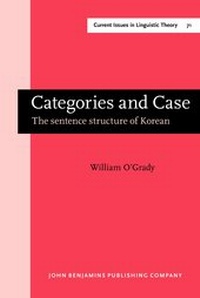
Categories and Case
The sentence structure of Korean
Published on 8. May 1991
Book
Hardback
294 pages
978-90-272-3569-5 (ISBN)
Description
The principal objective of this book is to provide a unified treatment of morphological case in Korean. Focussing on the nominative, accusative and dative suffixes, the author seeks to show that each of these morphemes consistently encodes a corresponding combinatorial relation in the 'surface' form of sentences.In support of his analysis, the author discusses a broad and representative range of Korean case marking patterns, providing one of the more complete treatments of case available for any language. This book should therefore be useful not only to Koreanists but also to researchers interested in the case systems of other languages.Written in a style that makes it accessible to readers from a variety of backgrounds in linguistics and other disciplines, Categories and Case also provides a good introduction to many important syntactic phenomena in the Korean language.
More details
Series
Language
English
Place of publication
Amsterdam
Netherlands
Target group
College/higher education
Professional and scholarly
Dimensions
Height: 245 mm
Width: 164 mm
Weight
530 gr
ISBN-13
978-90-272-3569-5 (9789027235695)
Copyright in bibliographic data and cover images is held by Nielsen Book Services Limited or by the publishers or by their respective licensors: all rights reserved.
Schweitzer Classification
Other editions
Additional editions
E-Book
05/1991
1st Edition
John Benjamins Publishing Company
€149.99
Available for download
Content
1. 1. The Problem; 2. 2. The Grammar; 3. 3. Grammatical Relations and Thematic Roles; 4. 4. The Case System; 5. 5. Passivization and Dative Advancement; 6. 6. Possessor Ascension; 7. 7. Inversion Constructions; 8. 8. Focus Constructions; 9. 9. Subject-to-Object Raising; 10. 10. Lexical Causatives; 11. 11. Syntactic Causatives; 12. 12. Case and Word Order; 13. 13. Floated Quantifiers; 14. 14. Some Special Challenges; 15. 15. The Acquisition Problem; 16. 16. Concluding Remarks; 17. References