

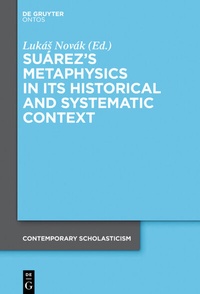
Suárez's Metaphysics in Its Historical and Systematic Context
Description

Although the importance of Francisco Suárez has been, for some time already, generally recognized even outside the circles of historians of scholasticism, the wider context of his thought - i.e., the rich and diverse Renaissance and Baroque scholasticism - remains largely unexplored. This book is an attempt to contribute to the quest of putting Suárez's metaphysics (a mere fragment of the whole of his intellectual legacy) into context, historical and systematic.
Being the fruit of an international conference held in Prague in October 2008, it puts together a systematically ordered selection of papers devoted to general and specific topics of Suárezian metaphysics, with special respect to its sources and further impact.
Part One explores in the first place the notion of being and the nature of metaphysics in general; Part Two then deals with more specific metaphysical topics such as the problem of universals, causality, relations, and God. The book will be of value not just to Suárez-scholars, but to anyone interested in the history of ideas in general and in the the intricacies of metaphysical thought at the verge of modernity in particular.
More details
Other editions
Additional editions
Person
Content
2 - Regaining the Context for Suárez an Introduction to the Volume [Seite 7]
3 - Note on Editorial Policies. List of Abbreviations [Seite 14]
4 - Part One. General Metaphysics [Seite 17]
4.1 - In Search of The Roots of Suárez'S Conception of Metaphysics: Aquinas, Bonino, Hervaeus Natalis, Orbellis, Trombetta [Seite 19]
4.2 - Zum Historischen Hintergrund Der Transzendentalienlehre In Den Disputationes Metaphysicae [Seite 45]
4.3 - Suárez On Translatio Vocis 'Veritas [Seite 69]
4.4 - Francisco Suárez, The Analogy Of Being, and its Tensions [Seite 93]
4.5 - Univozität und Distinktion Metaphysische Grundstrukturen bei Duns Scotus, Suárez, Descartes und Spinoza [Seite 111]
4.6 - The Hidden Influence of Suárez on Kant'S Transcendental Conception of 'Being', 'Essence' and 'Existence [Seite 123]
4.7 - Ontology Between Goclenius And Suárez [Seite 141]
4.8 - Das Gedankending und der Gegenstand der Metaphysik eine Untersuchung zum Problem der Analogie Zwischen dem Realen Seienden und dem Ens Rationis in den Disputationes Metaphysicae des Suárez [Seite 159]
4.9 - The Historical Non-Significance of Suárez'S Theory of Beings of Reason: A Lesson from Hurtado [Seite 189]
5 - Part Two. Special Themes [Seite 215]
5.1 - Suárez'S Nominalist Master Argument: Metaphysical Disputations 5, 1 [Seite 217]
5.2 - The Efficient Cause in Domingo de Soto [Seite 243]
5.3 - The Connexions Between Vital Acts in Suárez'S Psychology [Seite 265]
5.4 - Scotus and Suárez on Sympathy: The Necessity of the "Connexio Potentiarum" in The Present State [Seite 281]
5.5 - Suárez and the Problem of Final Causation [Seite 299]
5.6 - Suárez in Relation to Anselm, Aquinas and Scotus on Proving God'S Existence [Seite 315]
6 - Author Profiles [Seite 331]
7 - About the Editor [Seite 335]
8 - General Index [Seite 337]
9 - Index of Persons [Seite 351]
10 - Index of Greek Terms [Seite 354]
