

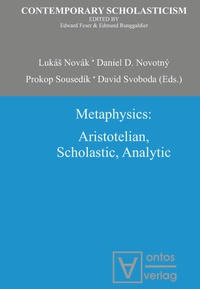
Metaphysics
Description

Throughout the greater part of the twentieth century, both in the analytic and continental traditions, metaphysics was deemed to be passé. The last few decades, however, have witnessed a remarkable growth of interest among analytic philosophers in various traditional metaphysical topics, such as modality, truth, causality, etc. which resulted in the emergence of various forms of analytic metaphysics. The new forms of metaphysics differ from its traditional forms mostly in their methodology (we may notice various applications of contemporary formal logical techniques) and in the range of proposed solutions to particular problems. Besides these and other differences, however, there are also many similarities and there are even some who intentionally develop traditional metaphysical themes using the contemporary analytical methods. All these developments call for detailed exploration, which is the general goal of the present publication Metaphysics: Aristotelian, Scholastic, Analytic. The publication is the fruit of the conference which took place in Prague in 2010 and which had for its aim to bring together those willing to explore relations between the traditional and contemporary concerns, both from among the leading analytic philosophers working in metaphysics and the historians of philosophy devoted to the study of the metaphysical tradition. The specific focus of the conference was a re-examination of topics such as categories, metaphysical structure, substance and accident, existence, modalities, and predication.
More details
Other editions
Additional editions
Content
2 - PREFACE [Seite 9]
3 - SECTION I: CATEGORIES AND BEYOND [Seite 13]
3.1 - What is an Ontological Category? [Seite 15]
3.2 - Scholastic Debates about Beings of Reason and Contemporary Analytical Metaphysics [Seite 29]
4 - SECTION II: METAPHYSICAL STRUCTURE [Seite 45]
4.1 - What Is Constituent Ontology? [Seite 47]
4.2 - Elemental Transformation in Aristotle: Three Dilemmas for the Traditional Account [Seite 63]
4.3 - Essential Dependence, Truthmaking, and Mereology: Then and Now [Seite 77]
5 - SECTION III: SUBSTANCE & ACCIDENT [Seite 95]
5.1 - Essence and Ontology [Seite 97]
5.2 - An Aristotelian Argument Against Bare Particulars [Seite 117]
5.3 - The Ontology of Number: Is Number an Accident? [Seite 127]
6 - SECTION IV: EXISTENCE [Seite 145]
6.1 - Existential Inertia [Seite 147]
6.2 - Aquinas vs. Buridan on Essence and Existence, and the Commensurability of Paradigms [Seite 173]
7 - SECTION V: MODALITIES [Seite 187]
7.1 - Potentiality in Scholasticism (potentiae) and the Contemporary Debate on "Powers" [Seite 189]
7.2 - Dispositional Necessity and Ontological Possibility [Seite 199]
7.3 - The Optimal and the Necessary in Leibniz' Mathematical Framing of the Compossible [Seite 213]
8 - SECTION VI: PREDICATION [Seite 231]
8.1 - The Interpretation(s) of Predication [Seite 233]
8.2 - Towards a Thomistic Theory of Predication [Seite 251]
9 - Authors [Seite 261]
10 - General Index [Seite 267]
11 - Index of Persons [Seite 285]
