

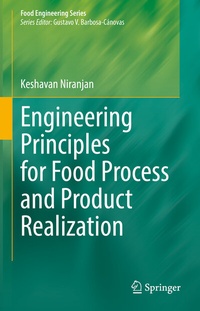
Engineering Principles for Food Process and Product Realization
Description

As an introductory text book on food engineering principles, this text gives students a firm, quantitative foundation in all aspects of food process and product formulation, packaging, manufacturing processes; engineering aspects of the fate of food in the GI tract; engineering principles of the environmental impact of foods; and principles of process economics and project management. The contents are based on a new definition of Food Engineering which is fit-for-purpose for this day and age:
Food Engineering is the work of designing, formulating and manipulating food products which have desired sensory, satiety, health and well-being responses; and developing - across various operational scales - designs for the lowest environmental impact processing, packaging and storage systems capable of realizing the products.
Based on this definition, Engineering Principles for Food Process and Product Realization re-defines the core competencies of food engineering, covers the engineering principles needed for food process and product design, and examines the engineering principles relevant to the interactions between food on the one hand, and human health, security and environment on the other - which are the key drivers for the growth of food business. With security, human health and environmental legacy driving business, the engineering paradigm must shift from being farm and preservation focused to becoming consumer focused - which this book aims to achieve.
All of these topics are covered at a level that is easy to read and absorb, but with challenging questions and problems which require knowledge integration across topics. This book is uniquely placed to serve as an effective launching pad for undertaking further studies on advanced topics and concepts relating to the design of food processes and products.
More details
Other editions
Additional editions
Person
Content
Mass and Energy Balances.- Elements of fluid flow.- Elements of Heat transfer.- Elements of Mass transfer.- Reaction kinetics.- Phase and Reaction Equilibrium, and phase transitions.- Thermal processing of foods.- Environmental issues in food engineering.- An engineering view of the fate of food in the Gastrointestinal tract (GIT).- A selection of engineering methodologies for food product realization.- Index.
