

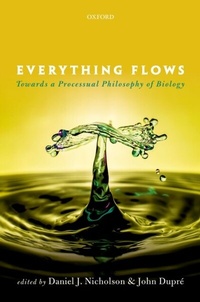
Everything Flows
Towards a Processual Philosophy of Biology
1st Edition
Published on 24. May 2018
424 pages
978-0-19-108517-8 (ISBN)
Description

This is an open access title available under the terms of a CC BY-NC-ND 4.0 International licence. It is free to read at Oxford Scholarship Online and offered as a free PDF download from OUP and selected open access locations.
Everything Flows explores the metaphysical thesis that the living world is not made up of substantial particles or things, as has often been supposed, but is rather constituted by processes. The biological domain is organised as an interdependent hierarchy of processes, which are stabilized and actively maintained at different timescales. Even entities that intuitively appear to be paradigms of things, such as organisms, are actually better understood as processes. Unlike previous attempts to articulate processual views of biology, which have tended to use Alfred North Whitehead's panpsychist metaphysics as a foundation, this book takes a naturalistic approach to metaphysics. It submits that the main motivations for replacing an ontology of substances with one of processes are to be found in the empirical findings of science. Biology provides compelling reasons for thinking that the living realm is fundamentally dynamic, and that the existence of things is always conditional on the existence of processes. The phenomenon of life cries out for theories that prioritise processes over things, and it suggests that the central explanandum of biology is not change but rather stability, or more precisely, stability attained through constant change. This edited volume brings together philosophers of science and metaphysicians interested in exploring the prospects of a processual philosophy of biology. The contributors draw on an extremely wide range of biological case studies, and employ a process perspective to cast new light on a number of traditional philosophical problems, such as identity, persistence, and individuality.
More details
Other editions
Additional editions
Book
06/2018
Oxford University Press
€160.40
Shipment within 15-20 days
Persons
Daniel J. Nicholson is a research fellow currently based at Egenis, The Centre for the Study of Life Sciences, at the University of Exeter. Previously, he held appointments at the Cohn Institute for the History and Philosophy of Science and Ideas in Tel Aviv, as well as at the Konrard Lorenz Institute for Evolution and Cognition Research near Vienna. His work is characterized by an integrated and strongly interdisciplinary approach to the history and philosophy of biology, with a specific interest in the ontology of living systems and the adequacy of mechanistic explanations to make sense of them. He is also interested in general topics in the philosophy of science and in theoretical biology, broadly construed.
John Dupré is Professor of Philosophy and Director of Egenis, The Centre for the Study of Life Sciences, at the University of Exeter. He has formerly held posts at Oxford, Birkbeck College, London, and Stanford, and visiting chairs at the University of Amsterdam and Cambridge. He has wide-ranging interests in the philosophy of biology, the philosophy of science generally, and naturalistic, empirically grounded metaphysics. He is a former president of the British Society for Philosophy of Science, and a Fellow of the American Association for the Advancement of Science.
Content
- Cover
- Everything Flows: Towards a Processual Philosophy of Biology
- Copyright
- Contents
- Acknowledgements
- Contributors
- Foreword
- References
- PART I: Introduction
- 1: A Manifesto for a Processual Philosophy of Biology
- 1. Introduction
- 2. Historical Background
- 3. The Organicist Precedent
- 4. Processes and Things
- 5. Empirical Motivations
- 5.1. Metabolic turnover
- 5.2. Life cycles
- 5.3. Ecological interdependence
- 6. Philosophical Payoffs
- 6.1. Grounding critiques of essentialism
- 6.2. Grounding critiques of reductionism
- 6.3. Grounding critiques of mechanicism
- 7. Biological Consequences
- 7.1. Physiology
- 7.2. Genetics
- 7.3. Evolution
- 7.4. Medicine
- 8. Conclusions
- 9. Overview of Contributions
- References
- PART II: Metaphysics
- 2: Processes and Precipitates
- 1. Introduction
- 2. The Continuant/Occurrent Duality
- 3. Specification
- 4. The Priority Question
- 5. Reasons to Take Processes as Fundamental
- 6. (Just a Few) Kinds of Processes in Biology
- 7. Continuants out of Processes
- 8. Abstraction
- 9. Abstracting to Continuants
- 10. Modal Properties
- 11. Consequences for Biology
- References
- 3: Dispositionalism: A Dynamic Theory of Causation
- 1. A Received Orthodoxy
- 2. Causation in Biology
- 3. Dispositions and Processes
- 4. Static or Dynamic?
- 5. Conclusions
- Acknowledgements
- References
- 4: Biological Processes: Criteria of Identity and Persistence
- 1. Introduction
- 2. Ontological Explanation for Scientific Domains
- 3. An Argument for Biological Process Ontology
- 4. Criteria of Identity and the Individuation of Processes
- 5. Process Persistence: Identity versus Composition
- 5.1. The endurance of substances
- 5.2. The perdurance of processes
- 6. Conclusions
- Acknowledgements
- References
- 5: Genidentity and Biological Processes
- 1. Introduction
- 2. What Is Genidentity? And How Can It Be Applied to the Living World?
- 3. The Inconspicuous Centrality of Genidentity in Hull's Conception of Biological Individuality
- 4. Why Cases of Symbiosis Strengthen the Genidentity View
- 5. How Genidentity Helps Define What an Organism Is
- 6. Genidentity as a Way to Shed Light on the Notion of Biological Process: 'Priority' as the Central Question
- 7. Conclusions
- Acknowledgements
- References
- 6: Ontological Tools for the Process Turn in Biology: Some Basic Notions of General Process Theory
- 1. Introduction
- 2. General Processes or Dynamics: A New Category
- 3. Relationships among General Processes: GPT's 'Levelled Mereology'
- 4. A Typology of Processes
- 4.1. Spatio-temporal signature
- 4.2. Participant structure
- 4.3. Dynamic composition
- 4.4. Dynamic shape
- 4.5. Dynamic context
- 5. Applying GPT in the Philosophy of Biology
- 5.1. Biological individuality
- 5.2. Biological composition
- 5.3. Emergence
- 6. Conclusions
- Acknowledgements
- References
- PART III: Organisms
- 7: Reconceptualizing the Organism: From Complex Machine to Flowing Stream
- 1. Introduction
- 2. Organisms ? Machines: The Argument from Thermodynamics
- 2.1. Addressing potential objections to the argument
- 3. The Stream of Life: A Processual Conception of the Organism
- 4. Organisms as Streams: Three Lessons for Biological Ontology
- 4.1. First ontological lesson: 'Activity is a necessary condition for existence'
- 4.2. Second ontological lesson: 'Persistence is grounded in the continuous self-maintenance of form'
- 4.3. Third ontological lesson: 'Order does not entail design'
- 5. Conclusions
- Acknowledgements
- References
- 8: Objectcy and Agency: Towards a Methodological Vitalism
- 1. Introduction
- 2. An Ontological Surprise
- 3. Phases
- 4. Agential Dynamics
- 5. Object Theories and Agent Theories
- 5.1. Objectcy
- 5.2. Agency
- 6. Evolution and Agency
- 7. Conclusions
- Acknowledgements
- References
- 9: Symbiosis, Transient Biological Individuality, and Evolutionary Processes
- 1. Introduction
- 2. Beyond Replicators
- 3. Seeing the Light
- 4. Transient and Intermittent Individuals
- 5. Conclusions
- Acknowledgements
- References
- 10: From Organizations of Processes to Organisms and Other Biological Individuals
- 1. Introduction
- 2. Some Implications of the Promiscuous Individualism Thesis Combined with a Hypercollaborative View of Life
- 3. A Process-Based Organizational Ontology for Biology
- 3.1. Simple self-maintenance
- 3.2. Minimal recursive self-maintenance and biological individuality
- 3.3. Recursive self-maintenance and the organismality of unicellular organizations
- 4. Collaboration and Multicellular Systems
- 4.1. A case of collaboration among single-species bacteria
- 4.2. A case of early eukaryotic collaboration
- 4.3. A case of eumetazoan collaboration
- 5. Revisiting the Implications of Promiscuous Individualism and an Excessively Collaborative View of Life
- 5.1. Organisms and other biological individuals
- 5.2. The individual and the organismal status of microbial communities
- 5.3. The distinction between life and non-life
- 6. Conclusions
- Acknowledgements
- References
- PART IV: Development and Evolution
- 11: Developmental Systems Theory as a Process Theory
- 1. Introduction
- 2. Process Biology
- 3. Process in the Developmental Systems Tradition
- 4. Core Ideas in DST: Epigenesis and Developmental Dynamics
- 4.1. Epigenesis
- 4.2. Developmental dynamics
- 5. An Ontology for DST: Genomes, Epigenomes, and Developmental Niches
- 6. DST as a Process Theory of the Organism
- 7. Conclusions
- Acknowledgements
- References
- 12: Waddington's Processual Epigenetics and the Debate over Cryptic Variability
- 1. Introduction
- 2. Substance versus Process: Two Conflicting Ontologies for Biology
- 3. Waddington's Epigenetics in the Context of Dynamical Systems Theory
- 4. Development as the Homeorhetic Balance between Robustness and Plasticity
- 5. Evolutionary Implications: The Genetic Assimilation of Acquired Characters
- 6. Assessing Two Contemporary Models of the Canalization of Development
- 6.1. How the two models differ in their interpretation of cryptic variability
- 6.2. Do both models capture the homeorhetic nature of canalization?
- 7. Conclusions
- Acknowledgements
- References
- 13: Capturing Processes: The Interplay of Modelling Strategies and Conceptual Understanding in Developmental Biology
- 1. Introduction
- 2. In Vivo Imaging and the Four-Dimensional Conceptualization of Life
- 3. Resolution, Contextuality, and the Return of Organicism
- 4. Reconstructing and Explaining Developmental Processes
- 5. Conclusions
- Acknowledgements
- References
- 14: Intersecting Processes Are Necessary Explanantia for Evolutionary Biology, but Challenge Retrodiction
- 1. Introduction
- 2. An Increasingly Appreciated Issue: The Underdetermination of Phylogenetic Trees
- 3. Intersecting Processes Are Also Absent from Phylogenetic Networks
- 4. The Need to Investigate Reticulate Intersecting Processes in Evolutionary Studies
- 4.1. Explaining the evolution of translation with a hypercycle
- 4.2. Explaining the evolution of biological functions by network analyses
- 5. Processes, and Hence Explanantia, Evolve
- 6. Conclusions: Towards a Typology of Processes
- Acknowledgements
- References
- PART V: Implications and Applications
- 15: A Process Ontology for Macromolecular Biology
- 1. Introduction
- 2. The Ecological Model of the World
- 2.1. Ecosystems, machines, and the environment
- 2.2. Internal versus external relations
- 2.3. Substance versus process
- 3. Problems with the Ecological Model
- 4. Symbiosis and the Importance of Integrated Capacities
- 4.1. Termites and their capacity to survive and reproduce
- 4.2. Process and individuality
- 4.3. Distributed capacities
- 4.4. The ecology of powers
- 4.5. Component versus integrated capacities
- 4.6. Integrated capacities at all levels?
- 5. Proteins, Structure, and Capacities
- 5.1. From structure to power?
- 5.2. More than just collaboration
- 5.3. Towards a general process account for macromolecular biology
- 6. Conclusions
- Acknowledgements
- References
- 16: A Processual Perspective on Cancer
- 1. Introduction
- 2. Cancer as a Process
- 3. The Relational Ontology of Levels
- 4. Morphogenetic Fields
- 5. Conclusions
- Acknowledgements
- References
- 17: Measuring the World: Olfaction as a Process Model of Perception
- 1. Introduction: Why Things Stink
- 2. The Received View: The Input Determines the Perceptual Experience
- 3. The Neural Basis of Olfaction and the Idea of Forecasting in Perception
- 4. The Interactivity of Forecasting and Stimulus Input in Perception
- 5. Conclusions: Perception as a Measure of Changing Signal Ratios and Expectancy Effects
- Acknowledgements
- References
- 18: Persons as Biological Processes: A Bio-Processual Way Out of the Personal Identity Dilemma
- 1. Introduction
- 2. Elimination or Mystification: The Personal Identity Dilemma
- 3. The Thing-Ontological Roots of the Dilemma: Substances, Bundles, and the Disappearance of Change
- 4. A Way Out: Persons as Biological Processes
- 5. Conclusions
- Acknowledgements
- References
- Index
