

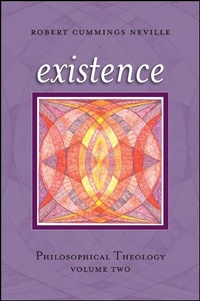
Existence
Description

All prices
More details
Other editions
Person
Robert Cummings Neville is Professor of Philosophy, Religion, and Theology and Dean Emeritus of the School of Theology at Boston University. He is the author of many books, including Realism in Religion: A Pragmatist's Perspective; Ritual and Deference: Extending Chinese Philosophy in a Comparative Context; and Ultimates: Philosophical Theology, Volume One, all published by SUNY Press.
Content
Cross-References
Preface
Introduction
I. The Existential Dimensions of Religion
II. The Human Condition, Suffering, and Semiotics
III. Universality of Religion
IV. Ontological Ultimacy: Death and Life
Part I. Ultimate Boundary Conditions
Part I. Preliminary Remarks
1. Form as the Condition of Obligation
I. Form and Human Possibility
II. Value
III. Obligation
IV. Obligations: Moral, Social, Personal, and Natural
2. Components as the Condition for Grounded Wholeness
I. Deference and Integration
II. Mythos: Orientation to Wholeness
III. Some Contemporary Christian Re-Mythologies
IV. Comportments: Appropriation, Deference, Negotiating Change, Realism
3. Existential Location as the Condition for Engagement
I. The Cosmology of Existential Location
II. Contours, Value, and Otherness
III. Human Engagement across the Existential Field
IV. Modes of Engagement: Awareness, Appreciation, Courage, Love
4. Value-Identity as the Condition for Meaning
I. The Cosmology of Value-Identity
II. The Eternity of Value-Identity
III. The Symbolism of Meaning
IV. Modes of Achievement: Personal Goals, Contributions to Nature and Society, Facing Suffering, Relating to Ultimacy
Part I. Summary Implications
Part II. Predicaments and Deliverances
Part II. Preliminary Remarks
5. Guilt and Justification
I. Failure of Obligation: Damnation, Betrayal, Existential Refusal, Blood Guilt
II. Brokenness of Obligation
III. Deliverance from Moral and Social Guilt: Redemption and Restoration
IV. Deliverance from Personal and Natural Guilt: Sagacity and Purification
6. Disintegration and Centeredness
I. Disintegration: Alienation, Arrogance, Suffering, Delusion
II. Centeredness: Deliverance from Disintegration
III. Deliverance from Alienation and Arrogance: Healing and Humility
IV. Deliverance from Suffering and Delusion: Comfort and Enlightenment
7. Estrangement and Connection
I. Estrangements: Denial, Distortion, Despair, Hate
II. Connection
III. Deliverance from Denial and Distortion: Acceptance and Purgation
IV. Deliverance from Despair and Hate: Faith and Reconciliation
8. Meaninglessness and Happiness
I. Destruction of Meaning: Impotence, Isolation, Apathy, Non-Being
II. The Ambiguity of Absolute Value-Identity
III. Deliverance from Impotence and Isolation: Renunciation and Dedication
IV. Deliverance from Apathy and Non-Being: Submission and Affirmation
Part II. Summary Implications
Part III. Ecstatic Fulfillments
Part III. Preliminary Remarks
9. Ecstatic Meaning in Time
I. Meaning in Life
II. Historical Apocalyptic
III. Cosmic Apocalyptic
IV. Time within Eternity
10. Ecstatic Life in Eternity
I. The Problem of Ultimate Meaning
II. Mapping the Infinite onto the Finite
III. Eternal Life and Its Temporal Maps
IV. The Truth of Finite Symbols of Ultimate Meaning
11. Ecstatic Love
I. Gratuity
II. Arbitrariness
III. Undeservedness
IV. Surprise
12. Ecstatic Freedom
I. Cosmological Freedom
II. Release from Attachment to Finding Meaning
III. Freedom in Becoming a Sign of Ultimacy
IV. Freedom to Love
Part III. Summary Implications
Part IV. Engagement and Participation
Part IV. Preliminary Remarks
13. Ritual
I. Anthropological Understandings of Ritual
II. A Ritual Analysis
III. Confucian Understandings of Ritual
IV. Ritual Engagement
14. Commitment
I. Bio-Developmental Dimensions of Commitment
II. Religious Commitment and Worldviews
III. Intensity of Religious Commitment
IV. Sharing of Religious Commitment
15. The Life of Faith
I. Preparation
II. Presence and Action
III. Relationships
IV. Faith Enduring Change and Death
16. Inhabitation of a Sacred Worldview
I. Sacred Worldviews
II. Inhabiting Absolute Value-Identity
III. The Ontological Shock of Creation
IV. Chaos and Containment
Part IV. Summary Implications
Notes
Bibliography
Index
