
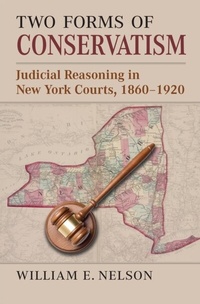
Two Forms of Conservatism
Description
Alles über E-Books | Antworten auf Fragen rund um E-Books, Kopierschutz und Dateiformate finden Sie in unserem Info- & Hilfebereich.
The period between 1860 and 1920?inclusive of the Gilded Age and much of the Lochner era in legal history?is typically regarded as the heyday of conservative jurisprudence. According to this received wisdom, conservative judges and much of the legal profession were on the side of big business and the rich. Judges in this period subscribed to ?classical? legal thought, and it was only when this was supplanted by ?progressive? legal thought that courts reached decisions critical of business.
Renowned legal historian William E. Nelson seeks to correct this narrative by examining in close detail the work of judges in the single jurisdiction of New York as well as the rulings of U.S. Supreme Court justices. What he finds is another type of conservatism besides the one that favors the rich. Instead, the judges in this period often reached decisions that were critical of business. Many of their accomplishments were forward-looking and progressive in character but conservative for another reason: they rigidly followed precedent, with only occasional exceptions. While some legal realists see the emphasis on precedent as a veneer to hide the judges' policy preferences, Nelson shows that this explanation does not fit the evidence. The judges had no consistent policy preferences, and their decisions favored a wide array of policies.
Two Forms of Conservatism is the work of an expert historian with an eye for detail and a deep understanding of legal thought. He shows that these New York judges, who were quite conservative regarding the law, nevertheless laid the foundation for the liberalism of later political leaders.
All prices
More details
Other editions
Additional editions
Person
William E. Nelson is the author of Marbury v. Madison: The Origins and Legacy of Judicial Review and E Pluribus Unum: How the Common Law Helped Unify and Liberate Colonial America, 1607?1776.
Content
Preface and Acknowledgments
Introduction
Part One: Judicial Support for Both ?Little Fellows? and the Rich
1. Judicial Deference to Progressive Legislation2. Labor Law
Part Two: Facilitating Inevitable Legal Change
3. Business Law4. Personal Injury Law
Part Three: Adherence to Precedent and the Past
5. The Law of Pleading and Civil Procedure6. The Law of Nuisance
7. Religion and Morality
Conclusion: The Emergence of Policy-Oriented Judging
Notes
Index

System requirements
File format: ePUB
Copy protection: Adobe-DRM (Digital Rights Management)
System requirements:
- Computer (Windows; MacOS X; Linux): Install the free reader Adobe Digital Editions prior to download (see eBook Help).
- Tablet/smartphone (Android; iOS): Install the free app Adobe Digital Editions or the app PocketBook before downloading (see eBook Help).
- E-reader: Bookeen, Kobo, Pocketbook, Sony, Tolino and many more (not Kindle).
The file format ePub works well for novels and non-fiction books – i.e., „flowing” text without complex layout. On an e-reader or smartphone, line and page breaks automatically adjust to fit the small displays.
This eBook uses Adobe-DRM, a „hard” copy protection. If the necessary requirements are not met, unfortunately you will not be able to open the eBook. You will therefore need to prepare your reading hardware before downloading.
Please note: We strongly recommend that you authorise using your personal Adobe ID after installation of any reading software.
For more information, see our ebook Help page.
File format: PDF
Copy-Protection: Adobe-DRM (Digital Rights Management)
System requirements:
- Computer (Windows; MacOS X; Linux): Install the free reader Adobe Digital Editions prior to download (see eBook Help).
- Tablet/smartphone (Android; iOS): Install the free app Adobe Digital Editions or the app PocketBook before downloading (see eBook Help).
- E-reader: Bookeen, Kobo, Pocketbook, Sony, Tolino and many more (only limited: Kindle).
The file format PDF always displays a book page identically on any hardware. This makes PDF suitable for complex layouts such as those used in textbooks and reference books (images, tables, columns, footnotes). Unfortunately, on the small screens of e-readers or smartphones, PDFs are rather annoying, requiring too much scrolling.
This eBook uses Adobe-DRM, a „hard” copy protection. If the necessary requirements are not met, unfortunately you will not be able to open the eBook. You will therefore need to prepare your reading hardware before downloading.
Please note: We strongly recommend that you authorise using your personal Adobe ID after installation of any reading software.
For more information, see our eBook Help page.
File format: ePUB
Copy protection: Watermark-DRM (Digital Rights Management)
System requirements:
- Computer (Windows; MacOS X; Linux): Use a reading software that can process the file format ePUB: e.g., Adobe Digital Editions or FBReader – both free (see eBook Help).
- Tablet/Smartphone (Android; iOS): Before downloading, install the free app Adobe Digital Editions (see eBook Help).
- E-reader: Bookeen, Kobo, Pocketbook, Sony, Tolino and many more (not Kindle).
The file format ePUB works well for novels and non-fiction books – i.e., „flowing” text without complex layout. On an e-reader or smartphone, line and page breaks automatically adjust to fit the small displays.
This eBook uses Watermark-DRM, a „soft” copy protection. This means that there are no technical restrictions to prevent illegal distribution. However, there is a personalised watermark embedded in the eBook that can be used to identify the purchaser of the eBook in the event of misuse and to provide evidence for legal purposes.
For more information, see our eBook Help page.
