

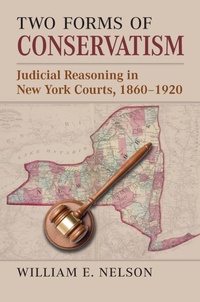
Two Forms of Conservatism
Judicial Reasoning in New York Courts, 1860-1920
Published on 12. July 2024
Book
Hardback
192 pages
978-0-7006-3664-8 (ISBN)
Description
The period between 1860 and 1920-inclusive of the Gilded Age and much of the Lochner era in legal history-is typically regarded as the heyday of conservative jurisprudence. According to this received wisdom, conservative judges and much of the legal profession were on the side of big business and the rich. Judges in this period subscribed to "classical" legal thought, and it was only when this was supplanted by "progressive" legal thought that courts reached decisions critical of business.Renowned legal historian William E. Nelson seeks to correct this narrative by examining in close detail the work of judges in the single jurisdiction of New York as well as the rulings of U.S. Supreme Court justices. What he finds is another type of conservatism besides the one that favors the rich. Instead, the judges in this period often reached decisions that were critical of business. Many of their accomplishments were forward-looking and progressive in character but conservative for another reason: they rigidly followed precedent, with only occasional exceptions. While some legal realists see the emphasis on precedent as a veneer to hide the judges' policy preferences, Nelson shows that this explanation does not fit the evidence. The judges had no consistent policy preferences, and their decisions favored a wide array of policies.
Two Forms of Conservatism is the work of an expert historian with an eye for detail and a deep understanding of legal thought. He shows that these New York judges, who were quite conservative regarding the law, nevertheless laid the foundation for the liberalism of later political leaders.
Two Forms of Conservatism is the work of an expert historian with an eye for detail and a deep understanding of legal thought. He shows that these New York judges, who were quite conservative regarding the law, nevertheless laid the foundation for the liberalism of later political leaders.
Reviews / Votes
"Nelson's book represents the best tradition of legal scholarship: lucid in its prose, subtle in its findings, and relentless in its inquiry. One would expect nothing less from a master of the field working at the height of his powers."-Andrew Porwancher, coauthor of The Prophet of Harvard LawMore details
Language
English
Place of publication
Kansas
United States
Target group
Professional and scholarly
Product notice
sewn/stitched
Cloth over boards
With dust jacket
Dimensions
Height: 222 mm
Width: 145 mm
Thickness: 14 mm
Weight
395 gr
ISBN-13
978-0-7006-3664-8 (9780700636648)
Copyright in bibliographic data and cover images is held by Nielsen Book Services Limited or by the publishers or by their respective licensors: all rights reserved.
Schweitzer Classification
Other editions
Additional editions
E-Book
06/2024
1st Edition
University Press of Kansas
from
€28.99
Available for download
Person
William E. Nelson is the author of Marbury v. Madison: The Origins and Legacy of Judicial Review and E Pluribus Unum: How the Common Law Helped Unify and Liberate Colonial America, 1607-1776.
Content
Preface and Acknowledgments
Introduction
Part One: Judicial Support for Both "Little Fellows" and the Rich
1. Judicial Deference to Progressive Legislation
2. Labor Law
Part Two: Facilitating Inevitable Legal Change
3. Business Law
4. Personal Injury Law
Part Three: Adherence to Precedent and the Past
5. The Law of Pleading and Civil Procedure
6. The Law of Nuisance
7. Religion and Morality
Conclusion: The Emergence of Policy-Oriented Judging
Notes
Index
Introduction
Part One: Judicial Support for Both "Little Fellows" and the Rich
1. Judicial Deference to Progressive Legislation
2. Labor Law
Part Two: Facilitating Inevitable Legal Change
3. Business Law
4. Personal Injury Law
Part Three: Adherence to Precedent and the Past
5. The Law of Pleading and Civil Procedure
6. The Law of Nuisance
7. Religion and Morality
Conclusion: The Emergence of Policy-Oriented Judging
Notes
Index