

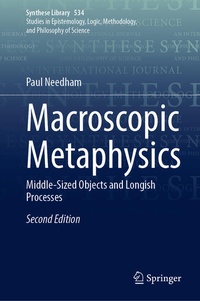
Macroscopic Metaphysics
Description

This second edition of Macroscopic Metaphysics develops a theory of the modal features of quantities of matter based on their states and possible processes transforming these states and is extended to accommodate modalities introduced in an earlier chapter dealing with individuals. The theory of spatial regions is amplified with the introduction of notions of size and shape in terms of congruence relations based on greater than relations between regions and angles. A major theme of the first edition of the book was the primacy of processes and continuants with the latter divided into quantities of matter and individuals, and biological organisms were the prime exemplars of the latter. A recent challenge to this view posed by processual biology, which would reduce biological organisms to processes, is met by marshalling the underlying metaphysics of chemical processes developed in earlier chapters in an extended critique. The addition of the new material strengthens the original project of bringing together traditional metaphysical issues concerning the nature of matter and the philosophy of science, and chemistry in particular.
More details
Other editions
Additional editions
Previous edition

Person
Paul Needham is emeritus professor of theoretical philosophy at the University of Stockholm. He has a first degree in chemistry and a masters degree in philosophy, both from the University of Birmingham, and a doctorate in philosophy from the University of Uppsala. His interests include metaphysics, epistemology and the philosophy of science. He has previously worked on time and tense, causation and subjunctive conditionals. More recent interests are concerned with issues related to chemistry. This includes themes connected to the work of Pierre Duhem, particularly in connection with his role in the establishment of the field of physical chemistry, studies of the origins of the concept of chemical substance in the ancients and its development in more recent times, the discussion of natural kinds and criteria of sameness of substance in modern chemistry, and applications of mereology in the interpretation of macroscopic notions.
Content
Preface to First Edition.- Preface to Second Edition.- Synopsis.- 1 Mereology.- 2 Occupying Space.- 3 Constitution.- 4 Distributivity and Cumulativity.- 5 The Ancients' Ideas of Substance.- 6 The Nature of Matter.- 7 The Relation of Macroscopic Description to Microstructure.- 8 Longish Processes.- 9 The Processual Conception of Organisms.- 10 Modal Properties of Quantities.- 11 Modality: Time, States and Possible Worlds.- 12 Size and Shape.- Appendix.- Bibliography.- Index.
