

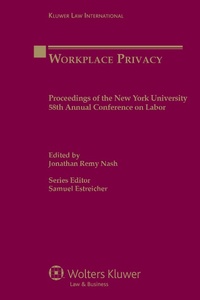
Workplace Privacy
Proceedings of the New York University 58th Annual Conference on Labor
Published on 21. December 2009
776 pages
978-90-411-4490-4 (ISBN)
Description

Employers everywhere today must delicately balance the need to maintain a safe and proper workplace with employees rights and the risk of liability. The fact that new technologies make it easier for employers to monitor their employees whereabouts, communications, and activities only serves to make the issue more acute. Now, in this collection of essays by outstanding scholars and practitioners in U.S. labour law and practice, employers and their legal counsel will find a broad array of important contributions to the law and study of workplace privacy. Based on papers delivered at the 58th annual labour conference of the New York University Center on Labor and Employment Law, this book reflects and analyzes recent developments, providing the best comprehensive work on U.S. workplace privacy. How far should employers be allowed to go in monitoring employers? Where do employers rights to run their businesses end and employees privacy rights begin? Is the existing law sufficient to resolve recurring conflicts? These are among the big questions tackled in these articles. Among the many specific issues covered are the following: - use of global positioning systems (GPS) in tracking employees;
- background checking for job applicants;
- email monitoring;
- physical monitoring of employees;
- scope and lawfulness of so-called lawful activity laws;
- employer involvement in employees nonworkplace behaviour (e.g., drug testing);
- employees rights of association;
- regulation of fraternizing and dating among employees;
- employee privacy issues in employer-union bargaining;
- privacy issues in public sector employment;
- privacy issues and threats of terrorism; and
- efforts by employers to verify employees nationality and immigration status.
Authors pay special attention to fast-break developments such as in the extraterritorial reach of the European Union s data protection directive and the current status of the U.S. National Labor Relations Board s Register-Guard decision. A special feature is a very early draft of a chapter of the forthcoming Restatement (Third) of Labor and Employment Law made available through the graces of the American Law Institute on the U.S. common law of employee privacy rights. As always, this important annual publication offers definitive current scholarship in its theme area of labour and employment law. As such, it will be of inestimable value to practitioners, government officials, academics, and others interested in developments in employment and labour relations law and practice.
- background checking for job applicants;
- email monitoring;
- physical monitoring of employees;
- scope and lawfulness of so-called lawful activity laws;
- employer involvement in employees nonworkplace behaviour (e.g., drug testing);
- employees rights of association;
- regulation of fraternizing and dating among employees;
- employee privacy issues in employer-union bargaining;
- privacy issues in public sector employment;
- privacy issues and threats of terrorism; and
- efforts by employers to verify employees nationality and immigration status.
Authors pay special attention to fast-break developments such as in the extraterritorial reach of the European Union s data protection directive and the current status of the U.S. National Labor Relations Board s Register-Guard decision. A special feature is a very early draft of a chapter of the forthcoming Restatement (Third) of Labor and Employment Law made available through the graces of the American Law Institute on the U.S. common law of employee privacy rights. As always, this important annual publication offers definitive current scholarship in its theme area of labour and employment law. As such, it will be of inestimable value to practitioners, government officials, academics, and others interested in developments in employment and labour relations law and practice.
More details
Other editions
Additional editions
Jonathan Remy Nash | Samuel Estreicher
Workplace Privacy
Proceedings of the New York University 58th Annual Conference on Labor
Book
12/2009
Kluwer Law International
€274.84
Shipment within 10-20 days
Content
- Intro
- Title Page
- Copyright Page
- Summary of Contents
- Contents
- Center for Labor and Employment Law at New York University School of Law
- Editor's Preface
- Part I: GPS, RFID and Biometric Monitoring: New Frontiers in Privacy Law
- Chapter 1: No Direction Home: Will the Law Keep Pace with Human Tracking Technology to Protect Individual Privacy and Stop Geoslavery?
- 1.1.Introduction
- 1.2.Constitutional Limitations on the Use of Human Tracking Technology
- 1.2.1.Human Tracking and the Fourth Amendment
- 1.2.2.The Fourth Amendment outside and inside the Home
- 1.2.3.The Thirteenth Amendment and Human Tracking
- 1.2.4.State Constitutional Limitations on the Use of Tracking Devices
- 1.3.The Legal Implications of Human Tracking Implant Technology
- 1.4.Federal Legislative Responses to Human Tracking and Cellular Technology
- 1.5.State Common and Statutory Law Response to Electronic Human Tracking
- 1.5.1.The Application of State Tort Law
- 1.5.2.State Statutory Limitations on Electronic Tracking Devices
- 1.6.The Use of Tracking Devices in Employment
- 1.7.Developing Potential Legal Solutions
- Chapter 2: Monitoring Employee Location with GPS and RFID in 2005: Workplace Privacy Issues
- 2.1.Introduction
- 2.2.The Technology
- 2.2.1.Radio-Frequency Identification
- 2.2.1.1.RFID Tracking: More Technological Details
- 2.2.1.2.The Implantable RFID
- 2.2.1.3.Contending with Loss or Theft of an RFID Chip
- 2.2.1.4.RFID Tag as Physical Analogue of Internet Cookie
- 2.2.1.5.Security
- 2.2.1.6."9 to 5: Do You Know If Your Boss Knows Where You Are? Case Studies of Radio Frequency Identification Usage in the Workplace," RAND Corporation, 2005
- 2.2.1.7.More Uses
- 2.2.2.Global Positioning System
- 2.2.2.1.GPS Accessible on Handhelds
- 2.2.2.2.Examples of GPS Deployment
- 2.2.2.3.Seamless Integration between GPS and RFID
- 2.3.Statutes Relevant to Location Monitoring in the Employment Context
- 2.3.1.Identity Theft Statutes and Identity-Protection Statutes
- 2.3.2.Negligent Disclosure of Private Information
- 2.3.3.The Electronic Communications Privacy Act
- 2.4.Employers Have Particularly Strong Business Reasons to Monitor the Location of Certain Types of Employees
- 2.5.Monitored Time Outside Work Hours as Compensable Time
- 2.6.Legal Consequences of Employee Interference with Monitoring
- 2.6.1.Retaliatory Monitoring
- 2.6.2.Mandatory Bargaining
- 2.6.3.Application to a Particular Device: PDAs Carrying Sensitive Information Can and Should Be Monitored
- Part II: Information/Records Privacy
- Chapter 3: Background Checking and Job Applicant Testing outside the U.S.: A Guide to Multinational Pre-hire Screening
- 3.1.Introduction
- 3.2.Globally Aligning Pre-employment Screening Strategies
- 3.2.1.Choose Tools
- 3.2.2.Get Local Guidance
- 3.2.3.Adapt Aspirations to Foreign Realities
- 3.2.4.Launch Proactively
- 3.3.Applicant Background Checking
- 3.3.1.Data Privacy
- 3.3.2.Consents and Releases
- 3.3.3.References
- 3.3.4.Local Criminal Records Checks
- 3.3.5.Local Legal Quirks
- 3.4.Pre-employment Written Testing
- 3.5.Strategy
- Chapter 4: European Union Data Protection Directive
- 4.1.Data Protection Principles
- 4.2.Sanctions for Failure to Observe
- 4.3.Data Flow outside the EU
- 4.4.The Safe Harbor Principles
- 4.5.Violations
- 4.6.Conclusion
- Part III: Investigations
- A. E-mail Monitoring
- Chapter 5: International Employee Privacy: Union/Employee Perspective
- 5.1.Introduction
- 5.2.Privacy in the European Workplace
- 5.2.1.Legal Underpinnings of European Workplace Privacy
- 5.2.2.The Designation of Officials with Authority to Address Data Privacy Issues
- 5.2.3.Involvement by European Labor Unions in Privacy Issues
- 5.3.The U.S. Privacy Void
- Chapter 6: Monitoring Electronic Mail in the Workplace: Property versus Privacy
- 6.1.Introduction
- 6.1.1.Scope of the Issue
- 6.1.2.Employers Have a Significant Property Interest in Monitoring and Restricting Employee E-mail Access
- 6.2.Employer Monitoring of Employee E-mail
- 6.2.1.The Electronic Communications Privacy Act
- 6.2.2.Federal Constitutional Protections
- 6.2.3.State Constitutional and Statutory Law
- 6.2.4.Common-Law Protections
- 6.2.5.Action for Trespass to Chattels
- 6.2.6.The Future of Employee Monitoring
- 6.2.7.Current Legislative Activity
- 6.3.Labor Relations and Electronic Mail
- 6.3.1.Employee Use of Company Computer Systems for Union Organizing
- 6.3.1.1.Solicitation versus Distribution
- 6.3.2.Union Use of Company Computer Systems
- 6.3.2.1.Access by outside Unions
- 6.4.Conclusion
- Chapter 7: E-mail and the Rip Van Winkle of Agencies: The NLRB's Register-Guard Decision
- 7.1.Introduction
- 7.2.Register-Guard Background
- 7.3.Employer Property Interests versus Employee Communications under the NLRA
- 7.3.1.Employee Communications under Republic Aviation
- 7.3.2.Employee E-mail Use under Register-Guard
- 7.3.2.1.The NLRB Plays "Telephone" to Limit E-mail
- 7.3.2.2.Personal Property versus the NLRA
- 7.3.2.3.The Rip Van Winkle of Agencies
- 7.3.3.A World without Register-Guard?
- 7.3.3.1.A New Concept of Work Schedules and Work Areas
- 7.3.3.2.Ending the Distinction between Oral and Written Communications
- 7.4.Discrimination and Employer Restrictions on Workplace Communications
- 7.5.Conclusion
- Chapter 8: Register-Guard and the Three I's: Ironic, Incoherent and (Largely) Irrelevant
- 8.1.Introduction
- 8.2.The Lead-Up to and the Decision in Register-Guard
- 8.3.The Irony of Register-Guard
- 8.4.The Incoherence of Register-Guard
- 8.5.The Irrelevance of Register-Guard
- B. Background Checks
- Chapter 9: Pre-employment Screening and Investigation: Navigating between a Rock and a Hard Place
- 9.1.Introduction
- 9.2.Reasons to Screen and Investigate
- 9.2.1.The Rationale for Pre-employment Screening
- 9.2.2.Increasing Incentives for Pre-employment Screening
- 9.2.2.1.Technological Advances
- 9.2.2.2.The Skills Gap
- 9.2.2.3.Fear of Monetary Liability
- 9.2.2.3.1.Workplace Violence
- 9.2.2.3.2.Tort Liability Theories
- 9.2.2.3.2.1.Vicarious Liability: Respondeat Superior
- 9.2.2.3.2.2.Direct Liability: Negligent Hiring
- 9.3.Limitations on Specific Pre-employment Screening Inquiries
- 9.3.1.A Word about Recruiting
- 9.3.2.Applications and Interviews
- 9.3.3.Medical Examinations
- 9.3.3.1.Medical Examinations and the ADA
- 9.3.3.2.Some Specific Types of Medical Examinations
- 9.3.3.2.1.Testing for HIV
- 9.3.3.2.2.Genetic Screening
- 9.3.4.Testing for Drug and Alcohol Use
- 9.3.4.1.The ADA and Drug Testing
- 9.3.4.2.Public Sector Testing
- 9.3.4.3.State Constitutions
- 9.3.4.4.State Statutes
- 9.3.5.Common Law Torts
- 9.3.6.Nonmedical Testing
- 9.3.6.1.Ability Tests
- 9.3.6.2.Polygraphs
- 9.3.6.3.Integrity and Personality Tests
- 9.3.7.Background Checks
- 9.3.7.1.Criminal Records
- 9.3.7.2.Credit Records
- 9.3.7.3.References
- 9.3.7.3.1.Qualified Privilege
- 9.3.7.3.2.Doctrine of Self-Publication
- 9.3.7.4.Immigration Status
- 9.4.A Cost/Benefit Theory of Pre-employment Screening
- 9.4.1.Determining the Benefits
- 9.4.2.Determining the Costs
- 9.4.3.A Hypothetical Application
- 9.5.Suggestions for Law Reform
- 9.5.1.Harmonize the Permissible Scope of Pre-employment Inquiries under Federal Anti-discrimination Laws
- 9.5.2.Permit Pre-employment Medical Examinations Only for Job-Related Capabilities or Conditions
- 9.5.3.Pre-employment Drug Testing Warrants a Federal Statute
- 9.5.4.Reduce the Threat of Defamation Liability for Employers in Providing Reference Information
- 9.6.Conclusion
- C. Physical Surveillance
- Chapter 10: Looking Out for Your Employees: Employers' Surreptitious Physical Surveillance of Employees and the Tort of Invasion of Privacy
- 10.1.Introduction
- 10.2.Why an Employer Might Conduct Surreptitious Physical Surveillance on Employees
- 10.3.A Brief History of the Tort of Invasion of Privacy
- 10.4.Case Law Involving the Tort of Intrusion and Employers' Physical Surveillance of Employees
- 10.4.1.Intrusion
- 10.4.2.Intentional
- 10.4.3.Solitude or Seclusion of Another or His or Her Private Affairs or Concerns
- 10.4.3.1.Private Activities
- 10.4.3.2.Activity Free from Exposure to Defendant
- 10.4.3.2.1.The "Lawful Vantage Point" Doctrine
- 10.4.3.2.2.Application of the Lawful Vantage Point Doctrine to Employers' Surreptitious Physical Surveillance of Employees
- 10.4.4.Highly Offensive to a Reasonable Person
- 10.4.5.The Rule Governing Employers' Surreptitious Physical Surveillance of Employees
- 10.5.Should Courts Expand an Employee's Right to Be Free from Surreptitious Physical Surveillance by His or Her Employer?
- 10.6.Conclusion
- Part IV: Nonworkplace Behavior
- A. Drug Testing
- Chapter 11: Collective and Individual Approaches to Protecting Employee Privacy: The Experience with Workplace Drug Testing
- 11.1.Introduction
- 11.2.The Expansion of Workplace Drug Testing
- 11.3.Contesting Workplace Drug Testing
- 11.3.1.The Leading Cases
- 11.3.2.A More Systematic Look at the Cases
- 11.3.2.1.The Union Setting
- 11.3.2.2.Individual Cases
- 11.4.Assessing Collective versus Individual Approaches to Protecting Employee Privacy
- 11.5.Tradeoffs between the Two Approaches
- 11.6.Conclusion
- B. "Lawful Activity" Laws
- Chapter 12: "Lawful Activity" Laws
- 12.1.Introduction
- 12.2.Positive Law
- 12.3.The Circumstances of Employer Prohibition
- 12.3.1.Cost
- 12.3.2.Noncost
- 12.4.Lifestyle Regulation in Comparative Context
- 12.5.A Concluding Reflection
- C. Right of Association
- Chapter 13: Reflections on the Technicolor Right to Association in American Labor and Employment Law
- 13.1.Introduction
- 13.2.The Right to Association in the American Public Workplace
- 13.2.1.Public Employee Political Association Protections
- 13.2.2.Public Employee Workplace Association Protections
- 13.3.The Right to Intimate Association in the Workplace Context
- 13.4.The Right to Expressive Association in the Employment Context
- 13.5.Proposal: The Federal FAWA
- 13.6.Conclusion
- Chapter 14: The Narrowing of the National Labor Relations Act: Maintaining Workplace Decorum and Avoiding Liability
- 14.1.Introduction
- 14.2.IBM Corp.: Narrowing the Weingarten Right
- 14.2.1.The Majority: Policies-Increasing Need for Workplace Investigations and the Jeopardy Posed by Extending the Weingarten Right
- 14.2.2.The Concurrence: Proving Section 7 Coverage and Common Law Prerogatives of Employers
- 14.2.3.The Dissent: Making the NLRA Less Applicable to Nonunion Workers
- 14.2.4.Critique of IBM Corp.
- 14.3.Holling Press: Narrowing Mutual Aid or Protection
- 14.3.1.The Majority: Distinguishing Collective and Individual Objectives
- 14.3.2.The Dissent: Civility Not Required
- 14.3.3.Critiquing Holling Press
- 14.4.Lutheran Heritage Village-Livonia Home, Inc.: Narrowing Restrictions on Employer Rules
- 14.4.1.The Majority: Rules to Ensure a Civil, Decent, and Harassment-Free Workplace
- 14.4.2.The Dissent: Civility Not Required by Section 7
- 14.4.3.Critiquing Lutheran Heritage
- 14.5.Potential Ramifications of the Three Decisions: Narrowing Section 7 Rights
- Chapter 15: Antifraternizing Policies and At-Will Employment: Counseling for a Better Relationship
- 15.1.Introduction
- 15.2.Defining the Issues in the Debate over Antifraternizing Policies
- 15.2.1.Employers' Interests in Reducing Exposure to Liability and Maintaining Workplace Productivity
- 15.2.2.Employees' Interest in Privacy and Personal Autonomy
- 15.2.3.Balancing Interests: The Need for a Clear Standard Recognizing Some Protected Activity
- 15.3.Common Law Theories of Employee Recovery
- 15.3.1.Judicially Created Exceptions to the At-Will Doctrine
- 15.3.1.1.Wrongful Discharge in Violation of Public Policy
- 15.3.1.2.Breach of an Express or Implied Covenant
- 15.3.1.3.Breach of an Implied Covenant of Good Faith and Fair Dealing
- 15.3.2.Traditional Tort Causes of Action
- 15.3.2.1.Tortious Invasion of Privacy
- 15.3.2.2.Intentional Infliction of Emotional Distress
- 15.4.Statutory Theories of Employee Recovery
- 15.4.1.Sex Discrimination
- 15.4.1.1.Disparate Treatment
- 15.4.1.2.Disparate Impact
- 15.4.2.Marital Status Discrimination
- 15.4.2.1.Narrow Construction of Marital Status Discrimination Statutes
- 15.4.2.2.Broad Construction of Marital Status Discrimination Statutes
- 15.4.3.Right to Privacy
- 15.5.State Legal Activities Laws
- 15.6.Conclusion
- Part V: Privacy Issues at the Bargaining Table
- Chapter 16: Bargaining for Privacy in the Unionized Workplace
- 16.1.Introduction
- 16.2.Existing Practice and Existing Law
- 16.2.1.Current Practice
- 16.2.2.Legal Restrictions
- 16.2.3.Proposed Legislation
- 16.3.Privacy as a Mandatory Bargaining Subject
- 16.4.Bargaining over Privacy
- 16.4.1.Privacy Provisions in Collective Bargaining Agreements
- 16.4.2.Privacy in Arbitration
- 16.5.The International Approach
- 16.6.Collective Bargaining as a Vehicle for Privacy Protection for U.S. Employees
- Part VI: The Emerging Common Law Workplace Privacy Right
- Chapter 17: Restatement Third of Employment Law Preliminary Formulation of Chapter 7: Workplace Privacy and Autonomy (MTB)
- § 7.01Employee Privacy
- § 7.02The Nature of Employee Privacy Interests
- § 7.03Privacy Interests in the Content of Information
- § 7.04Privacy Interests against Employer Intrusions into Locations
- § 7.05Privacy Interests in the Method of Collection of Information
- § 7.06Privacy Interests in Restricting Access to Information
- § 7.07Unreasonable Employer Infringement
- § 7.08Liability for Adverse Actions
- Part VII: Privacy Issues in the Public Sector
- Chapter 18: Privacy Legal Issues in the Public Sector
- 18.1.Introduction
- 18.2.Constitutional Requirements Regarding the Right to Privacy
- 18.3.Workplace Searches and Surveillance
- 18.4.Electronic Communications Privacy Act
- 18.5.Surveillance and Labor Relations Issues
- 18.6.Sunshine Laws and Public Employee Statutory Rights
- 18.7.Public-Sector Collective Bargaining with Reference to Privacy and Related Issues
- 18.8.The Right to Union Representation at Investigatory Interviews
- 18.9.Gay Marriages
- 18.10.The Future of Public-Sector Collective Bargaining in Relation to Privacy
- 18.11.Conclusion
- Part VIII: The Counterterrorism Challenge for Multinational Employers
- Chapter 19: The Public-Private Security Partnership: Counterterrorism Considerations for Employers in a Post-9/11 World
- 19.1.Introduction
- 19.2.Everything Has Changed
- 19.3.Private Activities by Employees
- 19.3.1.Military Service by Employees
- 19.3.2.Private Collective Action
- 19.3.2.1.Involvement in Private Efforts to Enhance National Security
- 19.3.2.2.Involvement in Private Efforts That Draw Law Enforcement Interest
- 19.3.3.Concealed Carry
- 19.4.Employer-Retained Private Security Forces
- 19.5.Conclusion
- Chapter 20: Counterterrorism and Employment: An Israeli Perspective
- 20.1.Introduction
- 20.2.Historical Background
- 20.3.Hiring Process
- 20.3.1.The Private Sector
- 20.3.2.The Public Sector
- 20.4.Physical Protection
- 20.5.Conclusion
- Chapter 21: Employers Beware: The I-9 Form: Verifying Identity and Identity Documents in the Employment Context
- 21.1.It Isn't What You Know, It Is Who You Know
- 21.2.Identity versus Identity Documents
- 21.2.1.Identity Markers
- 21.2.2.Identity Documentation: Life Events or Rites of Passage
- 21.2.3.Identity Documentation: Government Interactions
- 21.2.4.Identity Documentation: Private Interactions
- 21.2.5.Flawed Premises Lead to Flawed Results
- 21.3.Obligation to Verify Identification Documents
- 21.4.Reliance Problems with Identity Documentation
- 21.5.Outright Document Forgery
- 21.5.1.Easiest to Forge
- 21.5.2.Moderately Easy to Forge
- 21.5.3.More Challenging to Forge
- 21.6.Forgeries in General
- 21.6.1.Real Documentation of a Fictional Person
- 21.6.2.Alternative Real Identities
- 21.6.3.Real Documentation of an Unauthorized Person
- 21.7.Limits on Identification Document Verification and Investigations
- 21.7.1.OSC Investigates Zealous Employment Verifications
- 21.7.2.No Other Use of I-9 Data
- 21.8.Employers Options
- 21.9.Options for Government
- 21.9.1.Application Verification
- 21.9.2.Real Time Identity Document Verification
- 21.9.3.Reporting Identification Documentation Usage to Owner
- 21.9.4.Tie Identification Documentation Back to Specific and Unique Person
- 21.9.5.Foolproof?
- 21.9.6.A Word about Privacy and Documented Identity
- 21.10.Conclusions
