

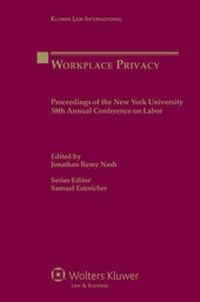
Workplace Privacy
Description
- background checking for job applicants;
- email monitoring;
- physical monitoring of employees;
- scope and lawfulness of so-called lawful activity laws;
- employer involvement in employees nonworkplace behaviour (e.g., drug testing);
- employees rights of association;
- regulation of fraternizing and dating among employees;
- employee privacy issues in employer-union bargaining;
- privacy issues in public sector employment;
- privacy issues and threats of terrorism; and
- efforts by employers to verify employees nationality and immigration status.
Authors pay special attention to fast-break developments such as in the extraterritorial reach of the European Union s data protection directive and the current status of the U.S. National Labor Relations Board s Register-Guard decision. A special feature is a very early draft of a chapter of the forthcoming Restatement (Third) of Labor and Employment Law made available through the graces of the American Law Institute on the U.S. common law of employee privacy rights. As always, this important annual publication offers definitive current scholarship in its theme area of labour and employment law. As such, it will be of inestimable value to practitioners, government officials, academics, and others interested in developments in employment and labour relations law and practice.
More details
Other editions
Additional editions
Content
<b>Part I: GPS Monitoring: The New Frontier</b>. 1. No Direction Home: Will
the Law Keep Pace with Human Tracking Technology to Protect Individual Privacy
and Stop Geoslavery? W.A. Herbert. 2. Monitoring Employee Location with GPS
and RFID in 2005: Workplace Privacy Issues; M. Weisz. Part II:
Information/Records Privacy. 3. Background Checking and Job Applicant Testing
Outside the U.S.: A Guide to Multinational Pre-Hire Screening; D.C. Dowling,
Jr. 4. European Union Data Protection Directive; E.A. Taussig.
<b>Part III: Investigations.</b> <b>A: Email Monitoring. </b>5. Monitoring
Electronic Mail in the Workplace: Property v. Privacy; M.B. Babson. 6. Email
and the Rip Van Winkle of Agencies: The NLRB's Register-Guard Decision; J.M.
Hirsch. 7. Register-Guard and the Three I's: Ironic, Incoherent and (Largely)
Irrelevant; M.H. Malin. <b>B: Background Checks.</b> 8. Pre-Employment
Screening and Investigation: Navigating Between a Rock and a Hard Place; S.F.
Befort. C: Physical Surveillance. 9. Looking Out for Your Employees:
Employers' Surreptitious Physical Surveillance of Employees and the Tort of
Invasion of Privacy; D.P. O'Gorman.
<b>Part IV: Nonworkplace Behavior. A: Drug Testing</b>. 10. Collective and
Individual Approaches to Protecting Employee Privacy: The Experience with
Workplace Drug Testing; P.T. Kim. <b>B: 'Lawful Activity' Laws</b>
. 11. 'Lawful Activity' Laws; M.W. Finkin. C. Right of Association. 12.
Reflections on the Technicolor Right to Association in American Labour and
Employment Law; P.M. Secunda. 13. The Narrowing of the National Labor
Relations Act: Maintaining Workplace Decorum and Avoiding Liability; W.R.
Corbett. 14. Antifraternizing Policies and At-Will Employment: Counseling for
a Better Relationship; A.M. DePalo.
<b>Part V: Privacy Issues at the Bargaining Table.</b> 15. Bargaining for
Privacy in the Unionized Workplace; A.C. Hodges.
<b>Part VI: The Emerging Common Law Workplace Privacy Right.</b> 16.
Restatement Third of Employment Law: Workplace Privacy and Autonomy (MTB);
M.T. Bodie. Part VII: Privacy Issues in the Public Sector. 17. Privacy Legal
Issues in the Public Sector; M.H. Rubinstein.
<b>Part VIII: The Counterterrorism Challenge for Multinational Employers</b>.
18. The Public-Private Security Partnership: Counterterrorism Considerations
for Employers in a Post 9/11 World; A.P. Morriss. 19. Counterterrorism and
Employment: An Israeli Perspective; A.N. Guiora. 20. Employers Beware: The I-9
Form: Verifying Identity and Identity Documents in the Employment Context;
J.A. Korosec.