

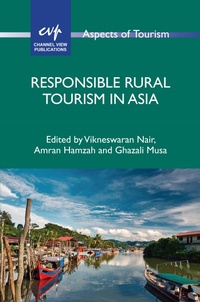
Responsible Rural Tourism in Asia
Published on 8. September 2020
248 pages
978-1-84541-753-6 (ISBN)
Description

The rural tourism sector has become a key driver for social and economic growth and a major source of income for developing and low-income countries in many parts of Asia. Rural tourism is progressively viewed as a solution, increasing the economic viability of marginalised areas, stimulating social regeneration and improving the living conditions of rural communities. Responsible rural tourism promotes conservation of the natural environment, protects the authenticity of culture, and offers socioeconomic opportunities and benefits for local communities. This book encompasses case studies from a range of Asian countries and examines both successful and failed attempts in developing responsible rural tourism, and the learnings that we can adopt and adapt for future responsible rural tourism in the region. It will be of interest to students, researchers, stakeholders and policymakers in tourism.
Reviews / Votes
This book is refreshingly about a discipline of gradualism over abrupt change, and the chapters offer practical solutions over lofty theories. This book is as much about opposing Western biocentrism as it is about doing sustainable tourism the 'Asian way', with a humble focus on respect for nature, diversity and harmony. * Catheryn Khoo-Lattimore, Griffith University, Australia * With more attention now being paid to rural areas, this is a timely volume. The chapters emphasise the importance of rural tourism in highlighting and benefitting destinations. The book will certainly contribute to academic discussions and will be useful for proponents of rural tourism. * Lawal M. Marafa, The Chinese University of Hong Kong, Hong Kong *More details
Series
Language
English
Place of publication
Bristol
United Kingdom
Publishing group
Channel View Publications Ltd
Target group
College/higher education
Product notice
Reflowable
Dimensions
Height: 234 mm
Width: 156 mm
ISBN-13
978-1-84541-753-6 (9781845417536)
Copyright in bibliographic data and cover images is held by Nielsen Book Services Limited or by the publishers or by their respective licensors: all rights reserved.
Schweitzer Classification
Other editions
Additional editions
Vikneswaran Nair | Amran Hamzah | Ghazali Musa
Responsible Rural Tourism in Asia
Book
11/2024
Channel View Publications
€51.20
Shipment within 10-20 days
Vikneswaran Nair | Amran Hamzah | Ghazali Musa
Responsible Rural Tourism in Asia
Book
09/2020
Channel View Publications
€170.70
Shipment within 10-20 days
Persons
Vikneswaran Nair is Professor and Dean, Graduate Studies & Research, University of The Bahamas, The Bahamas.
Amran Hamzah is Professor and Director of the Centre for Innovative Planning and Development, Universiti Teknologi Malaysia.
Ghazali Musa is Professor, Faculty of Business and Accountancy, University of Malaya, Malaysia.
Amran Hamzah is Professor and Director of the Centre for Innovative Planning and Development, Universiti Teknologi Malaysia.
Ghazali Musa is Professor, Faculty of Business and Accountancy, University of Malaya, Malaysia.
Content
Contributors
Acknowledgements
Introduction
1. Vikneswaran Nair, Ghazali Musa and Amran Hamzah: Conceptualizing Responsible Rural Tourism in Asia
Theme 1: Harmony Between Humans and Nature in Moulding Rural Tourism in Asia
2. Sarah Schiffling, Chris Phelan and Karma Pema Loday: Responsible Rural Tourism in Bhutan: Aligning Gross National Happiness with the Cape Town Principles
3. Trevor H.B. Sofield and Fung Mei Sarah Li: Crown Cave, Guilin: A Chinese Perspective on Responsible Rural Tourism
Theme 2: An Essentially Asian Form of Rural Tourism
4. Lee Jolliffe and Moe Nakashima: Responsible Rural Tourism in Japan's Tea Villages
5. Thu Thi Trinh: Community Garden Experience During the Off-Peak Tourism Rainy Season at Hoi An Heritage Town, Vietnam
6. Anu Treesa George, Terry DeLacy and Min Jiang: Responsible Rural Tourism Initiatives and Local Community Development in Kerala, India
Theme 3: Tourism That Takes Place in Rural Areas
7. Miguela M. Mena and Charmielyn C. Sy: Linking Responsible Rural Tourism to Agritourism in the Philippines: A Case Study of Costales Nature Farms
8. Sila Karacaoglu and Medet Yolal: Is Community-Based Tourism a Tool for the Sustainability of the Local Community and the Local Economy? The Case of Coruh Valley, Turkey
9. Tramy Ngo and Nguyen Thi Huyen: Community Characteristics, Social Cohesion and the Success of Community-Based Tourism: Case Studies of Vietnam
10. Amran Hamzah: Conversations with the Local Champions of Miso Walai Homestay: Responsible Tourism in Practice
11. Trevor H.B. Sofield: 'MlupBaitong' - A Pioneer in Responsible Rural Tourism in Cambodia
12. Frederic Bouchon: Can Tourism be a Success Story? Stakeholders' Management and Narratives of Rural Tourism: Reflexive Analysis of a Tourism Project in Timor Leste
13. Joo-Ee Gan and Vikneswaran Nair: The Constructs of Responsible Rural Tourism Governance for Belum-Temengor Forest Reserve, Malaysia
Conclusion
14. Amran Hamzah, Vikneswaran Nair and Ghazali Musa: The Quest for an Essentially Asian Form of Rural Tourism
Index
Acknowledgements
Introduction
1. Vikneswaran Nair, Ghazali Musa and Amran Hamzah: Conceptualizing Responsible Rural Tourism in Asia
Theme 1: Harmony Between Humans and Nature in Moulding Rural Tourism in Asia
2. Sarah Schiffling, Chris Phelan and Karma Pema Loday: Responsible Rural Tourism in Bhutan: Aligning Gross National Happiness with the Cape Town Principles
3. Trevor H.B. Sofield and Fung Mei Sarah Li: Crown Cave, Guilin: A Chinese Perspective on Responsible Rural Tourism
Theme 2: An Essentially Asian Form of Rural Tourism
4. Lee Jolliffe and Moe Nakashima: Responsible Rural Tourism in Japan's Tea Villages
5. Thu Thi Trinh: Community Garden Experience During the Off-Peak Tourism Rainy Season at Hoi An Heritage Town, Vietnam
6. Anu Treesa George, Terry DeLacy and Min Jiang: Responsible Rural Tourism Initiatives and Local Community Development in Kerala, India
Theme 3: Tourism That Takes Place in Rural Areas
7. Miguela M. Mena and Charmielyn C. Sy: Linking Responsible Rural Tourism to Agritourism in the Philippines: A Case Study of Costales Nature Farms
8. Sila Karacaoglu and Medet Yolal: Is Community-Based Tourism a Tool for the Sustainability of the Local Community and the Local Economy? The Case of Coruh Valley, Turkey
9. Tramy Ngo and Nguyen Thi Huyen: Community Characteristics, Social Cohesion and the Success of Community-Based Tourism: Case Studies of Vietnam
10. Amran Hamzah: Conversations with the Local Champions of Miso Walai Homestay: Responsible Tourism in Practice
11. Trevor H.B. Sofield: 'MlupBaitong' - A Pioneer in Responsible Rural Tourism in Cambodia
12. Frederic Bouchon: Can Tourism be a Success Story? Stakeholders' Management and Narratives of Rural Tourism: Reflexive Analysis of a Tourism Project in Timor Leste
13. Joo-Ee Gan and Vikneswaran Nair: The Constructs of Responsible Rural Tourism Governance for Belum-Temengor Forest Reserve, Malaysia
Conclusion
14. Amran Hamzah, Vikneswaran Nair and Ghazali Musa: The Quest for an Essentially Asian Form of Rural Tourism
Index
